|
VOOZH | about |
|
VOOZH | about |
Why do I say so?
The amount of reporting which happens on averages is astonishingly high. Sadly, working with averages never reveals actionable insights until broken down in segments. Let’s go through a typical example to demonstrate what I am saying:
Let us assume that you head Customer Management division of Credit cards for a bank. Two metric of immense importance to you are:
You look at the following report and feel that everything is under control. You reach a quick conclusion that there is no problem in continuing your engagement as they run today:
In a practical scenario, these metrics would be an aggregate across various cards, but for simplicity, lets say that there are 2 kinds of cards:
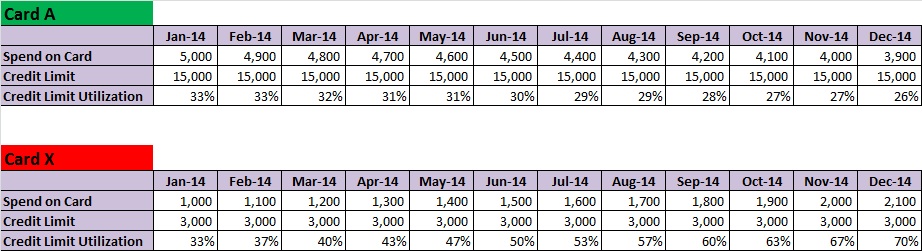
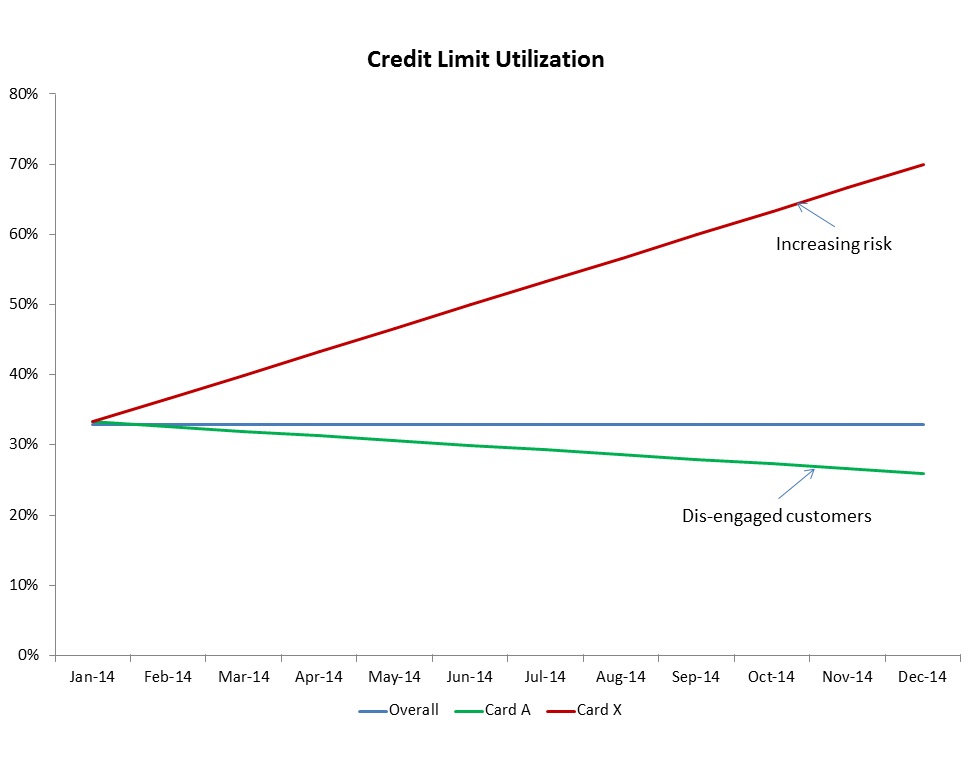
Again, just to simplify, lets assume that you have an even mix. The minute you split the metrics by segments, a different story emerges:
As you can see, what is actually happening is very different from what you would interpret from Average metrics. Actually, usage of cards with your low risk customers is on decline where as on the high risk customers is on increase – might be a scary situation!
[stextbox id=”section”]What is segmentation?[/stextbox]
Segmentation is a process of breaking a group of entities (Parent group) into multiple groups of entities (Child group) so that entities in child group have higher homogeneity with in its entities.
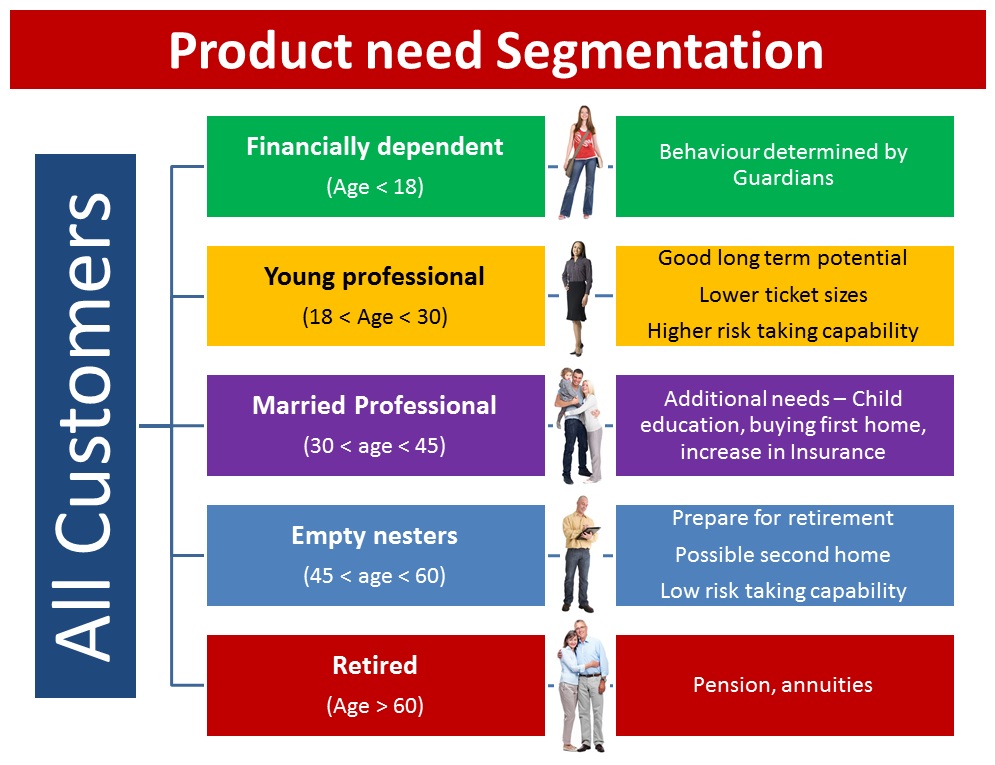
Following is a simple example of customer segmentation for a bank basis their age:
In this case you take a single group (customers of bank) and segment them in 5 child groups (basis their age). Incorporating this segmentation in your analysis can then drive various insights and ultimately actions in interest of your business like:
General guideline to create the child groups is that they should be “Heterogeneous with other groups, but homogeneous with in group“.
[stextbox id=”section”]How to create a segmentation?[/stextbox]
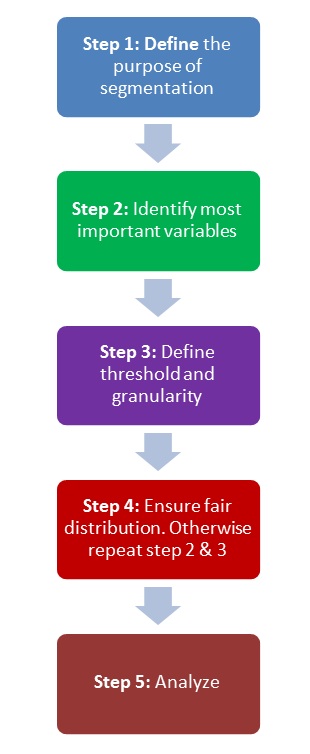
While there are multiple techniques to create a segmentation, the focus of this post is not on technical knowledge. I’ll layout the process used to create a segmentation and keep the technical details for a later point. This will enable you to create and implement a segmentation, even if it is not the best technically. You can obviously learn more details about the techniques and apply them in conjunction with the process mentioned here:
[stextbox id=”section”]Example of creating Segmentation:[/stextbox]
Let us say that you want to create HR strategy to identify which employees should be engaged in what manner so that you are able to reduce attrition and offer what the employee actually wants.
Hope this gives you a fair idea about creating and implementing a segmentation.
[stextbox id=”section”]A few additional notes:[/stextbox]
Before closing the article, would like to mention a few additional points to keep in mind:
So next time if you see any reporting happening at an overall level, STOP. STOP and think what you might be looking over and how can you improve this to bring out more actionable insights.
Kunal Jain is the Founder and CEO of Analytics Vidhya, one of the world's leading communities of Al professionals. With over 17 years of experience in the field, Kunal has been instrumental in shaping the global Al landscape. His expertise spans diverse markets, from developed economies like the UK to emerging ones like India, where he has successfully led and delivered complex data-driven solutions. As a recognized thought leader, Kunal has empowered countless individuals to realize their Al ambitions through his visionary approach to Al education and community building. Before founding Analytics Vidhya, Kunal earned both his undergraduate and postgraduate degrees from IIT Bombay and held key roles at Capital One and Aviva Life Insurance across multiple geographies. His passion lies at the intersection of analytics, Al, and fostering a thriving community of data science professionals.
GPT-4 vs. Llama 3.1 – Which Model is Better?
Llama-3.1-Storm-8B: The 8B LLM Powerhouse Surpa...
A Comprehensive Guide to Building Agentic RAG S...
Top 10 Machine Learning Algorithms in 2026
45 Questions to Test a Data Scientist on Basics...
90+ Python Interview Questions and Answers (202...
8 Easy Ways to Access ChatGPT for Free
Prompt Engineering: Definition, Examples, Tips ...
What is LangChain?
What is Retrieval-Augmented Generation (RAG)?
Very good article written on understanding the segmentation and how important it is for Analytics.
Great to see a analyst view on segmentation! Well done! You could have one more view on segmentation and process to build segmentation http://ramganalytics.com/segmentation/ Thanks Ram
Hi Kunal, thank you fo posting this article; It has given me somer understanding of why we build "segments". I would like to know; if these variables will work to create segmentation for Wind Turbines. 1. Location Temperature 2. Altitude 3. Vintage 4. Repairs cost or you could suggest. Thanks, Vishal
Vishal, As mentioned in the article, you need to define the purpose of segmentation as the first thing. SO, the obvious question to ask is why do you want to create this segmentation? What is the purpose? Is it to see which Wind turbines should be procured or which ones have the best ROI. Once you define this, then you can follow remaining steps. Thanks, Kunal
Edit
Resend OTP
Resend OTP in 45s