|
VOOZH | about |
|
VOOZH | about |
Looking to land your first data science role but struggling to clear interviews? We have curated the most comprehensive course to ace your next data science interview. Hundreds of questions, plenty of videos, and multiple resources – the ultimate course!
I have met a lot of analysts, who are good analysts when you interact with them informally. But something happens to them, as soon as they enter into an interview!
👁 Definitive guide to prepare for an analytics interview
Have you seen one of these analysts and wondered what happens to them in the room? Or have you faced this situation yourself? This guide is meant to help you / your friend to ace the next analytics interview!
The first thing to keep in mind before appearing analytics interview is:
As long as you know your subject, are a logical person and can stay calm – you can ace these interviews easily!
The actual skills, which the employer might be judging on, would vary from employer to employer, but it is likely a mix of the following skills:
This article can help you understand the perspective of an employer in some more details.
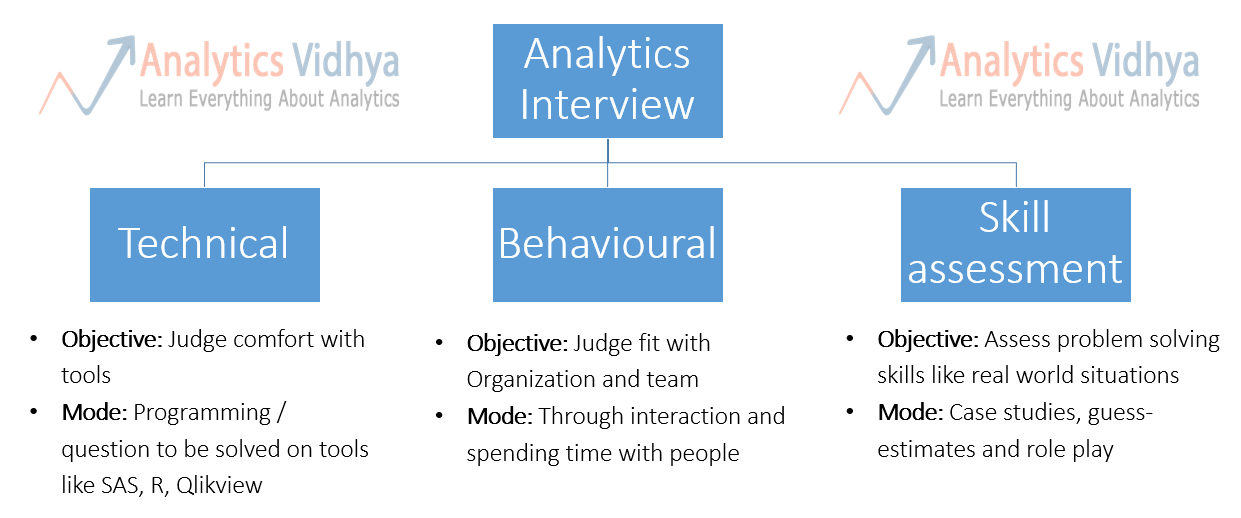
Analytics interviews can be divided in broadly three categories:
👁 types of analytics interviews
The preparation for technical analytics interviews happens over time. These interviews test how much time and efforts have you put, in learning your subject and tools.
If you are really good at what you do, these rounds should be a cake walk. If you are not, the best strategy is to be honest about what you know and what you don’t and let your potential employer know. Here are a few articles to help you with technical interviews:
There is a lot of material available on the internet to prepare for behavioural interview, hence I would skip those details.
These are the deciding factor in most of the analytical hiring, and for a good reason – if a person has sound logical skills and can demonstrate good business thinking and logical skills – he can pick up technical skills easily! Since these interviews are aimed to assess various skills, what matters more, is that you demonstrate those skills. The actual answer and solution is irrelevant in most cases. Any hiring manager would prefer a wrong answer with a better approach rather than an accurate answer with bad approach.
Skill interviews, again can be categorized in 2 categories:
Guess estimates are puzzle like questions, where you are expected to estimate a figure by putting a framework to a question, creating segments, making assumptions and adding up the numbers to arrive at a number.
You can read details on how to ace a guess-estimate along with a few examples here. Here are a few tips I would recommend:
Here is what Capital One says about case studies on its website:
Case interviews are broad, two-way discussions rather than one-way tests. You will be assessed more on how you go about dealing with the problem rather than on the specific answers you come up with.
A case typically starts with a broad question providing a business scenario and then narrows down in a particular direction. Cases might also evolve and grow in complexity as the interview progresses. Here is how a typical interview evolves over time:
Here is an example of a typical case study interview. Here is another one.
Following are some best practices to follow in a case study round:
For example, when asked how can you increase Profits for a product company, you should not jump to conclusions like “I’ll improve marketing or I’ll cut costs”. You should say Profits = Revenues – Costs. In order to increase profits, we can either increase Revenues or reduce costs. Revenues can be increased by increasing Sales or increasing the price. Costs can be reduced by doing ….
Keeping a structure will not only help the interviewer understand you better, it will also help you make sure that you have not missed out any thing.
Finally, here is a list of activities / behaviour, you should avoid during the interview. These, along with the best practices mentioned above, should give you enough ammunition to handle any analytics interview.
What do you think about this guide? Do you have handy tips and tricks, which helped you in your interviews? Please share your thoughts and practices through comments below. I am looking forward to hear them.
image credit: Oregon State University
Kunal Jain is the Founder and CEO of Analytics Vidhya, one of the world's leading communities of Al professionals. With over 17 years of experience in the field, Kunal has been instrumental in shaping the global Al landscape. His expertise spans diverse markets, from developed economies like the UK to emerging ones like India, where he has successfully led and delivered complex data-driven solutions. As a recognized thought leader, Kunal has empowered countless individuals to realize their Al ambitions through his visionary approach to Al education and community building. Before founding Analytics Vidhya, Kunal earned both his undergraduate and postgraduate degrees from IIT Bombay and held key roles at Capital One and Aviva Life Insurance across multiple geographies. His passion lies at the intersection of analytics, Al, and fostering a thriving community of data science professionals.
GPT-4 vs. Llama 3.1 – Which Model is Better?
Llama-3.1-Storm-8B: The 8B LLM Powerhouse Surpa...
A Comprehensive Guide to Building Agentic RAG S...
Top 10 Machine Learning Algorithms in 2026
45 Questions to Test a Data Scientist on Basics...
90+ Python Interview Questions and Answers (202...
8 Easy Ways to Access ChatGPT for Free
Prompt Engineering: Definition, Examples, Tips ...
What is LangChain?
What is Retrieval-Augmented Generation (RAG)?
I am thinking right now that you have heard my wish :) I will be facing case studies interview on 9th July. I was learning how to solve case study, business problem cases and guesstimates question. After reading this article, I am having a clear picture now on how to ACE in CASE... Thanks a ton Kunal sir.
All the best Vishwash! Do share your experience, once you have faced the interview.
Hi sir, Can i get some pdf guide comprising of all above sample eg's. If not, any book that i can refer for case studies,business cases,guestimates specific to analytics interviews.
Sahil, Stay tuned for a few days. We will provide this resource in some time. Regards, Kunal
Hi Sir, This has been immensely helpful! I am a second year MA Economics student with experience in R, ideally looking out for a career in Analytics. If you could tell me the level of difficulty in questions that I might face? Should I be expecting a highly statistics oriented questions? Regards
Edit
Resend OTP
Resend OTP in 45s