|
VOOZH | about |
|
VOOZH | about |
Eric Schmidt & Jared Cohen, in their book “The New Digital Age” describe typical future morning for a professional like this:
There will be no alarm in your wake-up routine – at least, not in the traditional sense. Instead, you’ll be roused by the aroma of freshly brewed coffee, by light entering your room as curtains open automatically, and by a gentle massage administered by your high-tech bed. You’re most likely to awake refreshed, because inside your mattress there’s a special sensor that monitors your sleeping rhythms, determining precisely when to wake so as not to interrupt a REM cycle.
A little later:
There’s a bit of time left before you need to leave for work – which you’ll get to by driverless car, of course. Your car knows what time you need to be in the office each moring based on your calendar and, after factoring in traffic data, it communicates with your wristwatch to give you a sixty-minute countdown to when you need to leave the house.
How does this world look? Futuristic? Or do you think we are pretty close to this future? I think we are some where is the middle – our world should look like this in 5 – 8 years from now! All thanks to “Internet of things” or “Web of things”, whatever you call it.
Internet of things refers to network of objects, each of which has an unique IP address & can connect to internet. These objects can be people, animal and day to day devices like your refrigerator and your coffee machine. These objects can connect to internet (and to each other) and communicate with each other through this net, in ways which have not been thought before.
Imagine a world when every small thing in your home is connected to internet and is speaking to each other – the coffee maker, refrigerator, doors, heating units, your watering system, your weighing scale, your car, mobile phone, watch, TV, your wardrobe, your house cleaning machines, everything on a single network and all interacting and communicating with each other.
If this sounds like a scene from the movie Transformers – its not! It is much closer to reality than you would think.
There is no rule which defines what these devices can or can not do. So, it is pretty much open to the imagination of the designers and manufacturers. However, here are a few obvious things, which come to my mind:
Here is how Google search for Internet of things trends in comparison to Big Data. It already has about one-thirds of searches in comparison to Big Data.
So, why is this being searched? I think the best way to answer this is to illustrate a few scenarios and possibilities enabled by this internet of things.
I am sure, you get the idea. Basically, Internet of Things (IoT) is set to change how we work and interact with the world in every possible manner.
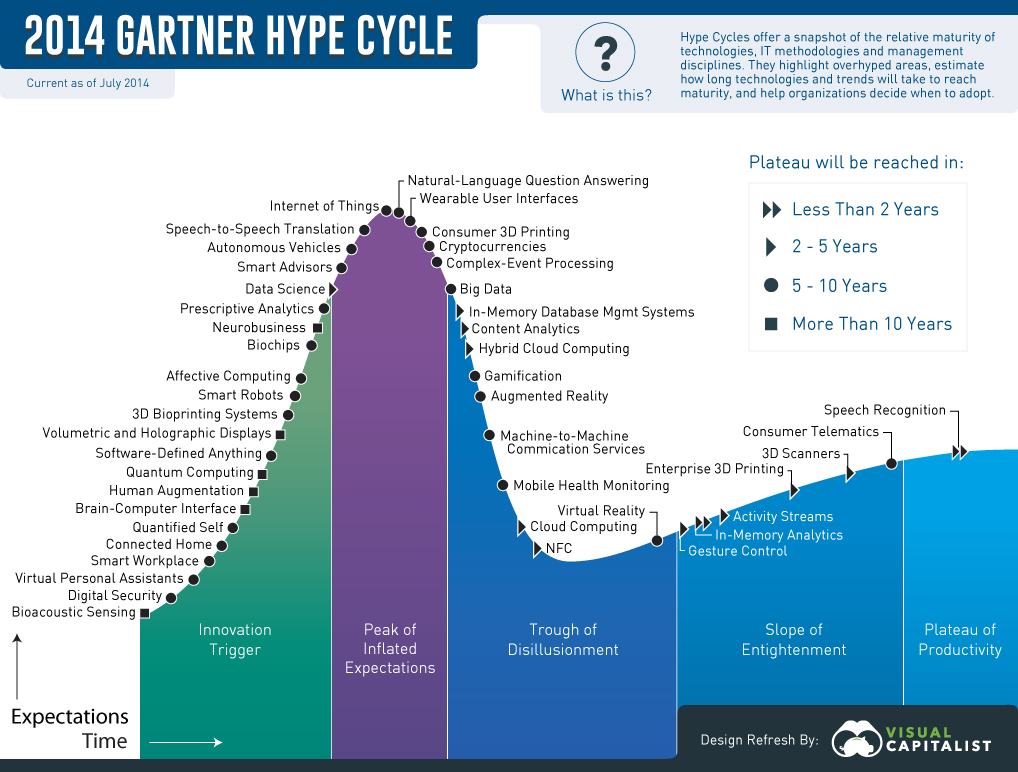
Hype cycle is a typical representation on how technologies evolve over time. They typically go through Innovation trigger followed by inflation of expectations, trough of disillusionment, enlightenment and finally hitting plateau of productivity. This is the time, when a technology has lived it’s life cycle!
Here is the hype cycle of various technologies in July 2014, as per Gartner:
👁 Internet-Of-Things-Tops-Technology-Hype-Cycles (1)
As you can see, there are various manifestations of Internet of things, which are 5 – 10 years from the eventual plateau. For example – Connected Home, Wearable user interfaces, machine to machine communication services.
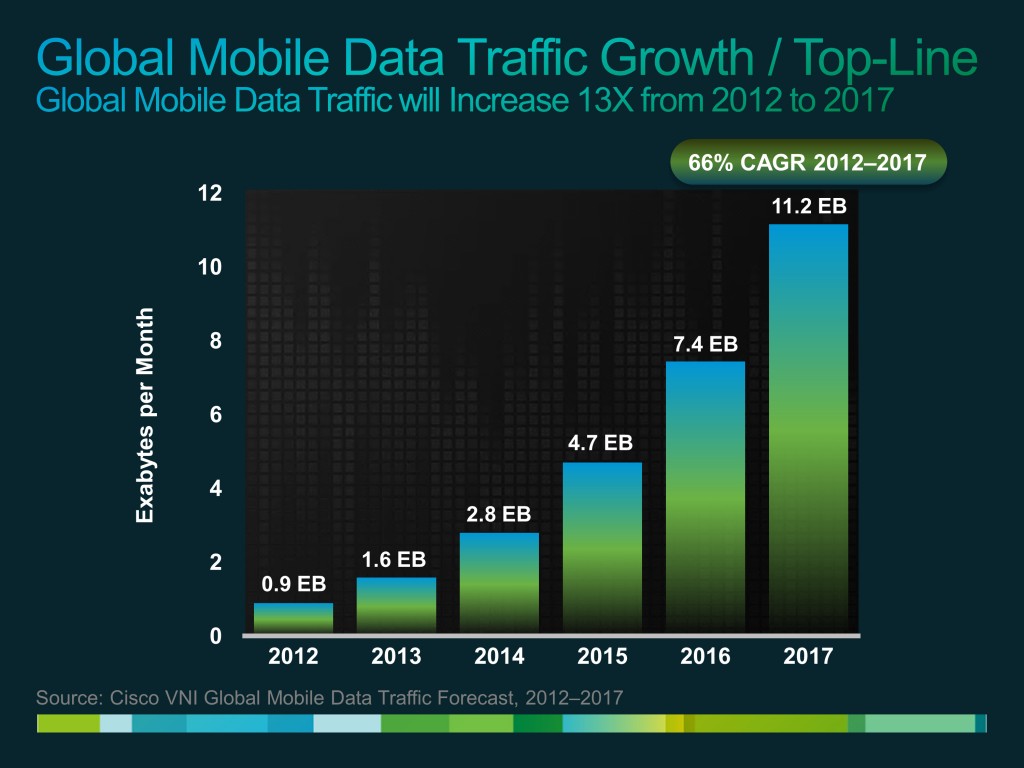
If you are not scratching your head already, have a look at this graph. This is how the data generated through internet of things is expected to explode (at whopping 66% CAGR):
So, Cisco expects the data emitted by all mobile devices to grow 4 times in 3 years! Now, imagine the opportunities it opens up for data science professionals. Here are a few of them, which come to my mind:
In simple words, with this explosion in data, we will need more people who can handle this data and make more sense of it.
While the picture I painted is definitely rosy, there are a few significant challenges to overcome before we reach there.
In this article, I have described the basics of one of the hottest field right now – the Internet of Things (IoT). The space is evolving every week with advancements changing the landscape quickly. It is also a convergence of various hardware and software – something which we have been thinking for long time.
I have also touched upon the implications of this for data science professionals and a few challenges in the domain. These are by no means exhaustive, but just the tip of the iceberg. Hopefully, I have told enough to get you excited about this evolving field.
Kunal Jain is the Founder and CEO of Analytics Vidhya, one of the world's leading communities of Al professionals. With over 17 years of experience in the field, Kunal has been instrumental in shaping the global Al landscape. His expertise spans diverse markets, from developed economies like the UK to emerging ones like India, where he has successfully led and delivered complex data-driven solutions. As a recognized thought leader, Kunal has empowered countless individuals to realize their Al ambitions through his visionary approach to Al education and community building. Before founding Analytics Vidhya, Kunal earned both his undergraduate and postgraduate degrees from IIT Bombay and held key roles at Capital One and Aviva Life Insurance across multiple geographies. His passion lies at the intersection of analytics, Al, and fostering a thriving community of data science professionals.
GPT-4 vs. Llama 3.1 – Which Model is Better?
Llama-3.1-Storm-8B: The 8B LLM Powerhouse Surpa...
A Comprehensive Guide to Building Agentic RAG S...
Top 10 Machine Learning Algorithms in 2026
45 Questions to Test a Data Scientist on Basics...
90+ Python Interview Questions and Answers (202...
8 Easy Ways to Access ChatGPT for Free
Prompt Engineering: Definition, Examples, Tips ...
What is LangChain?
What is Retrieval-Augmented Generation (RAG)?
Thanks Kunal to provide excellent knowledge on IOT. I think Apple Watch is in example of IOT in action.
Thanks Kunal. Indeed a great Article. It opens up our mind on the immense potential underneath data science. Looking for some more articles on this.
Really exciting article just like Hollywood movies we are watching... Encouraging for data science professionals !!
Edit
Resend OTP
Resend OTP in 45s