|
VOOZH | about |
|
VOOZH | about |
If you’ve ever participated in data science competitions, you must be aware of the pivotal role that ensemble modeling plays. In fact, it is being said that ensemble modeling offers one of the most convincing way to build highly accurate predictive models. The availability of bagging and boosting algorithms further embellishes this method to produce awesome accuracy level.
So, next time when you build a predictive model, do consider using this algorithm. You would definitely pat my back for this suggestion. And, if you’ve already mastered this method, great. I’d love to hear your experience about ensemble modeling in the comments section below.
For the rest, I am sharing some of the most commonly asked questions on ensemble modeling. If you ever wish to evaluate any person’s knowledge on ensemble, you can daringly ask these questions & check his / her knowledge. In addition, these are among the easiest questions, hence you can’t dare to get them wrong!
After analyzing various data science forums, I have identified the 5 most common questions related to ensemble modeling. These questions are highly relevant to data scientists new to ensemble modeling. Here are the questions:
Let’s discuss each question in detail.
Let’s try to understand it by solving a classification challenge.
Problem: Set rules for classification of spam emails
Solution: We can generate various rules for classification of spam emails, let’s look at the some of them:
Above, I’ve listed some common rules for filtering the SPAM e-mails. Do you think that all these rules individually can predict the correct class?
Most of us would say no – And that’s true! Combining these rules will provide robust prediction as compared to prediction done by individual rules. This is the principle of Ensemble Modeling. Ensemble model combines multiple ‘individual’ (diverse) models together and delivers superior prediction power.
If you want to relate this to real life, a group of people are likely to make better decisions compared to individuals, especially when group members come from diverse background. The same is true with machine learning. Basically, an ensemble is a supervised learning technique for combining multiple weak learners/ models to produce a strong learner. Ensemble model works better, when we ensemble models with low correlation.
A good example of how ensemble methods are commonly used to solve data science problems is the random forest algorithm (having multiple CART models). It performs better compared to individual CART model by classifying a new object where each tree gives “votes” for that class and the forest chooses the classification having the most votes (over all the trees in the forest). In case of regression, it takes the average of outputs of different trees.
You can also follow this article “Basics of Ensemble Learning Explained in Simple English” for more knowledge on ensemble modeling.
Let’s look at each of these individually and try to understand the differences between these terms:
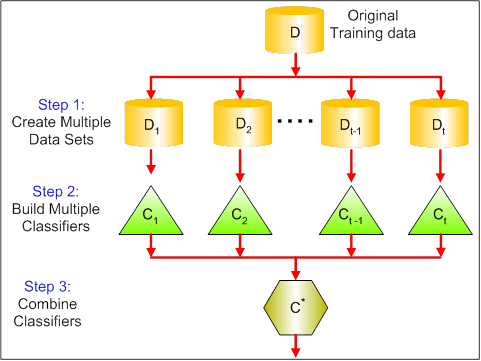
Bagging (Bootstrap Aggregating) is an ensemble method. First, we create random samples of the training data set (sub sets of training data set). Then, we build a classifier for each sample. Finally, results of these multiple classifiers are combined using average or majority voting. Bagging helps to reduce the variance error.
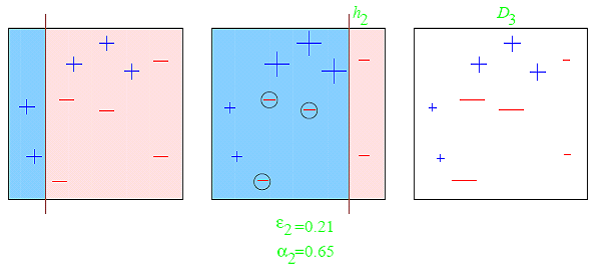
Boosting provides sequential learning of the predictors. The first predictor is learned on the whole data set, while the following are learnt on the training set based on the performance of the previous one. It starts by classifying original data set and giving equal weights to each observation. If classes are predicted incorrectly using the first learner, then it gives higher weight to the missed classified observation. Being an iterative process, it continues to add classifier learner until a limit is reached in the number of models or accuracy. Boosting has shown better predictive accuracy than bagging, but it also tends to over-fit the training data as well. 👁 boosting
Most common example of boosting is AdaBoost and Gradient Boosting. You can also look at these articles to know more about boosting algorithms.
Getting smart with Machine Learning – AdaBoost and Gradient Boost
Learn Gradient Boosting Algorithm for better predictions (with codes in R)
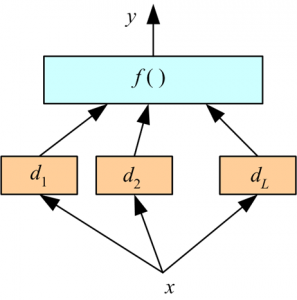
Stacking works in two phases. First, we use multiple base classifiers to predict the class. Second, a new learner is used to combine their predictions with the aim of reducing the generalization error. 👁 stacking-297x300
Yes, we can combine multiple models of same ML algorithms, but combining multiple predictions generated by different algorithms would normally give you better predictions. It is due to the diversification or independent nature as compared to each other. For example, the predictions of a random forest, a KNN, and a Naive Bayes may be combined to create a stronger final prediction set as compared to combining three random forest model. The key to creating a powerful ensemble is model diversity. An ensemble with two techniques that are very similar in nature will perform poorly than a more diverse model set.
Example: Let’s say we have three models (A, B and C). A, B and C have prediction accuracy of 85%, 80% and 55% respectively. But A and B are found to be highly correlated where as C is meagerly correlated with both A and B. Should we combine A and B? No, we shouldn’t, because these models are highly correlated. Hence,we will not combine these two as this ensemble will not help to reduce any generalization error. I would prefer to combine A & C or B & C.
One of the most common challenge with ensemble modeling is to find optimal weights to ensemble base models. In general, we assume equal weight for all models and takes the average of predictions. But, is this the best way to deal with this challenge?
There are various methods to find the optimal weight for combining all base learners. These methods provide a fair understanding about finding the right weight. I am listing some of the methods below:
You can also look at the winning solution of Kaggle / data science competitions to understand other methods to deal with this challenge.
The aggregate opinion of a multiple models is less noisy than other models. In finance, we called it “Diversification” a mixed portfolio of many stocks will be much less variable than just one of the stocks alone. This is also why your models will be better with ensemble of models rather than individual. One of the caution with ensemble models are over fitting although bagging takes care of it largely.
In this article, we have looked at the 5 frequently asked questions on Ensemble models. While answering these questions, we have discussed about “Ensemble Models”, “Methods of Ensemble”, “Why should we ensemble diverse models?”, “Methods to identify optimal weight for ensemble” and finally “Benefits”. I would suggest you to look at the top 5 solutions of data science competitions and see their ensemble approaches to have better understanding and practice a lot. It will help you to understand what works or what doesn’t.
Sunil Ray is Chief Content Officer at Analytics Vidhya, India's largest Analytics community. I am deeply passionate about understanding and explaining concepts from first principles. In my current role, I am responsible for creating top notch content for Analytics Vidhya including its courses, conferences, blogs and Competitions.
I thrive in fast paced environment and love building and scaling products which unleash huge value for customers using data and technology. Over the last 6 years, I have built the content team and created multiple data products at Analytics Vidhya.
Prior to Analytics Vidhya, I have 7+ years of experience working with several insurance companies like Max Life, Max Bupa, Birla Sun Life & Aviva Life Insurance in different data roles.
Industry exposure: Insurance, and EdTech
Major capabilities: Content Development, Product Management, Analytics, Growth Strategy.
GPT-4 vs. Llama 3.1 – Which Model is Better?
Llama-3.1-Storm-8B: The 8B LLM Powerhouse Surpa...
A Comprehensive Guide to Building Agentic RAG S...
Top 10 Machine Learning Algorithms in 2026
45 Questions to Test a Data Scientist on Basics...
90+ Python Interview Questions and Answers (202...
8 Easy Ways to Access ChatGPT for Free
Prompt Engineering: Definition, Examples, Tips ...
What is LangChain?
What is Retrieval-Augmented Generation (RAG)?
It's very well written...... Really the best article to get introduced to ensemble learning..... I was totally lost in the algorithms before reading this article....Simple description is the best part of this article...
HI , It was very Informative . Tanks alot... Plz clarify , how to check the correlation b/w two models ?referring to Point 3 Example case (A,B,C ) Thanks in advance Chandu
Hi Chandu. This is what I think you can do. Let's say you are predicting a number column called Target. If you type sum(A$TARGET - B$TARGET) and notice that it's a small value when compared to sum(A$TARGET - C$TARGET), and also verify that the sum is large for sum(B$TARGET - C$TARGET), then you can assume that A,B are uncorrelated with C, and it is likely that A,B are correlated with each other. Usually models A, B will be correlated if they come from the same family of models (e.g. if I use two xgboost models with different parameters, combining them won't be very useful since they're both xgboost)
Edit
Resend OTP
Resend OTP in 45s