|
VOOZH | about |
|
VOOZH | about |
Artificial Intelligence is purely math and scientific exercise but when it becomes computational, it starts to solve human problems.
Machine Learning is a subset of Artificial Intelligence. ML is the study of computer algorithms that improve automatically through experience. ML explores the study and construction of algorithms that can learn from data and make predictions on data. Based on more data, machine learning can change actions and responses which will make it more efficient, adaptable, and scalable.
Deep Learning is a technique for implementing machine learning algorithms. It uses Artificial Neural Networks for training data to achieve highly promising decision making. The neural network performs micro calculations with computational on many layers and can handle tasks like humans.
👁 Types of Machine Learning Algorithms
1. Supervised Learning: In a supervised learning model, the algorithm learns on a labeled dataset, to generate expected predictions for the response to new data.
Eg; For House price prediction, we first need data about houses such as; square foot, no. of rooms, the house has a garden or not, and so on features. We then need to know the prices of these houses ie; class labels. Now data coming from thousands of houses, their features, and prices, we can now train a supervised machine learning model to predict a new house’s price based on past experiences of the model.
Supervised Learning is of two types:
a) Classification: In Classification, a computer program is trained on a training dataset, and based on the training it categorizes the data in different class labels. This algorithm is used to predict the discrete values such as male|female, true|false, spam|not spam, etc.
Eg; Email spam detection, speech recognition, identification of cancer cells, etc.
Types of Classification Algorithms:
b) Regression: The task of the regression algorithm is to find the mapping function to map input variables(x) to the continuous output variable(y). Regression algorithms are used to predict continuous values such as price, salary, age, marks, etc.
Eg; Weather prediction, house price prediction, fake news detection, etc.
2. Unsupervised Learning: In an unsupervised learning model, the algorithm learns on an unlabeled dataset and tries to make sense by extracting features, co-occurrence, and underlying patterns on its own.
Eg; Anomaly detection, including fraud detection. Another example is Opening emergency hospitals to the maximum prone to accident areas. K-means clustering will group these locations of max prone areas into clusters and define a cluster center(ie;hospital) for each cluster(ie;accident prone areas).
3. Reinforcement Learning: Reinforcement learning is a type of machine learning where the model learns to behave in an environment by performing some actions and analyzing the reactions. RL takes appropriate action in order to maximize the positive response in the particular situation. The reinforcement model decides what actions to take in order to perform a given task that’s why it is bound to learn from the experience itself.
Eg; Lets take an example of a baby when she is learning how to walk. In the first case, when the baby starts walking and makes it to the chocolate since the chocolate is the end goal for the baby and the response of a baby is positive as she is happy. In the second case, when the baby starts walking and while walking she gets hit by the chair and couldnot reach to the chocolate then she starts crying which is a negative response. It is to say that how we human learn from trail and error. Here, the baby is “agent” , chocolate is the “reward” and many hurdles in between. Now the agent tries several ways and finds out the best possible path to reach the reward.
Machine Learning helps to increase the performance and productivity of the task. It includes learning and self-correction when introduced with new data.
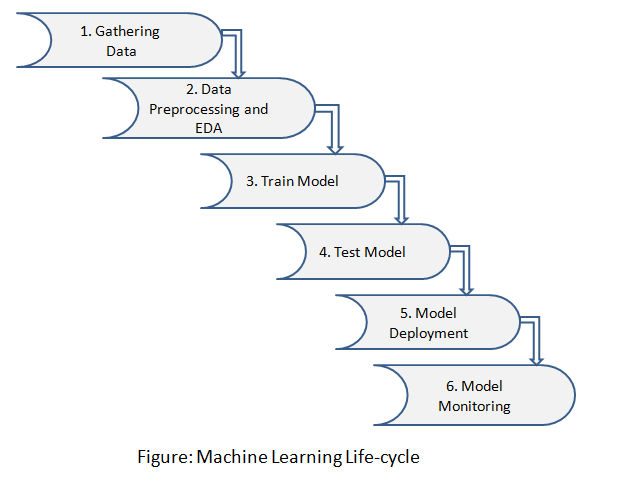
Machine Learning lifecycle involves six major steps:
Identify various data sources such as Kaggle and collect the required dataset
In this step, we do an analysis of the data for missing values, duplicate data, invalid data using different analytical techniques. And also preprocessing the data for feature extractions, feature analysis, and data visualization.
We use a dataset to train the model using various machine learning algorithms. Training a model is important so that it can understand the various patterns, rules, and features.
In this step, we check for the accuracy of our model by providing a test dataset to the trained model.
Model deployment means integrating a machine learning model into an existing production environment that takes input and returns output to make business decisions based on data. Various technologies that you can use to deploy your machine learning models are listed:
After deployment of the model here comes model monitoring which monitors your machine learning models for factors like errors, crashes, and latency and most importantly to ensure that your model is maintaining the desired performance. Model monitoring is very important because your models will degrade over time due to several factors such as unseen data, changes in the environment, and relationships between variables.
Machine Learning can be used in almost all sectors of human life to make our work efficient, robust, and Uncomplicated. As we know everything comes with its own pros and cons, machine learning has also its disadvantages such as with the increase in machine learning many people may lose their current scenario job. But most importantly it is beneficial in the long run for humankind.
The media shown in this article are not owned by Analytics Vidhya and is used at the Author’s discretion.
GPT-4 vs. Llama 3.1 – Which Model is Better?
Llama-3.1-Storm-8B: The 8B LLM Powerhouse Surpa...
A Comprehensive Guide to Building Agentic RAG S...
Top 10 Machine Learning Algorithms in 2026
45 Questions to Test a Data Scientist on Basics...
90+ Python Interview Questions and Answers (202...
8 Easy Ways to Access ChatGPT for Free
Prompt Engineering: Definition, Examples, Tips ...
What is LangChain?
What is Retrieval-Augmented Generation (RAG)?
The author has put in a lot of effort to keep it simple and informative. Really enjoyed 😊 it.
Edit
Resend OTP
Resend OTP in 45s