|
VOOZH | about |
|
VOOZH | about |
In many real-life machine learning scenarios, numerous relevant features are available for model building, but only a fraction of them are observable. Due to the absence of values for unobserved (latent) variables, the Expectation-Maximization (EM) algorithm leverages existing data to estimate optimal values for these variables and subsequently determine model parameters. EM iteratively computes expected values for latent variables based on observed data points and maximizes the likelihood function through parameter updates. This approach is particularly valuable in scenarios like clustering algorithms, such as K-means, where latent variables play a crucial role in defining cluster memberships and optimizing cluster centroids. By iteratively refining these latent variables, EM facilitates robust model estimation and enhances the performance of clustering algorithms.
This article was published as a part of the Data Science Blogathon
A latent variable model consists of observable variables along with unobservable variables. Observed variables are those variables in the dataset that can be measured whereas unobserved (latent/hidden) variables are inferred from the observed variables.
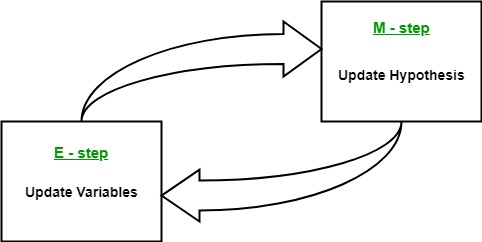
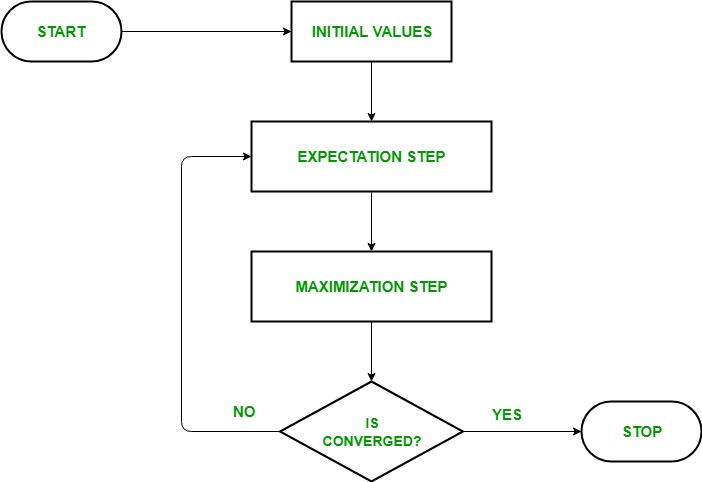
The Expectation-Maximization algorithm aims to use the available observed data of the dataset to estimate the missing data of the latent variables and then using that data to update the values of the parameters in the maximization step.
Let us understand the EM algorithm in a detailed manner:
The latent variable model has several real-life applications in Machine learning:
You’re likely familiar with Gaussian Distributions (or the Normal Distribution) since this distribution sees heavy use in the field of Machine Learning and Statistics. It has a bell-shaped curve, with the observations symmetrically distributed around the mean (average) value.
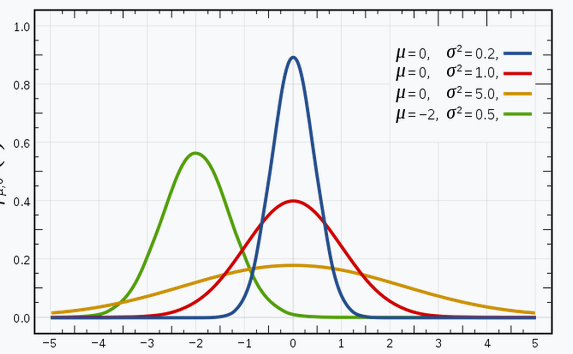
The given image shown has a few Gaussian distributions with different values of the mean (μ) and variance (σ2). Remember that the higher the σ (standard deviation) value more would be the spread along the axis.
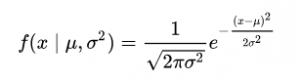
In 1-D space, the probability density function of a Gaussian distribution is given by:
Fig. Probability Density Function (PDF)where μ represents the mean and σ2 represents the variance.
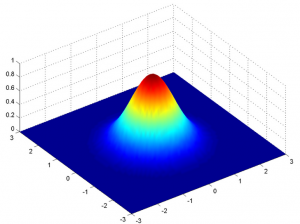
But this would only be true for a variable in 1-D only. In the case of two variables, we will have a 3D bell curve instead of a 2D bell-shaped curve as shown below:
The probability density function would be given by:
where x is the input vector, μ is the 2-D mean vector, and Σ is the 2×2 covariance matrix. We can generalize the same for the d-dimension.
Thus, for the Multivariate Gaussian model, we have x and μ as vectors of length d, and Σ would be a d x d covariance matrix.
Hence, for a dataset having d features, we would have a mixture of k Gaussian distributions (where k represents the number of clusters), each having a certain mean vector and variance matrix.
The main assumption of these mixture models is that there are a certain number of Gaussian distributions, and each of these distributions represents a cluster. Hence, a Gaussian Mixture model tries to group the observations belonging to a single distribution together.
Gaussian Mixture Models are probabilistic models which use the soft clustering approach for distributing the observations in different clusters i.e, different Gaussian distribution.
For Example, the Gaussian Mixture Model of 2 Gaussian distributions
We have two Gaussian distributions- N(𝜇1, 𝜎12) and N(𝜇2, 𝜎22)
Here, we have to estimate a total of 5 parameters:
𝜃 = ( p, 𝜇1, 𝜎12,𝜇2, 𝜎22)
where p is the probability that the data comes from the first Gaussian distribution and 1-p that it comes from the second Gaussian distribution. Then, the probability density function (PDF) of the mixture model is given by:
g(x|𝜃) = p g1(x| 𝜇1, 𝜎12) + (1-p)g2(x| 𝜇2, 𝜎22 )
Objective: To best fit a given probability density by finding 𝜃 = ( p, 𝜇1, 𝜎12,𝜇2, 𝜎22) through EM iterations.
Let’s delve into the code! In this implementation, we harness the power of the Sklearn Library in Python.
Using Sklearn, we leverage the GaussianMixture class, which seamlessly integrates the Expectation-Maximization (EM) algorithm for fitting a mixture of Gaussian models. After instantiating the object, we use the GaussianMixture.fit method to train the model and learn a Gaussian Mixture Model from the provided training data.
This implementation relies on fundamental concepts such as the EM algorithm and Gaussian Mixture Models, which play a crucial role in various machine learning algorithms and regression tasks. By understanding the underlying principles of these techniques and their application to random variables, we can effectively optimize the current parameters and enhance the performance of our models.
Step-1: Import necessary Packages and create an object of the Gaussian Mixture class
# Import necessary Packages
import numpy as np
import matplotlib.pyplot as plt
from sklearn.mixture import GaussianMixture

# Create an object of the Gaussian Mixture class
gmm = GaussianMixture(n_components = 2, tol=0.000001)

print(gmm)
Step-2: Fit the created object on the given dataset
gmm.fit(np.expand_dims(data, 1))Step-3: Print the parameters of 2 input Gaussians
Gaussian_nr = 1
print('Input Normal_distb {:}: μ = {:.2}, σ = {:.2}'.format("1", Mean1, Standard_dev1))
print('Input Normal_distb {:}: μ = {:.2}, σ = {:.2}'.format("2", Mean2, Standard_dev2))
Input Normal_distb 1: μ = 2.0, σ = 4.0 Input Normal_distb 2: μ = 9.0, σ = 2.0
Step-4: Print the parameters after mixing of 2 Gaussians
for mu, sd, p in zip(gmm.means_.flatten(), np.sqrt(gmm.covariances_.flatten()), gmm.weights_):
 print('Normal_distb {:}: μ = {:.2}, σ = {:.2}, weight = {:.2}'.format(Gaussian_nr, mu, sd, p))
 g_s = stats.norm(mu, sd).pdf(x) * p
 plt.plot(x, g_s, label='gaussian sklearn');
 Gaussian_nr += 1
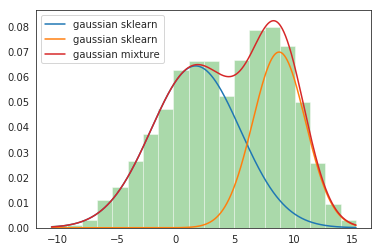
Normal_distb 1: μ = 1.7, σ = 3.8, weight = 0.61
Normal_distb 2: μ = 8.8, σ = 2.2, weight = 0.39
Step-5: Plot the distribution plots
sns.distplot(data, bins=20, kde=False, norm_hist=True)
gmm_sum = np.exp([gmm.score_samples(e.reshape(-1, 1)) for e in x])
plt.plot(x, gmm_sum, label='gaussian mixture');
plt.legend();
The Expectation-Maximization (EM) algorithm serves as a powerful tool for parameter estimation in models with latent variables and missing data. Despite its challenges, such as local optima and initialization dependence, EM remains widely used and versatile across various domains. This guide has provided an overview of EM principles, its applications in Gaussian Mixture Models, and its implementation using Python. By understanding EM’s concepts, practitioners can effectively leverage its capabilities for complex data analysis tasks, driving insights and advancements in the field of machine learning.
A. EM algorithm basic principles are:
• EM iterates between E-step and M-step until convergence
• E-step calculates expected log-likelihood given parameters and observed data
• M-step maximizes the Q-function to update parameter estimates
• EM guarantees convergence to a local log-likelihood maximum
• EM is a versatile method for estimating parameters in various models
A. The advantages of the EM algorithm are:
Versatile: Can handle various statistical models with latent variables and missing data.
Refines Estimates: Iteratively improves parameter estimates until convergence, enhancing accuracy.
Handles Missing Data: Indirectly estimates missing values using observed data and the model’s structure.
Efficient Computation: Suitable for large datasets and complex models.
Guides Optimization: Provides direction for parameter estimation, leading to local maxima of the likelihood function.
A. The EM algorithm in natural language processing helps computers learn even when information is
missing. It makes educated guesses and refines them over time, like solving a puzzle by fitting in missing pieces and adjusting until everything works perfectly. This is particularly useful in tasks involving language understanding, where complete information may only sometimes be available.
A. The advantages of the EM algorithm are:
Local optima prone: Can get stuck in suboptimal solutions.
Initialization-dependent: Performance relies on initial parameter choices.
Slow convergence: Computationally expensive for large and complex models.
Non-convex optimization struggles: Faces challenges with non-convex likelihood functions.
Limited theoretical guarantees: No assurance of finding optimal solutions in all cases.
The media shown in this article on Expectation-Maximization Algorithm are not owned by Analytics Vidhya and is used at the Author’s discretion.
I am a B.Tech. student (Computer Science major) currently in the pre-final year of my undergrad. My interest lies in the field of Data Science and Machine Learning. I have been pursuing this interest and am eager to work more in these directions. I feel proud to share that I am one of the best students in my class who has a desire to learn many new things in my field.
GPT-4 vs. Llama 3.1 – Which Model is Better?
Llama-3.1-Storm-8B: The 8B LLM Powerhouse Surpa...
A Comprehensive Guide to Building Agentic RAG S...
Top 10 Machine Learning Algorithms in 2026
45 Questions to Test a Data Scientist on Basics...
90+ Python Interview Questions and Answers (202...
8 Easy Ways to Access ChatGPT for Free
Prompt Engineering: Definition, Examples, Tips ...
What is LangChain?
What is Retrieval-Augmented Generation (RAG)?
Edit
Resend OTP
Resend OTP in 45s