|
VOOZH | about |
|
VOOZH | about |
This article was published as a part of the Data Science Blogathon.
Customer Churn prediction means knowing which customers are likely to leave or unsubscribe from your service. For many companies, this is an important prediction. This is because acquiring new customers often costs more than retaining existing ones. Once you’ve identified customers at risk of churn, you need to know exactly what marketing efforts you should make with each customer to maximize their likelihood of staying.
Customers have different behaviors and preferences, and reasons for cancelling their subscriptions. Therefore, it is important to actively communicate with each of them to keep them on your customer list. You need to know which marketing activities are most effective for individual customers and when they are most effective.
Impact of customer churn on businesses
A company with a high churn rate loses many subscribers, resulting in lower growth rates and a greater impact on sales and profits. Companies with low churn rates can retain customers.
Customer churn is important because it costs more to acquire new customers than to sell to existing customers. This is the metric that determines the success or failure of a business. Successful customer retention increases the customer’s average lifetime value, making all future sales more valuable and improving unit margins.
The way to maximize a company’s resources is often by increasing revenue from recurring subscriptions and trusted repeat business rather than investing in acquiring new customers. Retaining loyal customers for years makes it much easier to grow and weather financial hardship than spending money to acquire new customers to replace those who have left.
Increase profits
Businesses sell products and services to make money. Therefore, the ultimate goal of churn analysis is to reduce churn and increase profits. As more customers stay longer, revenue should increase, and profits should follow.
Improve the customer experience
One of the worst ways to lose a customer is an easy-to-avoid mistake like: Ship the wrong item. Understanding why customers churn, you can better understand their priorities, identify your weaknesses, and improve the overall customer experience.
Customer experience, also known as “CX”, is the customer’s perception or opinion of their interactions with your business. The perception of your brand is shaped throughout the buyer journey, from the first interaction to after-sales support, and has a lasting impact on your business, including your bottom line.
Optimize your products and services
If customers are leaving because of specific issues with your product or service or shipping method, you have an opportunity to improve. Implementing these insights reduces customer churn and improves the overall product or service for future growth.
Customer retention
The opposite of customer churn is customer retention. A company can retain customers and continue to generate revenue from them. High customer loyalty enables companies to increase the profitability of their existing customers and maximize their lifetime value (LTV).
If you sell a service for $1,000 per month and keep the customer for another 3 months, he will earn an additional $3,000 for each customer without spending on customer acquisition. The scope and amount vary depending on the business, but the concept of “repeat business = profitable business” is universal.
We first have to do some Exploratory Data Analysis in the Dataset, then fit the dataset into Machine Learning Classification Algorithm and choose the best Algorithm for the Bank Customer Churn Dataset.
XGBOOST
XGBoost, short for Extreme Gradient Boosting, is a scalable machine learning library with Distributed Gradient Boosted Decision Trees (GBDT). It provides Parallel Tree Boosting and is the leading machine learning library for regression, classification and ranking problems. To understand XGBoost, it’s important first to understand the machine learning concepts and algorithms that XGBoost is built on: supervised machine learning, decision trees, ensemble learning, and gradient boosting. Supervised machine learning uses an algorithm to train a model to find patterns in a dataset containing labels and features and then uses the trained model to predict the labels of the features in a new dataset.
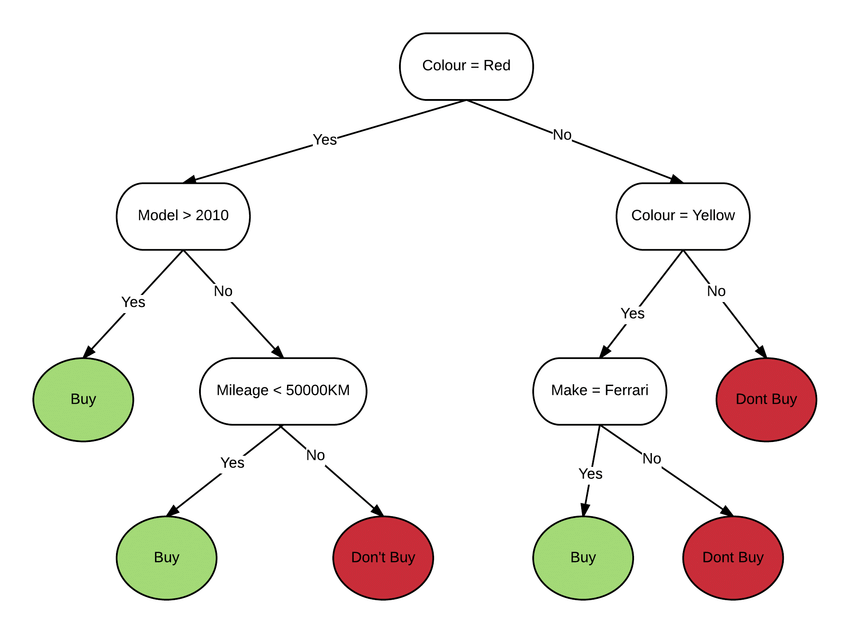
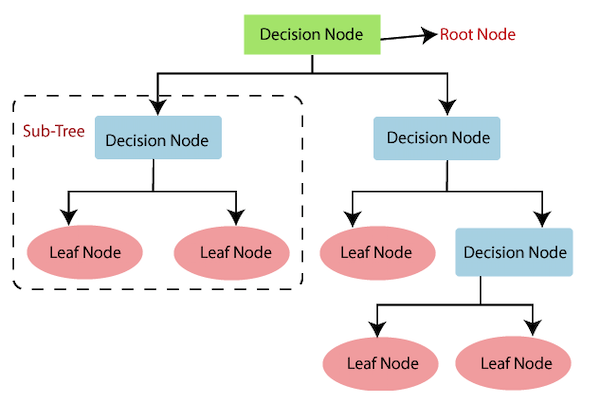
Decision trees are models that predict labels by evaluating a tree of if-then-else true/false functional questions and estimating the minimum number of questions needed to evaluate the likelihood of a correct decision. Decision trees can be used for classification to predict categories and regression to predict continuous numbers. The following simple example uses a decision tree to estimate a house’s price (tag) based on the size and number of bedrooms (features).
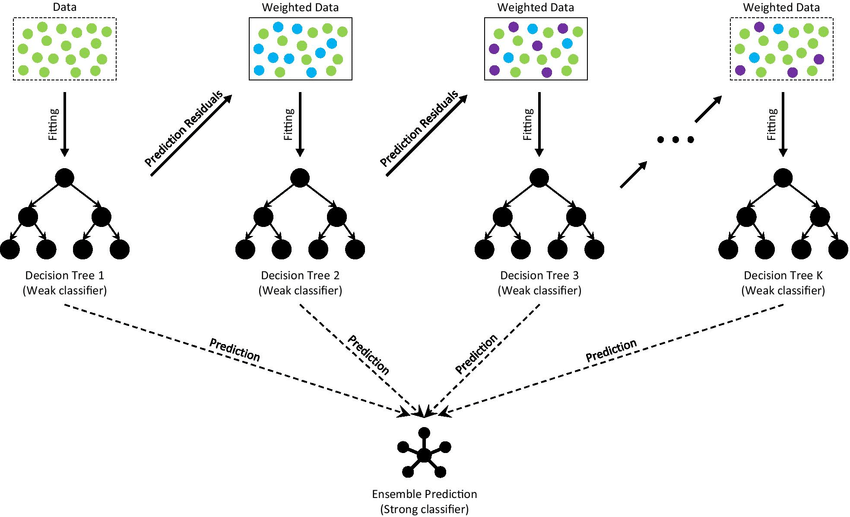
Gradient Boosted Decision Trees (GBDT) is a random forest-like decision tree ensemble learning algorithm for classification and regression. Ensemble learning algorithms combine multiple machine learning algorithms to get a better model. Both Random Forest and GBDT create models that consist of multiple decision trees. The difference is in how the trees are constructed and combined.
Decision Tree
Decision trees are a nonparametric supervised learning method used for classification and regression. The goal is to build a model that predicts the value of a target variable by learning simple decision rules derived from the properties of the data. A tree can be viewed as a piecewise constant approximation.
For example, in the following example, a decision tree learns from data to approximate a sine wave using a series of if-then-else decision rules. The deeper the tree, the more complex the decision rules and the better the model.
The advantages of decision trees are:
The disadvantages of decision trees include:
Random Forest
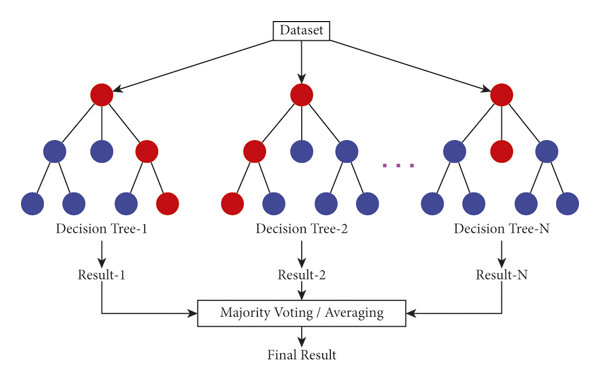
Random forest is a machine learning technique to solve regression and classification problems. It uses ensemble learning, a technique that combines many classifiers to provide solutions to complex problems.
A random forest algorithm consists of many decision trees. The “forest” created by the random forest algorithm is trained by bagging or bootstrap aggregation. Bagging is an ensemble meta-algorithm that improves the accuracy of machine learning algorithms. A (random forest) algorithm determines an outcome based on the predictions of a decision tree. Predict by averaging outputs from different trees. Increasing the number of trees improves the accuracy of the results.
Random forest removes the limitations of decision tree algorithms. Reduce data set overfitting and increase accuracy. Generate predictions without requiring a lot of configuration in your package
Support Vector Machines
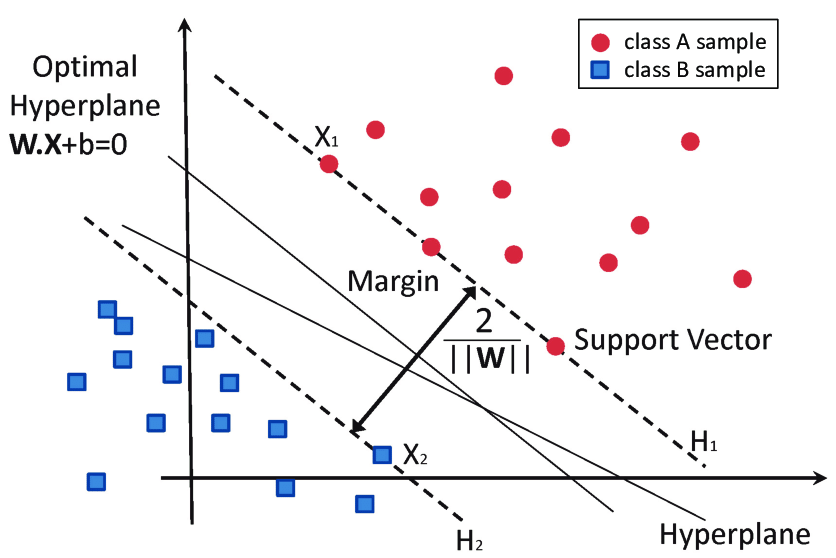
Support vector machines (SVMs) are supervised machine learning algorithms that can be used for both classification and regression tasks. However, it is mainly used in classification problems. The SVM algorithm plots each data item as a point in n-dimensional space (where n is the number of features it possesses). where the value of each feature is the value of a specific coordinate. Classification is then done by finding the hyperplane that distinguishes the two classes very well.
The advantages of support vector machines are:
The disadvantages of support vector machines include:
The first thing we have to do is import some libraries and datasets. You can get the dataset from here: https://www.kaggle.com/datasets/gauravtopre/bank-customer-churn-dataset
Now we have to import some libraries :
import pandas as pd
import seaborn as sns
import matplotlib.pyplot as plt
import numpy as np
sns.set_theme(color_codes=True)

df = pd.read_csv('Bank Customer Churn Prediction.csv')
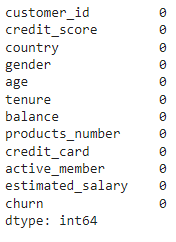
print(df.head())The first thing we have to do in Exploratory Data Analysis is checked if there are null values in the dataset.
df.isnull().head()
df.isnull().sum()
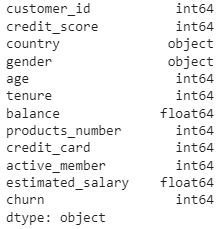
#Checking Data types
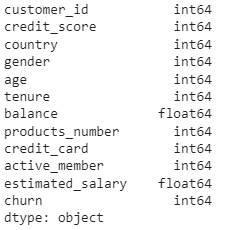
df.dtypes
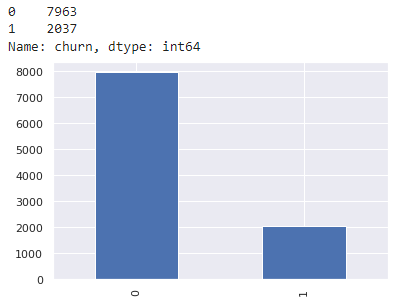
#Counting 1 and 0 Value in Churn column
color_wheel = {1: "#0392cf", 2: "#7bc043"}
colors = df["churn"].map(lambda x: color_wheel.get(x + 1))
print(df.churn.value_counts())
p=df.churn.value_counts().plot(kind="bar")
#Change value in country column
df['country'] = df['country'].replace(['Germany'],'0')
df['country'] = df['country'].replace(['France'],'1')
df['country'] = df['country'].replace(['Spain'],'2')
#Change value in gender column
df['gender'] = df['gender'].replace(['Female'],'0')
df['gender'] = df['gender'].replace(['Male'],'1')
df.head()
#convert object data types column to integer
df['country'] = pd.to_numeric(df['country'])
df['gender'] = pd.to_numeric(df['gender'])
df.dtypes
#Remove customer_id column
df2 = df.drop('customer_id', axis=1)
df2.head()
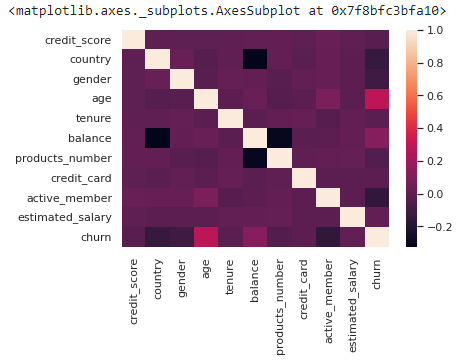
sns.heatmap(df2.corr(), fmt='.2g')
X = df2.drop('churn', axis=1)
y = df2['churn']
#test size 20% and train size 80%
from sklearn.model_selection import train_test_split, cross_val_score, cross_val_predict
from sklearn.metrics import accuracy_score
X_train, X_test, y_train, y_test = train_test_split(X,y, test_size=0.2,random_state=7)
from sklearn.tree import DecisionTreeClassifier
dtree = DecisionTreeClassifier()
dtree.fit(X_train, y_train)
y_pred = dtree.predict(X_test)
print("Accuracy Score :", accuracy_score(y_test, y_pred)*100, "%")
from sklearn.ensemble import RandomForestClassifier
rfc = RandomForestClassifier()
rfc.fit(X_train, y_train)
y_pred = rfc.predict(X_test)
print("Accuracy Score :", accuracy_score(y_test, y_pred)*100, "%")
from sklearn import svm
svm = svm.SVC()
svm.fit(X_train, y_train)
y_pred = svm.predict(X_test)
print("Accuracy Score :", accuracy_score(y_test, y_pred)*100, "%")
from xgboost import XGBClassifier
xgb_model = XGBClassifier()
xgb_model.fit(X_train, y_train)
y_pred = xgb_model.predict(X_test)
print("Accuracy Score :", accuracy_score(y_test, y_pred)*100, "%")
#importing classification report and confusion matrix from sklearn

from sklearn.metrics import classification_report, confusion_matrix
Random Forest
y_pred = rfc.predict(X_test)
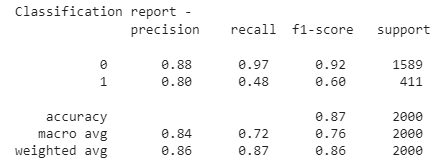
print("Classification report - n", classification_report(y_test,y_pred))
cm = confusion_matrix(y_test, y_pred)
plt.figure(figsize=(5,5))
sns.heatmap(data=cm,linewidths=.5, annot=True,square = True, cmap = 'Blues')
plt.ylabel('Actual label')
plt.xlabel('Predicted label')
all_sample_title = 'Accuracy Score: {0}'.format(rfc.score(X_test, y_test))
plt.title(all_sample_title, size = 15)
from sklearn.metrics import roc_curve, roc_auc_score
y_pred_proba = rfc.predict_proba(X_test)[:][:,1]
df_actual_predicted = pd.concat([pd.DataFrame(np.array(y_test), columns=['y_actual']), pd.DataFrame(y_pred_proba, columns=['y_pred_proba'])], axis=1)
df_actual_predicted.index = y_test.index
fpr, tpr, tr = roc_curve(df_actual_predicted['y_actual'], df_actual_predicted['y_pred_proba'])
auc = roc_auc_score(df_actual_predicted['y_actual'], df_actual_predicted['y_pred_proba'])
plt.plot(fpr, tpr, label='AUC = %0.4f' %auc)
plt.plot(fpr, fpr, linestyle = '--', color='k')
plt.xlabel('False Positive Rate')
plt.ylabel('True Positive Rate')
plt.title('ROC Curve', size = 15)
plt.legend()
y_pred = xgb_model.predict(X_test)
print("Classification report - n", classification_report(y_test,y_pred))
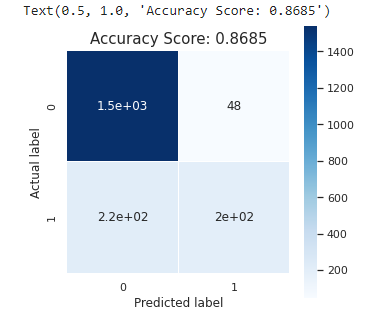
cm = confusion_matrix(y_test, y_pred)
plt.figure(figsize=(5,5))
sns.heatmap(data=cm,linewidths=.5, annot=True,square = True, cmap = 'Blues')
plt.ylabel('Actual label')
plt.xlabel('Predicted label')
all_sample_title = 'Accuracy Score: {0}'.format(xgb_model.score(X_test, y_test))
plt.title(all_sample_title, size = 15)
from sklearn.metrics import roc_curve, roc_auc_score
y_pred_proba = xgb_model.predict_proba(X_test)[:][:,1]
df_actual_predicted = pd.concat([pd.DataFrame(np.array(y_test), columns=['y_actual']), pd.DataFrame(y_pred_proba, columns=['y_pred_proba'])], axis=1)
df_actual_predicted.index = y_test.index
fpr, tpr, tr = roc_curve(df_actual_predicted['y_actual'], df_actual_predicted['y_pred_proba'])
auc = roc_auc_score(df_actual_predicted['y_actual'], df_actual_predicted['y_pred_proba'])
plt.plot(fpr, tpr, label='AUC = %0.4f' %auc)
plt.plot(fpr, fpr, linestyle = '--', color='k')
plt.xlabel('False Positive Rate')
plt.ylabel('True Positive Rate')
plt.title('ROC Curve', size = 15)
plt.legend()
The churn variable has imbalanced data. So, the solution to handle imbalanced data are :
We have to change the value in the Country and Gender columns so the Machine Learning model can read and predict the dataset; after changing the value, we have to change the data types on the Country and Gender column from string to integer because XGBoost Machine Learning Model cannot read string data types even though the value in the column is number.
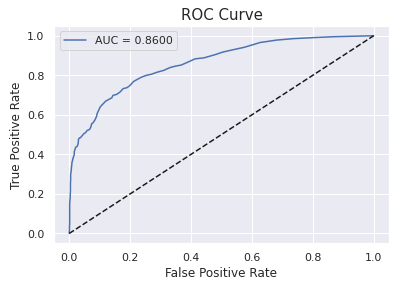
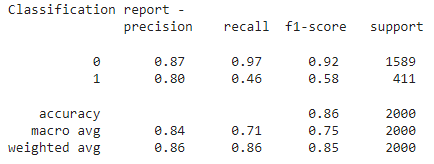
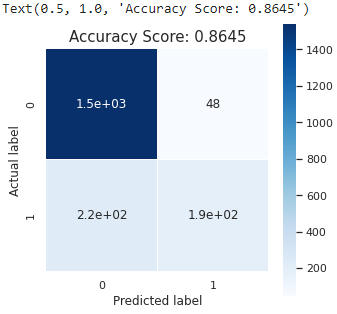
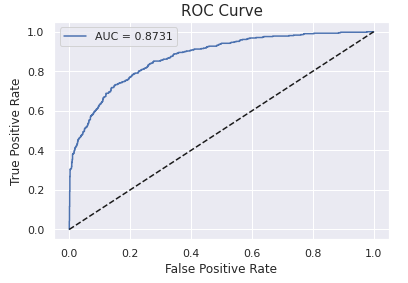
Lastly, XGBoost and Random Forest are the best algorithms to predict Bank Customer Churn since they have the highest accuracy (86,85% and 86.45%). Random Forest and XGBoost have perfect AUC Scores. They have 0.8731 and 0.8600 AUC Scores.
I hope you liked my article on customer churn prediction. Share your views in the comments below. Read Customer Churn Prediction using MLlib here.
The media shown in this article is not owned by Analytics Vidhya and is used at the Author’s discretion.
My name is Michael, im 21 years old Computer Science Student who like Data Science and Data Analytics. My hobby is analyzing data and predict the data in Google Collabs using python and write some papers about it. Im very confident guy who dont give up easily. My motto : Always Do Your Best No Matter What Will Happen Next
GPT-4 vs. Llama 3.1 – Which Model is Better?
Llama-3.1-Storm-8B: The 8B LLM Powerhouse Surpa...
A Comprehensive Guide to Building Agentic RAG S...
Top 10 Machine Learning Algorithms in 2026
45 Questions to Test a Data Scientist on Basics...
90+ Python Interview Questions and Answers (202...
8 Easy Ways to Access ChatGPT for Free
Prompt Engineering: Definition, Examples, Tips ...
What is LangChain?
What is Retrieval-Augmented Generation (RAG)?
Thank You for this awesome article, i learned a lot, especially about XGboost and the support vector machine. I would like to email you if that is possible, I have some questions to ask that i may have not understood from the article.
Gender is a binary variable so changing it to a 0/1 is fine. But the `country` is a categorical variable and it's not ordinal i.e not having in inherent order (as in it doesn't have an order like France<Spain), by converting it to 0/1/2 we're inducing an order, is that the best approach? In my opinion a categorical non-ordinal feature having low number of values should be handled by onehot encoding
Edit
Resend OTP
Resend OTP in 45s