|
VOOZH | about |
|
VOOZH | about |
The A* (A-star) algorithm is primarily used for pathfinding and graph traversal. It is famous for its efficiency in determining the shortest path. Fields such as artificial intelligence, robotics, and game development rely on this algorithm.
The A* algorithm’s key strength lies in its systematic exploration of a graph or grid. Starting from an initial node, it efficiently searches for the optimal path to the goal node. This efficiency is achieved by combining the comprehensive nature of Dijkstra’s algorithm and the heuristic approach of the Greedy Best-First Search.
The A* algorithm’s unique cost function sets it apart. By considering both the actual cost of reaching a node and an estimated heuristic of the remaining cost, it intelligently prioritizes the most promising paths. This dual consideration expedites the search, making it highly accurate and valuable.
In the subsequent article, we will delve into detailed examples of the A* algorithm in action, showcasing its effectiveness and versatility.
By maintaining a formal tone and using short, concise sentences, this version conveys the key points about the A* algorithm while retaining a professional and technical focus.
The A* algorithm uses a combination of actual and heuristic distances to determine the best path. Here are the main components:
Heuristics are used to estimate the distance from the current node to the goal. Common heuristics include:
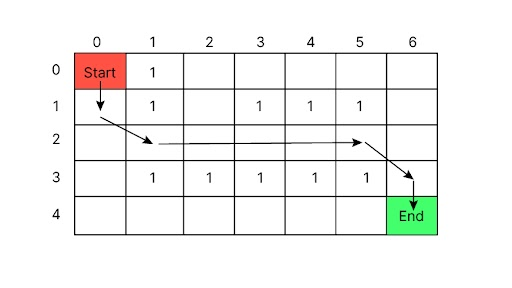
Now, let’s see how to implement the A* algorithm in Python. We’ll define a simple grid-based map where 0 represents walkable cells and 1 represents obstacles.
Code:
import heapq

import math

class Node:

    def __init__(self, position, parent=None):

        self.position = position

        self.parent = parent

        self.g = 0  # Distance from start node

        self.h = 0  # Heuristic to goal

        self.f = 0  # Total cost

    def __eq__(self, other):

        return self.position == other.position

    def __lt__(self, other):

        return self.f < other.f

    def __repr__(self):

        return f"({self.position}, f: {self.f})"

def heuristic(a, b):

    return math.sqrt((a[0] - b[0])**2 + (a[1] - b[1])**2)

def astar(maze, start, end):

    open_list = []

    closed_list = set()

    start_node = Node(start)

    end_node = Node(end)

    heapq.heappush(open_list, start_node)

    while open_list:

        current_node = heapq.heappop(open_list)

        closed_list.add(current_node.position)

        if current_node == end_node:

            path = []

            while current_node:

                path.append(current_node.position)

                current_node = current_node.parent

            return path[::-1]

        for new_position in [(0, -1), (0, 1), (-1, 0), (1, 0), (-1, -1), (-1, 1), (1, -1), (1, 1)]:

            node_position = (current_node.position[0] + new_position[0], current_node.position[1] + new_position[1])

            if node_position[0] > (len(maze) - 1) or node_position[0] < 0 or node_position[1] > (len(maze[len(maze)-1]) - 1) or node_position[1] < 0:

                continue

            if maze[node_position[0]][node_position[1]] != 0:

                continue

            new_node = Node(node_position, current_node)

            if new_node.position in closed_list:

                continue

            new_node.g = current_node.g + 1

            new_node.h = heuristic(new_node.position, end_node.position)

            new_node.f = new_node.g + new_node.h

            if add_to_open(open_list, new_node):

                heapq.heappush(open_list, new_node)

    return None

def add_to_open(open_list, neighbor):

    for node in open_list:

        if neighbor == node and neighbor.g > node.g:

            return False

    return True

maze = [

    [0, 1, 0, 0, 0, 0, 0],

    [0, 1, 0, 1, 1, 1, 0],

    [0, 0, 0, 0, 0, 0, 0],

    [0, 1, 1, 1, 1, 1, 0],

    [0, 0, 0, 0, 0, 0, 0]

]

start = (0, 0)

end = (4, 6)

path = astar(maze, start, end)

print(path)
Output:
[(0, 0), (1, 0), (2, 1), (2, 2), (2, 3), (2, 4), (2, 5), (3, 6), (4, 6)]This path represents the sequence of steps from the starting point (0, 0) to the endpoint (4, 6). Here is a detailed step-by-step explanation of the traversal:
Move to (4, 6): Move one step down to reach the goal position.
This guide has provided a comprehensive overview of the A* algorithm’s functionality along with code implementation. A* algorithm is a valuable tool that simplifies complex problems, offering a strategic and efficient approach to finding optimal solutions. I hope you find this article helpful in understanding this algorithm of python.
A. A* is an informed search algorithm, a type of best-first search. It operates on weighted graphs, starting from a specific node and aiming to find the optimal path to the goal node. The algorithm considers various factors, such as distance and time, to identify the path with the smallest overall cost.
A. The AO* algorithm employs AND-OR graphs to break down complex problems. The “AND” side of the graph represents interconnected tasks essential to achieving a goal, while the “OR” side stands for individual tasks. This approach simplifies problem-solving by identifying task dependencies and standalone actions.
A. A* finds the shortest path in single-path problems using a heuristic for cost estimation. AO* handles AND-OR decision graphs, solving subproblems with combined costs, ideal for complex decision-making and game-playing scenarios.
Hello, I am Nitika, a tech-savvy Content Creator and Marketer. Creativity and learning new things come naturally to me. I have expertise in creating result-driven content strategies. I am well versed in SEO Management, Keyword Operations, Web Content Writing, Communication, Content Strategy, Editing, and Writing.
GPT-4 vs. Llama 3.1 – Which Model is Better?
Llama-3.1-Storm-8B: The 8B LLM Powerhouse Surpa...
A Comprehensive Guide to Building Agentic RAG S...
Top 10 Machine Learning Algorithms in 2026
45 Questions to Test a Data Scientist on Basics...
90+ Python Interview Questions and Answers (202...
8 Easy Ways to Access ChatGPT for Free
Prompt Engineering: Definition, Examples, Tips ...
What is LangChain?
What is Retrieval-Augmented Generation (RAG)?
Edit
Resend OTP
Resend OTP in 45s