|
VOOZH | about |
|
VOOZH | about |
Lets assume that you are CEO of a MNC with operations across the globe!
Over last few years, you have heard a lot of buzz around analytics and about a lot of companies benefiting from analytics. On the other hand, you also come across companies, which invested big time in Analytics, but the unit continues to remain a cost center even after years of presence.
While the idea of creating an Analytics team sounds like an obvious thing for your company, you wonder:
It’s a question which many leaders across the globe face on a regular basis. Of late, similar debates and discussions are happening with regards to starting a big data practice. The aim of this post is to bring out some of the best practices analytics leaders follow to create a high performing Analytics team.
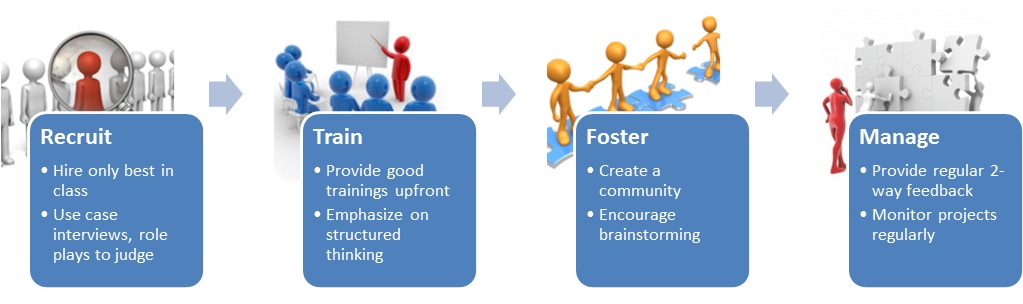
[stextbox id=”section”]Keep a high bar on recruitment:[/stextbox]
If there is only one advice, you would want to follow, this is the advice. If you get this right, everything ahead becomes easy to implement. If you fail at this, you will never be able to create a High performance team, no matter how much you excel in remaining tips.
So, how do you make sure that you are recruiting the right profile? Judge the analyst on the following skills:
You can read further on how to judge on these skills here. In addition to these skills, check how curious the person is? How many questions does he / she asks. Remember, you can teach technical skills. You can manage performance. What you can’t do is force curiosity or passion.
Most of the highly analytical companies hold multiple rounds of case studies, role plays and interactions to judge the analysts on these traits. While these might sound easy to implement, they might not be. It means saying no to any back door entry. It also means, letting go of an analyst not clearing the thresholds, even though the work might suffer.
[stextbox id=”section”]Provide right tools, trainings and resources:[/stextbox]
Once you have the right people on-board, you should provide them with best in class training and resources. These training could be delivered externally (e.g. Training from SAS institute) or internally (e.g. Structured thinking and writing training to be provided by a seasoned analyst).
Some of the highly recommended training with in first 3 months of an analyst joining the team are:
[stextbox id=”section”]Create a culture and community that fosters analytical thinking:[/stextbox]
Now that you have trained your potential analysts, you need to provide them with a culture that accentuates analytical thinking. Following are some of the best practices, I have observed in analytical leaders:
[stextbox id=”section”]Manage the performance:[/stextbox]
Once you have a thriving community in place, all you need to do it manage the analysts to make sure they are workinng on most important and challenging problems on one hand and their is healthy work load to bring out the best in them. Following are some of the must do actions to manage the analysts:
If you are setting up an analytics team, this article provides you with a list of best practices. If you already have an analytics team, just check which of these practices are missing in your Organization and how you can implement them. Additionally, if you have any thoughts or practices which I might have missed, please add them in comments.
Kunal Jain is the Founder and CEO of Analytics Vidhya, one of the world's leading communities of Al professionals. With over 17 years of experience in the field, Kunal has been instrumental in shaping the global Al landscape. His expertise spans diverse markets, from developed economies like the UK to emerging ones like India, where he has successfully led and delivered complex data-driven solutions. As a recognized thought leader, Kunal has empowered countless individuals to realize their Al ambitions through his visionary approach to Al education and community building. Before founding Analytics Vidhya, Kunal earned both his undergraduate and postgraduate degrees from IIT Bombay and held key roles at Capital One and Aviva Life Insurance across multiple geographies. His passion lies at the intersection of analytics, Al, and fostering a thriving community of data science professionals.
GPT-4 vs. Llama 3.1 – Which Model is Better?
Llama-3.1-Storm-8B: The 8B LLM Powerhouse Surpa...
A Comprehensive Guide to Building Agentic RAG S...
Top 10 Machine Learning Algorithms in 2026
45 Questions to Test a Data Scientist on Basics...
90+ Python Interview Questions and Answers (202...
8 Easy Ways to Access ChatGPT for Free
Prompt Engineering: Definition, Examples, Tips ...
What is LangChain?
What is Retrieval-Augmented Generation (RAG)?
Edit
Resend OTP
Resend OTP in 45s