|
VOOZH | about |
|
VOOZH | about |
Benford's Law, also known as the First-Digit Law or Benford's Distribution, is a fascinating statistical phenomenon that predicts the frequency of the first digits in many real-life datasets. Unlike what one might expect (i.e., an equal probability for all digits from 1 to 9), Benford's law states that lower digits appear more frequently than the first digit.
Benford's Distribution has significant applications in fraud detection, forensic accounting, and data validation. This article explores Benford's Law, its mathematical basis, practical applications, and how to apply and visualize it using R. Benford's Law states that in many naturally occurring datasets, the leading digit d (where d ranges from 1 to 9) occurs with a probability given by:
Benford's Law is widely used in:
Now we will discuss step by step implementation of Benford's Distribution in R Programming Language.
To analyze Benford's Distribution, we will use the benford.analysis package. This package provides easy-to-use functions to analyze and visualize data according to Benford's Law.
Before applying Benford's Law, ensure your dataset is suitable:
For demonstration, let's create a simple dataset that spans multiple orders of magnitude.
The benford() function in the benford.analysis package can be used to apply Benford's analysis on your dataset.
Output:
 Length Class Mode
info 4 -none- list
data 4 data.table list
s.o.data 2 data.table list
bfd 13 data.table list
mantissa 2 data.table list
MAD 1 -none- numeric
MAD.conformity 1 -none- character
distortion.factor 1 -none- numeric
stats 2 -none- list
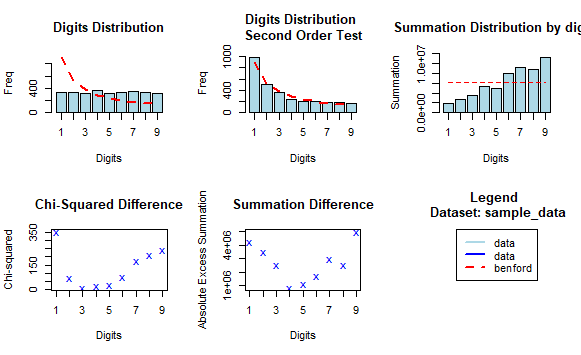
Visualization is a crucial step to understand how closely your data follows Benford's Law. The plot() function in the benford.analysis package allows you to generate multiple visualizations.
Output:
This function generates a bar plot comparing the actual frequency of the leading digits in your dataset against the expected frequencies according to Benford's Law.
You can perform additional tests to check how well your data fits Benford's Law:
Output:
	Pearson's Chi-squared test

data: sample_data
X-squared = 1186.6, df = 8, p-value < 2.2e-16
A non-significant result (high p-value) indicates that the dataset follows Benford's Law closely.
Benford's Law is a powerful tool in the world of statistics and data analysis, providing insights into data authenticity and helping to detect irregularities. In R, the benford.analysis package offers an easy and efficient way to analyze datasets according to Benford's Law, complete with statistical tests and visualizations. By understanding how to apply Benford's Distribution in R, you can use this technique to uncover anomalies in datasets, making it particularly useful in fraud detection, auditing, and other fields where data integrity is crucial.