|
VOOZH | about |
|
VOOZH | about |
Deep Learning is a part of AI that uses multi-layer neural networks to learn patterns from large and complex data. It is a subset of Machine Learning and is especially powerful for images, text, and sequential data. In R, deep learning combines strong statistical tools with modern neural network frameworks.
R is widely used in data science and machine learning because of its strong statistical foundation and rich package ecosystem. For deep learning, it offers several advantages:
This section covers the basic foundations of neural networks and how learning happens inside them.
Understanding basic building blocks is essential before moving to advanced models.
Some networks are specially designed for sequential and time-based data.
Deep learning for images requires preprocessing and manipulation.
These architectures are used for complex real-world problems.
This are key techniques for training neural networks, such as stochastic gradient descent, batch size and optimizing for accuracy instead of loss.
Advanced techniques help improve prediction accuracy.
R Programming Language has many deep learning packages in CRAN. Some of these packages are as follows :
| R Package Name | Description |
|---|---|
| nnet | Used for feed-forward neural networks with a single hidden layer or multinomial log-linear models. |
| neuralnet | Facilitates training neural networks using back-propagation. |
| h2o | Provides an interface for H2O deep learning functionality. |
| RSNNS | Interface to the Stuttgart Neural Network Simulator. |
| tensorflow | R interface to TensorFlow, a popular deep learning framework. |
R interface to Keras a popular deep learning framework. | |
| deepnet | A comprehensive deep learning toolkit in R. |
| darch | Provides tools for deep architectures and Restricted Boltzmann Machines. |
| rnn | Implements Recurrent Neural Networks (RNNs). |
| FCNN4R | Interface for the FCNN library to create user-extensible ANNs. |
| deepr | Built on top of darch and deepnet, it enhances the training and prediction process in deep learning. |
We will build a Neural Network using the deepnet package on the Breast Cancer dataset.
First, install and load the necessary libraries required for building and training the neural network model.
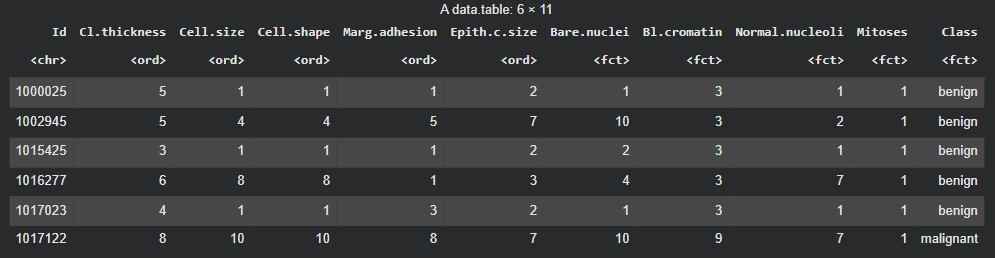
Next, load the Breast Cancer dataset available in the mlbench package.
Output:
Now we clean the dataset and convert the class labels into numeric values for training the neural network.
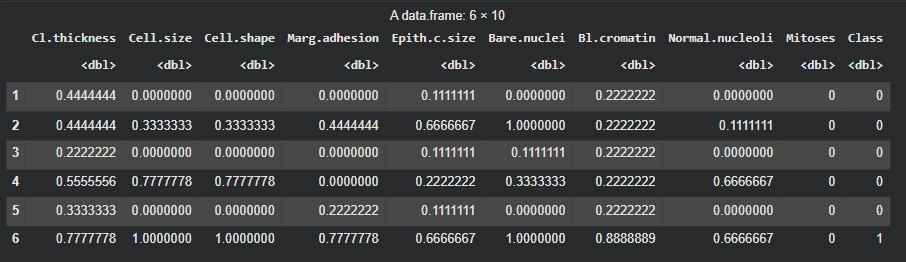
Neural networks perform better when the input data is scaled between 0 and 1. We normalize the dataset using a custom function.
Output:
This step ensures that:
We split the dataset into 70% training data and 30% testing data.
Now we train the neural network using the neuralnet() function
After training the neural network, we use the model to make predictions on the test dataset. The model returns probability values, which we convert into binary classes using a threshold value.
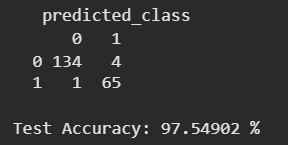
Finally, evaluate the model performance using a confusion matrix and compute the accuracy.
Output:
We can further increase the accuracy of our model by fine-tuning as well as performing feature selection.
You can download the complete source code from here.