|
VOOZH | about |
|
VOOZH | about |
Deep Learning is a subfield of machine learning and artificial intelligence that focuses on training neural networks to perform various tasks, such as image recognition, natural language processing, and reinforcement learning. When training a deep learning model, the concept of an "epoch" is fundamental.
An epoch represents a complete pass through the entire training dataset during the training of a neural network. In the R programming language you can use various deep learning libraries like Keras and TensorFlow to define, train, and evaluate your models. An epoch in this context refers to one iteration through the entire dataset, where the model's parameters (weights and biases) are updated based on the training data to minimize a specified loss function.
Here's a theoretical overview of what an epoch represents in deep learning
Let's break down the concept of an epoch in deep learning using R
In any deep learning task, you begin by preparing your data. This includes loading your training data, often represented as a set of input features (X) and corresponding target labels (Y). The data might need preprocessing, normalization, and transformation to make it suitable for training.
The neural network model is the heart of deep learning. You define the architecture of your model, including the number of layers, the types of layers (e.g., dense, convolutional, recurrent), the number of neurons in each layer, activation functions, and more. In R, you can use Keras to build and customize your neural network.
After defining your model, you need to compile it. Compiling involves specifying critical components such as the optimizer, loss function, and evaluation metrics. The choice of optimizer and loss function depends on the specific problem you're trying to solve (e.g., classification, regression).
The training phase involves feeding the training data to your model and iteratively updating the model's parameters through a process called backpropagation. During one epoch, the entire training dataset is processed by the model. For each batch of data, the model computes predictions, compares them to the actual targets, and adjusts its parameters to minimize the defined loss function.
Output:
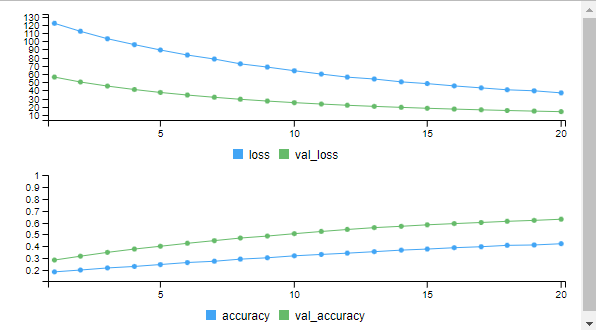
Epoch 1/20
375/375 [==============================] - 6s 17ms/step - loss: 121.8334 - accuracy: 0.1830 - val_loss: 56.3338 - val_accuracy: 0.2833
Epoch 2/20
375/375 [==============================] - 6s 16ms/step - loss: 112.0906 - accuracy: 0.1986 - val_loss: 50.3320 - val_accuracy: 0.3159
Epoch 3/20
375/375 [==============================] - 6s 17ms/step - loss: 103.0870 - accuracy: 0.2163 - val_loss: 45.3789 - val_accuracy: 0.3484
Epoch 4/20
375/375 [==============================] - 7s 19ms/step - loss: 95.9009 - accuracy: 0.2289 - val_loss: 41.1701 - val_accuracy: 0.3765
Epoch 5/20
375/375 [==============================] - 6s 17ms/step - loss: 89.3483 - accuracy: 0.2452 - val_loss: 37.5932 - val_accuracy: 0.4002
Epoch 6/20
375/375 [==============================] - 6s 16ms/step - loss: 83.1961 - accuracy: 0.2623 - val_loss: 34.4462 - val_accuracy: 0.4252
Epoch 7/20
375/375 [==============================] - 6s 16ms/step - loss: 78.3173 - accuracy: 0.2729 - val_loss: 31.7037 - val_accuracy: 0.4479
Epoch 8/20
375/375 [==============================] - 6s 17ms/step - loss: 72.4743 - accuracy: 0.2909 - val_loss: 29.2730 - val_accuracy: 0.4698
Epoch 9/20
375/375 [==============================] - 6s 17ms/step - loss: 68.5124 - accuracy: 0.3024 - val_loss: 27.1139 - val_accuracy: 0.4866
Epoch 10/20
375/375 [==============================] - 6s 17ms/step - loss: 64.0775 - accuracy: 0.3191 - val_loss: 25.1891 - val_accuracy: 0.5067
Epoch 11/20
375/375 [==============================] - 6s 16ms/step - loss: 59.9963 - accuracy: 0.3309 - val_loss: 23.4935 - val_accuracy: 0.5254
Epoch 12/20
375/375 [==============================] - 6s 16ms/step - loss: 56.2695 - accuracy: 0.3416 - val_loss: 21.9847 - val_accuracy: 0.5423
Epoch 13/20
375/375 [==============================] - 6s 16ms/step - loss: 53.9862 - accuracy: 0.3542 - val_loss: 20.6376 - val_accuracy: 0.5581
Epoch 14/20
375/375 [==============================] - 7s 18ms/step - loss: 50.5103 - accuracy: 0.3674 - val_loss: 19.4278 - val_accuracy: 0.5694
Epoch 15/20
375/375 [==============================] - 6s 16ms/step - loss: 48.3674 - accuracy: 0.3764 - val_loss: 18.3255 - val_accuracy: 0.5820
Epoch 16/20
375/375 [==============================] - 6s 16ms/step - loss: 45.5798 - accuracy: 0.3878 - val_loss: 17.3281 - val_accuracy: 0.5922
Epoch 17/20
375/375 [==============================] - 6s 16ms/step - loss: 43.1677 - accuracy: 0.3962 - val_loss: 16.4330 - val_accuracy: 0.6017
Epoch 18/20
375/375 [==============================] - 6s 17ms/step - loss: 40.8346 - accuracy: 0.4079 - val_loss: 15.6100 - val_accuracy: 0.6116
Epoch 19/20
375/375 [==============================] - 6s 16ms/step - loss: 39.6255 - accuracy: 0.4110 - val_loss: 14.8616 - val_accuracy: 0.6196
Epoch 20/20
375/375 [==============================] - 6s 16ms/step - loss: 37.0921 - accuracy: 0.4216 - val_loss: 14.1825 - val_accuracy: 0.6293
Once training is complete, you can evaluate the model's performance on a separate test dataset. This helps you assess how well your model generalizes to unseen data. Metrics like accuracy, precision, recall, and F1-score are commonly used to measure performance.
Output:
313/313 [==============================] - 2s 6ms/step - loss: 14.1852 - accuracy: 0.6398
Test loss: 14.18524
Test accuracy: 0.6398
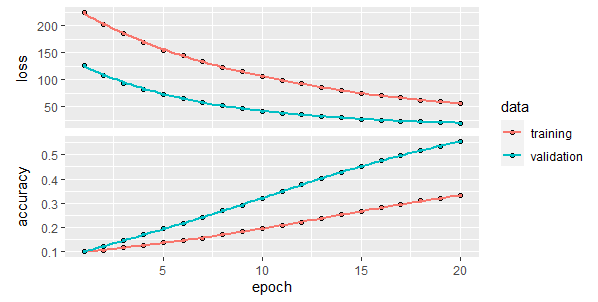
We can visualize the training process of the model using plot function.
Output:
In summary, an epoch is a critical concept in deep learning, representing a complete iteration through the training dataset. It allows the model to learn from the data, adjust its parameters, and converge towards a solution. The number of epochs, along with other hyperparameters, plays a crucial role in the successful training of deep learning models using R or any other programming language.