|
VOOZH | about |
|
VOOZH | about |
The concept of bias in neural networks is fundamental to their ability to model complex relationships and perform various tasks, including classification, regression, and deep learning. In this theory overview, we'll explore what bias neurons are, why they are essential, and how they work in the context of neural networks.
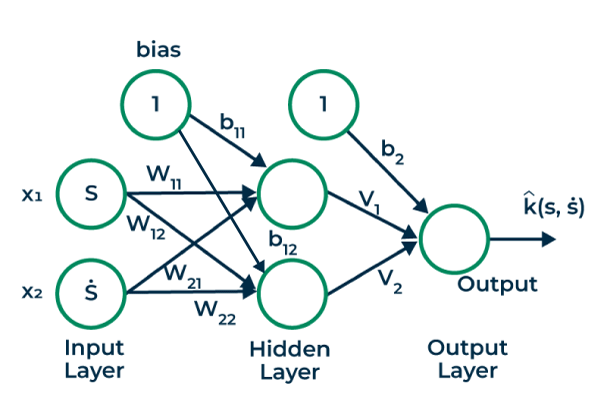
A bias neuron (or bias unit) is a special neuron in a neural network that does not have any inputs but is always connected to the other neurons in a layer. It serves as a learnable parameter in the network, allowing each neuron to learn an offset or shift in its activation function. In R Programming Language This offset helps the network fit the data more accurately and increases its expressive power.
Bias neurons are usually included in each layer of a neural network. In a typical feedforward neural network, they have no inputs but are connected to all neurons in the subsequent layer. Mathematically, they add a constant value to the weighted sum of inputs before applying the activation function. The bias term is adjusted during training through backpropagation, just like the weights.
During the training process of a neural network, the values of the bias neurons are updated alongside the weights using optimization algorithms like stochastic gradient descent (SGD). The goal is to minimize a loss function that quantifies the difference between the network's predictions and the true target values. The optimization algorithm seeks to find the optimal bias values that minimize this loss.
The Keras library that demonstrates the role of bias neurons in a neural network. In this example, we'll create a single neuron (perceptron) with bias.
We generate some sample data, x as input and y as the output, representing a linear relationship y = 2x + 1 with some random noise.
Output:
Model: "sequential_1"
________________________________________________________________________________
 Layer (type) Output Shape Param #
================================================================================
 dense_2 (Dense) (None, 2) 6
 dense_3 (Dense) (None, 1) 3
================================================================================
Total params: 9 (36.00 Byte)
Trainable params: 9 (36.00 Byte)
Non-trainable params: 0 (0.00 Byte)
________________________________________________________________________________
We create a sequential model and add a dense layer with one neuron using layer_dense. The use_bias = TRUE argument ensures that bias is included.
Output:
[[1]]
 [,1] [,2]
[1,] -1.1044016 0.9812743
[2,] -0.5948815 1.4780935[[2]]
[1] 0.0000000 0.3192987[[3]]
 [,1]
[1,] 0.1048971
[2,] 2.0368812[[4]]
[1] 0.2609277
Output:
Weight (x1 to 1st hidden unit): w11 = -1.104402
Weight (x2 to 1st hidden unit): w12 = 0.9812743
Weight (x1 to 2nd hidden unit): w21 = -0.5948815
Weight (x2 to 2nd hidden unit): w22 = 1.478094
Bias (1st hidden unit): b11 = 0
Bias (2nd hidden unit): b12 = 0.3192987
Output:
Weight (H11 to the output): v1 = 0.1048971
Weight (H12 to the output): v2 = 2.036881
Bias (for the output): b2 = 0.2609277
The printed values of "Learned Weight" and "Learned Bias" should be close to 2 and 1, respectively, indicating that the model has learned the linear relationship with bias. The bias term allows the model to capture the non-zero intercept of the linear function.
Output:
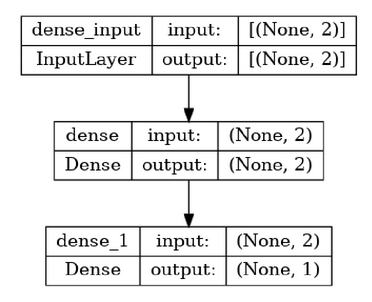
We can plot the model using plot function and shows all the layers in owr model.
Predictions using Model
Output:
Trained Model prediction for x1 = 2 and x2 = 3: 13.94088
First hidden neuron value : 0
Second hidden neuron value : 6.716128
Model prediction using the Trained Weights & Biases for x1 = 2 and x2 = 3: 13.94088
Bias neurons are essential components of neural networks, allowing them to handle non-zero intercepts, learn offsets, increase their expressive power, and break symmetry. They are trained alongside weights to make the network capable of modeling complex relationships in the data. Understanding the role of bias neurons is fundamental in building and training effective neural networks for various machine learning and deep learning tasks.