|
VOOZH | about |
|
VOOZH | about |
Bootstrapping is a statistical method for inference about a population using sample data. It can be used to estimate the confidence interval(CI) by drawing samples with replacement from sample data. Bootstrapping can be used to assign CI to various statistics that have no closed-form or complicated solutions. Suppose we want to obtain a 95% confidence interval using bootstrap resampling the steps are as follows:
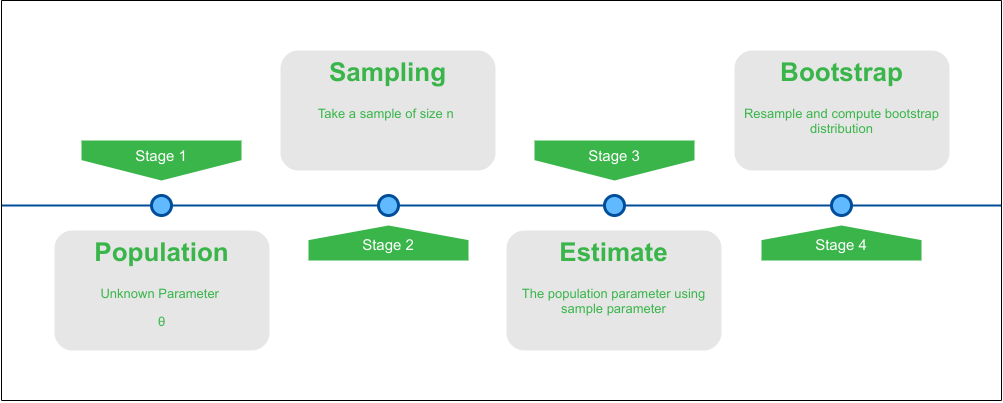
Illustration of the bootstrap distribution generation from sample:
👁 Bootstrap generation processIn R Programming the package boot allows a user to easily generate bootstrap samples of virtually any statistic that we can calculate. We can generate estimates of bias, bootstrap confidence intervals, or plots of bootstrap distribution from the calculated from the boot package.
For demonstration purposes, we are going to use the iris dataset due to its simplicity and availability as one of the built-in datasets in R. The data set consists of 50 samples from each of the three species of Iris (Iris setosa, Iris Virginia, and Iris versicolor). Four features were measured from each sample: the length and the width of the sepals and petals, in centimeters. We can view the iris dataset using head command and note the features of interests.
Output:
 Sepal.Length Sepal.Width Petal.Length Petal.Width Species
 5.1 3.5 1.4 0.2 setosa
We want to estimate the correlation between Petal Length and Petal Width.
Steps to Compute the Bootstrap CI in R:
1. Import the boot library for calculation of bootstrap CI and ggplot2 for plotting.
2. Create a function that computes the statistic we want to use such as mean, median, correlation, etc.
3. Using the boot function to find the R bootstrap of the statistic.
Output:
ORDINARY NONPARAMETRIC BOOTSTRAP


Call:
boot(data = iris, statistic = corr.fun, R = 1000)


Bootstrap Statistics :
 original bias std. error
t1* 0.9376668 -0.002717295 0.009436212
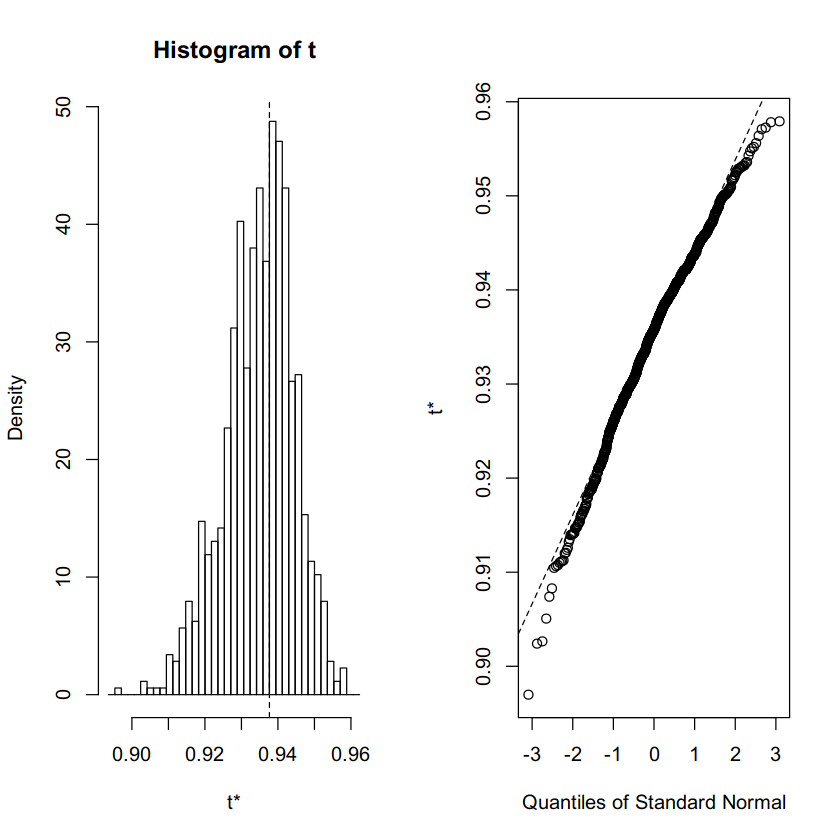
4. We can plot the generated bootstrap distribution using the plot command with calculated bootstrap.
Output:
👁 output-plot5. Using the boot.ci() function to get the confidence intervals.
Output:
BOOTSTRAP CONFIDENCE INTERVAL CALCULATIONS
Based on 1000 bootstrap replicates

CALL :
boot.ci(boot.out = bootstrap, type = c("norm", "basic", "perc",
 "bca"))

Intervals :
Level Normal Basic
95% ( 0.9219, 0.9589 ) ( 0.9235, 0.9611 )

Level Percentile BCa
95% ( 0.9142, 0.9519 ) ( 0.9178, 0.9535 )
Calculations and Intervals on Original Scale
Inference for Bootstrap CI From the Output:
Looking at the Normal method interval of (0.9219, 0.9589) we can be 95% certain that the actual correlation between petal length and width lies in this interval 95% of the time. As we have seen the output consists of multiple CI using different methods according to the type parameter in function boot.ci. The computed intervals correspond to the ("norm", "basic", "perc", "bca") or Normal, Basic, Percentile, and BCa which give different intervals for the same level of 95%. The specific method to use for any variable depends on various factors such as its distribution, homoscedastic, bias, etc.
The 5 methods that boot package provides for bootstrap confidence intervals are summarized below:
References :
R bootstrap package Boot
Bootstrapping Statistics Wikipedia
Bootstrap for Confidence Interval