|
VOOZH | about |
|
VOOZH | about |
The continuous uniform distribution is also referred to as the probability distribution of any random number selection from the continuous interval defined between intervals a and b. A uniform distribution holds the same probability for the entire interval. Thus, its plot is a rectangle, and therefore it is often referred to as Rectangular distribution. Here we will discuss various functions and cases in which these functions should be used to get a required probability.
For uniform distribution, we first need a randomly created sequence ranging between two numbers. The runif() function in R programming language is used to generate a sequence of random following the uniform distribution.
Syntax:
runif(n, min = 0, max = 1)
Parameter:
- n= number of random samples
- min=minimum value(by default 0)
- max=maximum value(by default 1)
Example:
Output
[1] "Random 15 numbers between 1 and 3"
[1] 1.534 1.772 1.027 1.765 2.739 1.681 1.964 2.199 1.987 1.372 2.655 2.337 2.588 1.216 2.447
By a quantile, we mean the fraction (or percent) of points below the given value. qunif() method is used to calculate the corresponding quantile for any probability (p) for a given uniform distribution. To use this simply the function had to be called with the required parameters.
Syntax:
qunif(p, min = 0, max = 1)
Parameter :
- p - The vector of probabilities
- min , max - The limits for calculation of quantile function
Example 1:
Output
[1] "Quantile Function Value"
[1] 8
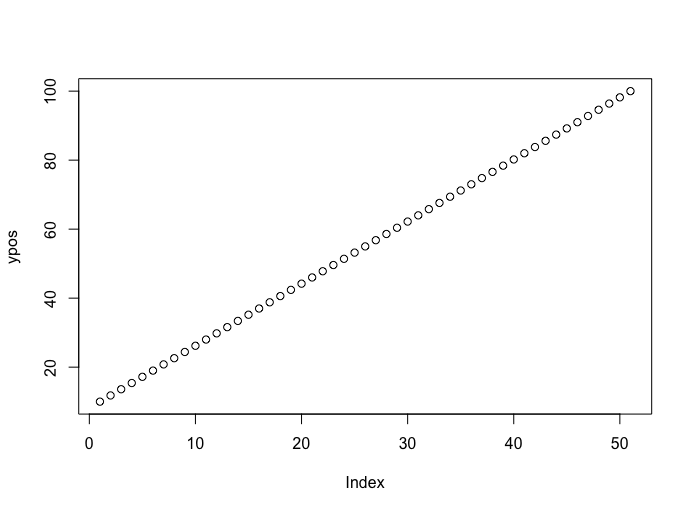
The x values can be specified in the form of a sequence of vectors using the seq() method in R. The corresponding y positions can be calculated.
Example 2:
Output
👁 Imagedunif() method in R programming language is used to generate density function. It calculates the uniform density function in R language in the specified interval (a, b).
Syntax:
dunif(x, min = 0, max = 1, log = FALSE)
Parameter:
- x: input sequence
- min, max= range of values
- log: indicator, of whether to display the output values as probabilities.
The result produced will be for each value of the interval. Hence, a sequence will be generated.
Example 1:
Output
[1] "dunif value"
[1] 0.05263158 0.05263158 0.05263158 0.05263158 0.05263158 0.05263158
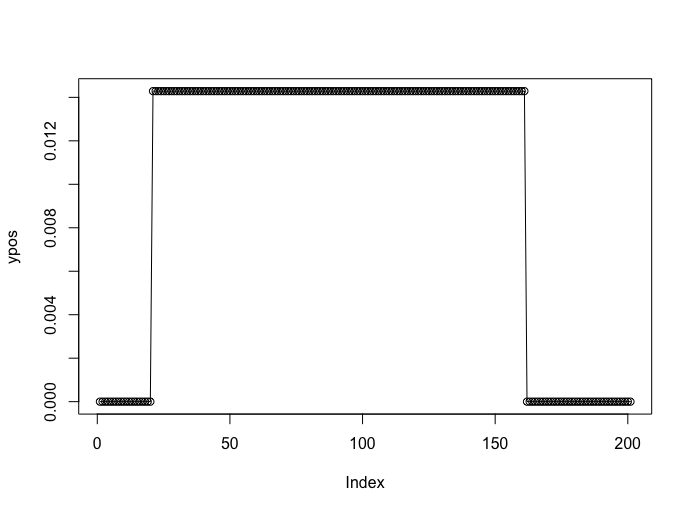
All values are equal and this is the reason why it is called uniform distribution. Let us plot it for a better picture.
Example 2:
Output
👁 ImageThe punif() method in R is used to calculate the uniform cumulative distribution function, this is, the probability of a variable X taking a value lower than x (that is, x <= X). If we need to compute a value x > X, we can calculate 1 - punif(x).
Syntax:
punif(q, min = 0, max = 1, lower.tail = TRUE)
All the independent probabilities that satisfy the comparison condition will be added.
Example:
Output
[1] 0.25
Example:
Output
[1] 0.75