|
VOOZH | about |
|
VOOZH | about |
Linear regression is a method of predictive analysis in machine learning. It is basically used to check two things:
Linear regression is used with one outcome variable and one or more than one predictor variable. Simple linear regression will work with one outcome and one predictor variable. The simple linear regression model is essentially a linear equation of the form y = c + b*x; where y is the dependent variable (outcome), x is the independent variable (predictor), b is the slope of the line; also known as regression coefficient and c is the intercept; labeled as constant.
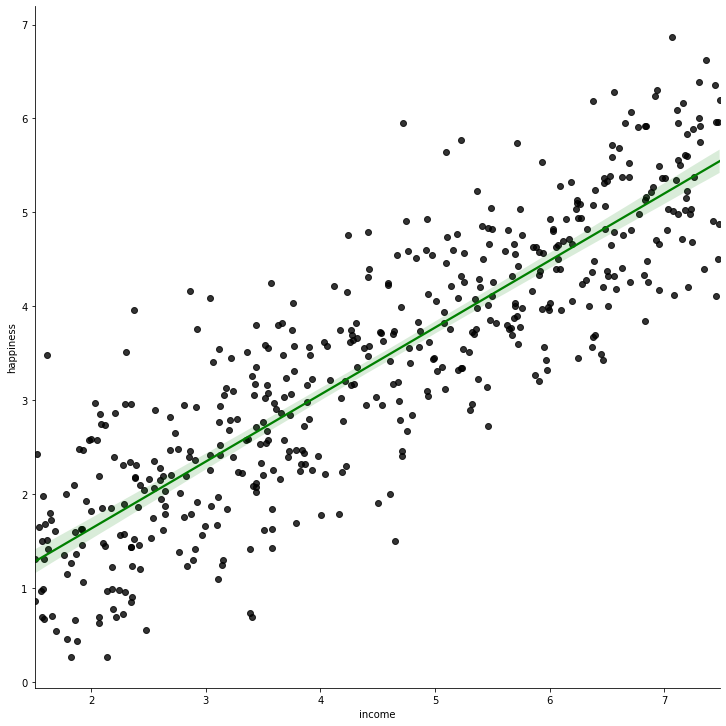
A linear regression line is a line that best fits the graph between the predictor variable (independent) and the predicted variable (dependent).
In the above diagram, the green line is the best fit line; and it is taken as the regression line for the given dataset.
One of the most popular methods of deciding the regression line is the method of least-squares. This method essentially works to find the best-fit line for the data by minimizing the sum of the squares of the vertical deviations from each data point (the deviation of a point residing on the line is 0). As the deviations are squared, there is no cancellation between the positive and negative values of the deviation.
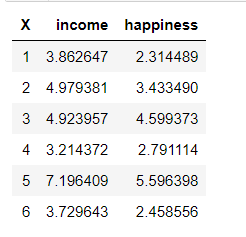
Step 1: Install and load the required packages. Read and explore the dataset. You can also set the working directory of the notebook using setwd() function, passing the path of the directory (where the dataset is stored) as an argument.
Output:
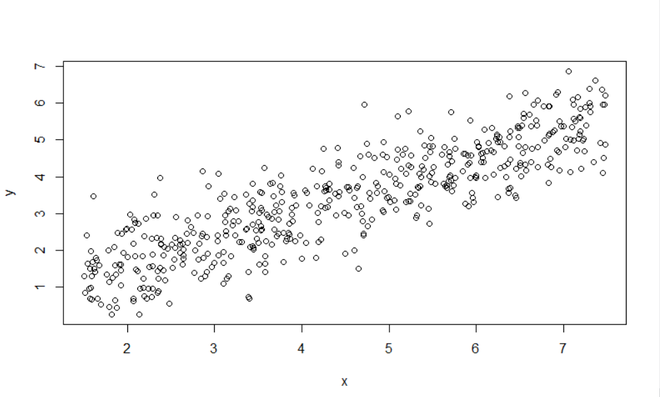
👁 ImageStep 2: Separate the variables of the dataset. Visualize the dataset.
Output:
Step 3: Clear the linear regression model from the data. Train and see the model.
Output:
Call:
lm(formula = y ~ x)

Coefficients:
(Intercept) x
 0.2043 0.7138
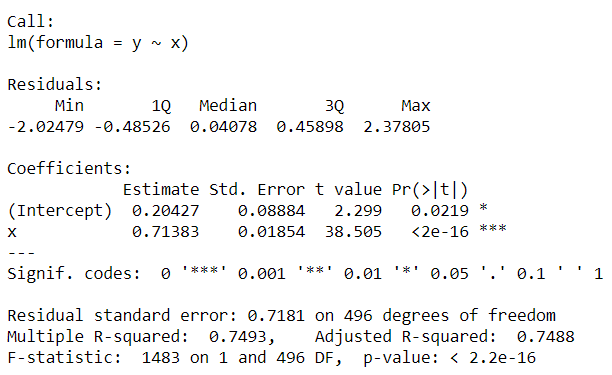
As you can see, the value of intercept is 0.2043. But how to obtain this value in a variable?
We can use a summary of the created model to extract the value of the intercept.
Code:
Output:
0.204270396204177
If you try to print the summary of the model (model_summary) variable, you will see the coefficients below. It is a 2D matrix, which stores all the said coefficients. Therefore, [1,1] will correspond to the predicted intercept (of the regression line).
Output:
👁 ImageThis is how we extract the value of intercept from a linear regression model in R.