Lasso Regression is a linear modeling technique that uses L1 regularization to improve prediction accuracy and model interpretability. By adding a penalty equal to the absolute values of the coefficients, it shrinks some of them to zero, effectively performing feature selection and reducing model complexity, especially in high-dimensional data.
Key Characteristics
Performs both regularization and feature selection.
Suitable for high-dimensional data.
Helps reduce variance while possibly increasing bias slightly.
Works well when there are many correlated features.
Mathematical Formulation
The cost function minimized by Lasso Regression is:
Where:
: number of observations
: number of predictors
: actual output
: input features
: intercept term
: model coefficients
regularization strength
Effect of Lambda (λ)
Equivalent to ordinary least squares regression.
As increases: More coefficients shrink to exactly zero, enhancing feature selection.
Very high : All coefficients become zero, leading to underfitting.
Implementation of Lasso Regression in R
We implement Lasso Regression using the Big Mart Sales dataset, aiming to predict product sales based on various product and outlet features. The process involves data preprocessing, encoding, normalization and training using the glmnet package with L1 regularization.
1. Installing Required Packages
We install the necessary packages to preprocess data, train the Lasso regression model and visualize results.
data.table: used for efficient data loading and manipulation.
dplyr: used for data transformation and filtering.
glmnet: used for fitting Lasso and Ridge regression models.
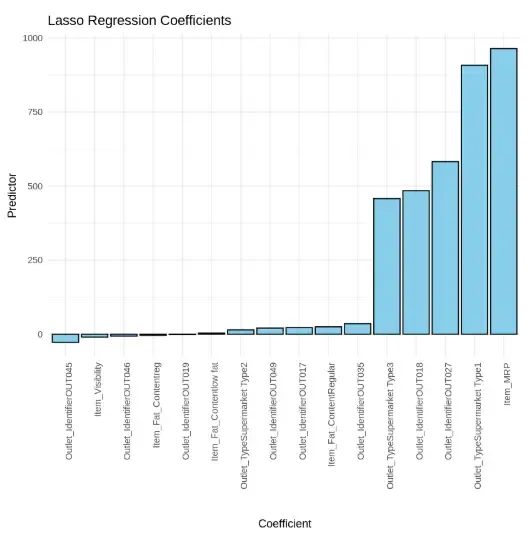
The plot displays the non-zero coefficients from a Lasso regression model, highlighting the most influential features on the target variable. Item_MRP and Outlet_Type_Supermarket_Type1 have the highest positive impact, while several features have coefficients close to zero, indicating minimal or no contribution.
Applications of Lasso Regression
Feature selection: Ideal for reducing overfitting by selecting only the most relevant variables.
High-dimensional modeling: Useful when number of predictors exceeds number of observations.
Finance: Used in credit risk models where many financial indicators exist.
Genomics: Applied to select key genes in DNA analysis.
Retail forecasting: Filters product/store features for effective sales prediction.