|
VOOZH | about |
|
VOOZH | about |
The ts function in R Programming Language is used to create time series objects, which are data structures designed for time-related data. Time series data consists of observations over a period, often at regular intervals, such as daily, weekly, monthly, or yearly data. Time series analysis is crucial in various fields like finance, economics, and environmental studies.
Time series data has a time component, making it different from other types of data. This component allows for trend analysis, seasonal analysis, forecasting, and other time-related operations. The ts function creates objects with specific properties that make them suitable for these operations.
The ts function has the following primary arguments:
Here's an example of creating a simple time series in R.
Suppose you have monthly data for a specific variable over two years:
Output:
 Jan Feb Mar Apr May Jun Jul Aug Sep Oct Nov Dec
2020 50 55 45 60 65 70 75 80 85 90 95 100
2021 105 110 115 120 125 130 135 140 145 150 155 160
This example creates a time series that starts from January 2020 with 12 observations per year (monthly). The ts_data object can now be used for various time series operations and analysis.
Once you've created a time series object, you can use it for further analysis and visualization:
Output:
To extract a specific portion of a time series, you can use subsetting:
Output:
 Jan Feb Mar Apr May Jun Jul Aug Sep Oct Nov Dec
2020 50 55 45 60 65 70 75 80 85 90 95 100
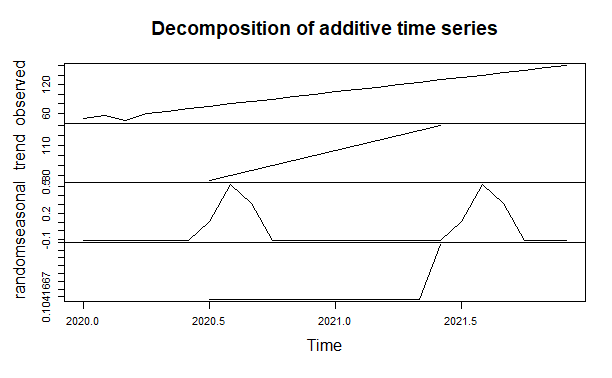
Time series data allows you to perform various analyses, such as decomposing into seasonal and trend components, forecasting future values, and identifying patterns. Here's an example of decomposing a time series:
Output:
The forecast package in R is widely used for time series forecasting. Here's an example of forecasting future values based on a simple time series model:
Output:
The ts function in R is a powerful tool for creating time series objects, allowing for various time series operations, analysis, and forecasting. Whether you're working with daily, monthly, or yearly data, understanding how to create and manipulate time series is crucial for analyzing trends, patterns, and future projections.