Repeated K-Fold Cross-Validation is a method used to evaluate machine learning models for both classification and regression tasks. It involves splitting the dataset into K equal parts, training the model on K−1 parts and testing it on the remaining part. This process is repeated K times so that each part is used once as a test set. The entire K-Fold process is then repeated multiple times with different random splits of the data. This helps provide a more reliable and consistent estimate of the model’s performance by reducing the impact of any single data split.
Steps in Repeated K-Fold Cross-Validation
Randomly split the dataset into K equal subsets.
Select one subset as the validation set.
Use the remaining K−1 subsets to train the model.
Evaluate the model on the validation set and calculate prediction error.
Repeat steps 2–4 until each subset has been used once as the validation set.
Calculate the average of all K prediction errors.
Repeat steps 1–6 for a fixed number of repetitions with a new random split each time.
Calculate the final model performance as the average of all repetition results.
Implementation of Repeated K-Fold Cross-Validation on Classification
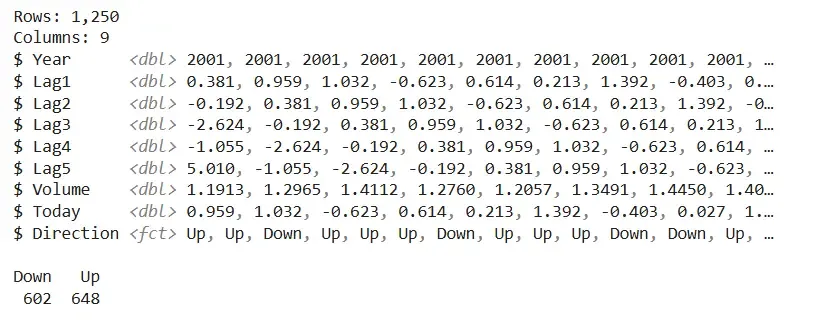
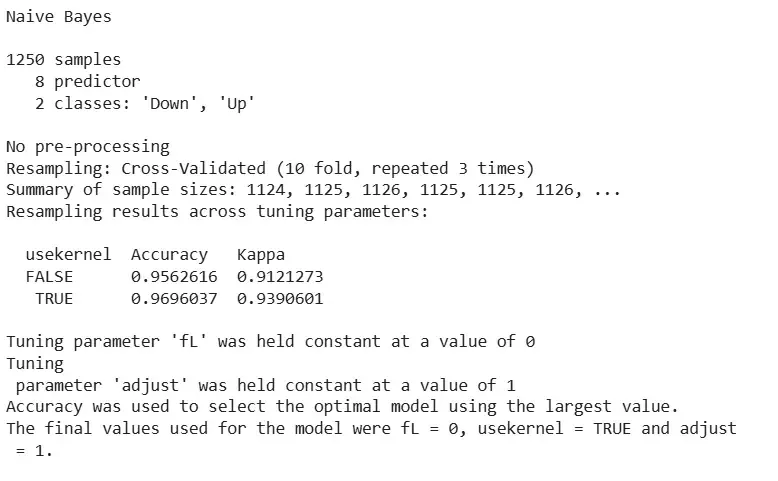
We build and evaluate a classification model using the repeated K-Fold cross-validation method in R with the Naive Bayes algorithm.
1. Installing and loading the required packages and libraries
We install and then load the necessary libraries to handle data, import datasets and perform repeated K-Fold cross-validation.
install.packages("tidyverse"): installs the package for data manipulation and visualization.
install.packages("caret"): installs the package for training and evaluating models.
install.packages("ISLR"): installs the package containing the Smarket dataset.
Implementation of Repeated K-fold Cross-validation on Regression
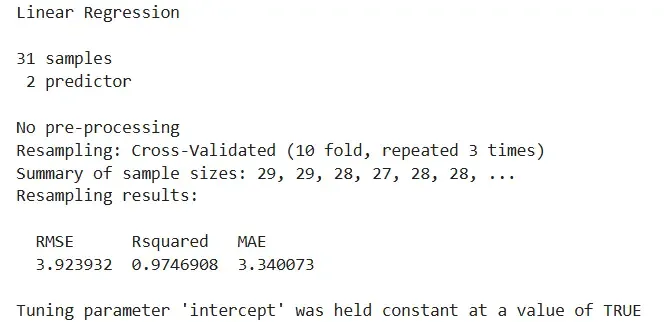
We implement the repeated k-fold cross-validation technique on a regression model using R's inbuilt trees dataset. This method improves the robustness of model evaluation by running k-fold cross-validation multiple times with different random splits.
1. Installing Required Packages
We install the required packages for data manipulation and cross-validation.
tidyverse: Used to perform data manipulation and visualization.
caret: Used to compute cross-validation methods.
2. Loading and Inspecting the Dataset
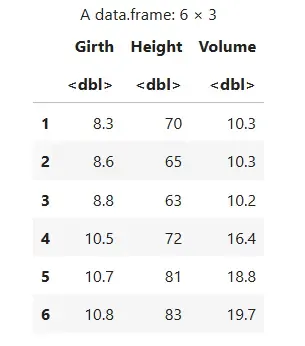
We load the inbuilt trees dataset and inspect the first few records.
data(trees): Loads the dataset into memory.
head(trees): Displays the first few rows to understand the structure.
A very effective method to estimate the prediction error and the accuracy of a model.
In each repetition, the data sample is shuffled which results in developing different splits of the sample data.
Disadvantages of Repeated K-fold cross-validation
A lower value of K leads to a biased model and a higher value of K can lead to variability in the performance metrics of the model. Thus, it is essential to use the correct value of K for the model(generally K = 5 and K = 10 is desirable).
With each repetition, the algorithm has to train the model from scratch which means the computation time to evaluate the model increases by the times of repetition.