|
VOOZH | about |
|
VOOZH | about |
Time series forecasting is the process of using historical data to make predictions about future events. It is commonly used in fields such as finance, economics and weather forecasting. The following are some important ideas and methods to consider when carrying out time series forecasting.
Time series data consists of observations or measurements collected at regular time intervals. These data points are typically plotted over time and the goal of time series forecasting is to predict future values in this sequence.
Note: We need to make our data stationary for time series forecasting. You can refer to this article to understand more about stationarity.
Time series forecasting methods are techniques used to make predictions about future values in a time series based on historical and current data. There are several well-established methods for time series forecasting, each with its own strengths and weaknesses. Here are some of the most commonly used time series forecasting methods.
There are so many more methods are available but these are the most common methods for time series forecasting.
Here we will use the AutoRegressive Integrated Moving Average which is nothing but the ARIMA method for forecasting using time series data. We will use AirPassengers(this dataset contains US airline passengers from 1949 to 1960) and forecast passenger data for 10 years that is from 1960-1970.
To get started, we need to install the forecast package in R.
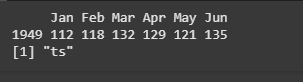
We can load the AirPassengers dataset and also check the class of the AirPassengers dataset to confirm it's a time series object, using the class function.
Output:
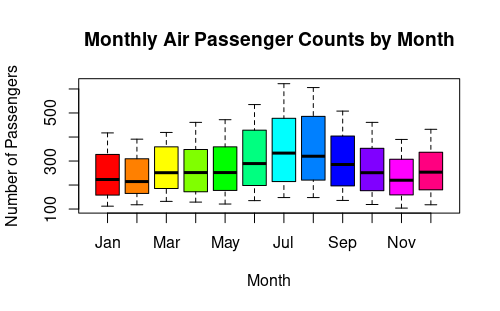
We can visualize the distribution of monthly passenger counts with a boxplot. Here, we use a custom color palette for better visualization.
Output:
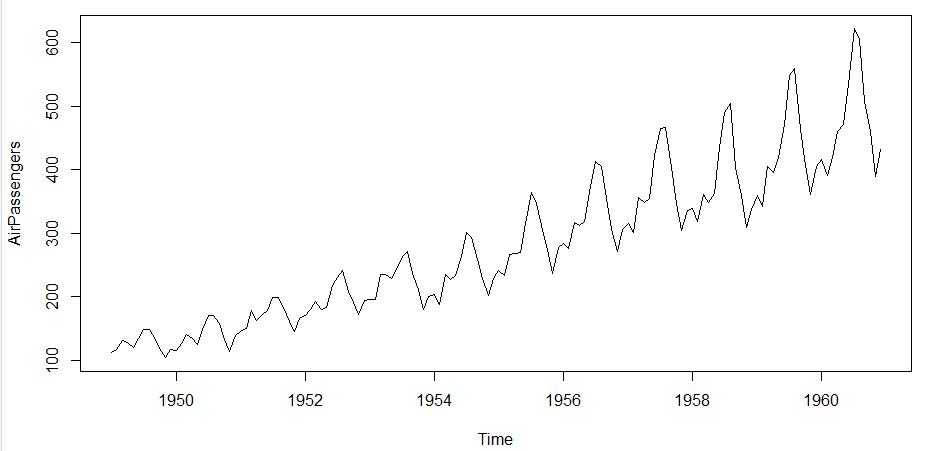
Next, we plot the AirPassengers data to observe trends and patterns over time.
Output:
The plot shows the passenger counts over time from 1949 to 1960, providing an initial look at the trend, seasonality and possible noise.
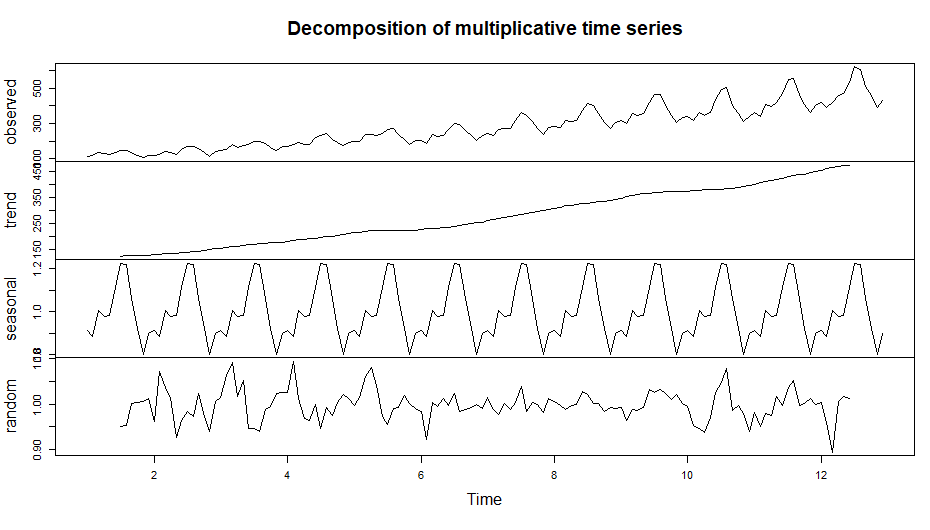
We will decompose the data using the "multiplicative" model, as the seasonal variation seems to change with the trend.
Output:
This plot shows the seasonal, trend and random components of the time series.
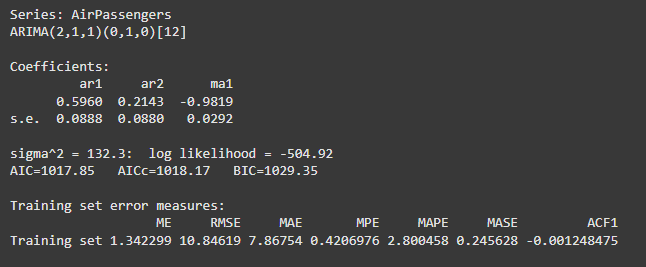
Now, we use the ARIMA model to forecast passenger data for the next 10 years (120 months). ARIMA is suitable for time series data that may have trends and seasonality.
Output:
The ARIMA(2,1,1)(0,1,0)[12] model includes:
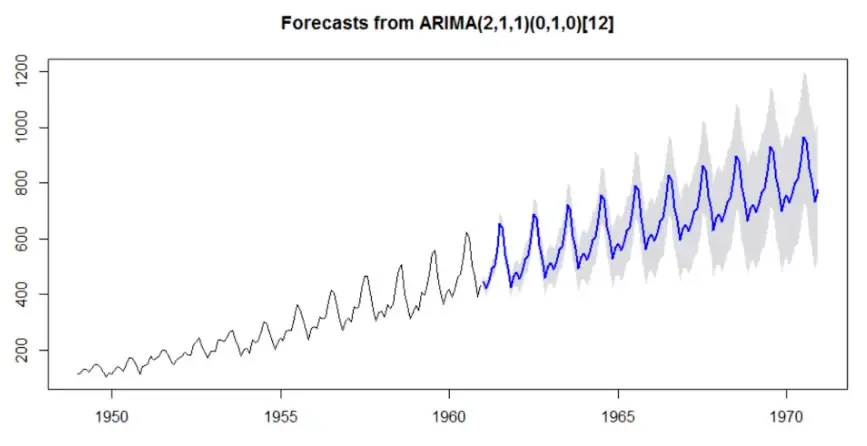
We forecast passenger counts for the next 10 years (120 months) using the ARIMA model.
Output:
The forecast provides the predicted number of passengers for each month from 1960 to 1970. The shaded area in the plot represents the 95% confidence interval for the forecast, indicating the level of uncertainty in the predictions.
In R Programming Language There are several R packages available for time series forecasting, including.
To use these packages, first, they need to be installed and loaded into R. Then, the time series data must be prepared and cleaned and the appropriate forecasting method can be applied. The forecasted values can then be plotted, evaluated and compared to the actual values.