|
VOOZH | about |
|
VOOZH | about |
Time series forecasting is an essential technique used in various fields such as finance, economics, weather prediction, and inventory management. The Holt-Winters method is a popular approach for forecasting time series data, particularly when dealing with seasonality. In this article, we will explore the theory behind the Holt-Winters method and demonstrate how to implement it in R Programming Language.
A time series is a sequence of data points collected or recorded at specific time intervals. Time series forecasting involves predicting future values based on previously observed values. The challenge lies in identifying and modeling the underlying patterns, such as trend, seasonality, and randomness. Components of a Time Series:
The Holt-Winters method is an extension of exponential smoothing that captures both trend and seasonality in time series data. It comes in two main variations:
The HoltWinters function in R provides a simple and effective way to apply the Holt-Winters method to time series data. Let's explore this with a practical example.
First we will load the dataset and the required packages.
Output:
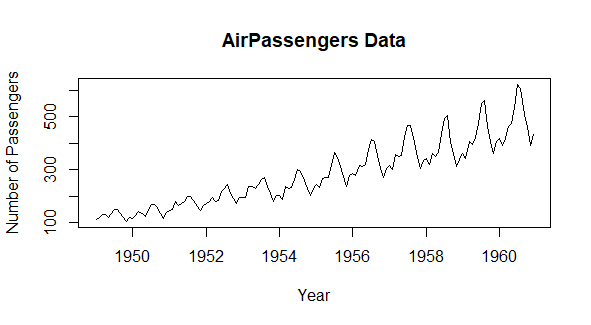
The AirPassengers dataset contains monthly totals of international airline passengers from 1949 to 1960. It exhibits both trend and seasonality, making it ideal for Holt-Winters forecasting.
Now we will Applying the Holt-Winters Model.
Output:
 Length Class Mode
fitted 528 mts numeric
x 144 ts numeric
alpha 1 -none- numeric
beta 1 -none- numeric
gamma 1 -none- numeric
coefficients 14 -none- numeric
seasonal 1 -none- character
SSE 1 -none- numeric
call 3 -none- call
The HoltWinters function automatically optimizes the smoothing parameters and fits the model to the data.
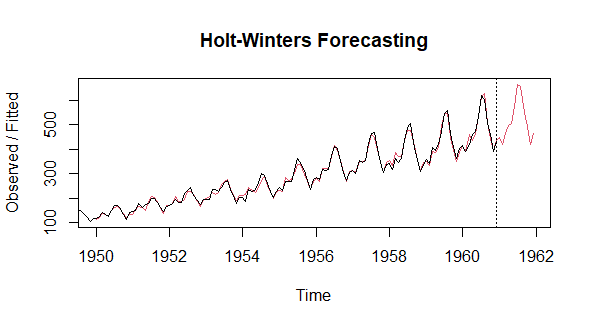
The predict function generates forecasts for the specified horizon (12 months in this case).
Output:
Now we will Evaluating the Model.
Output:
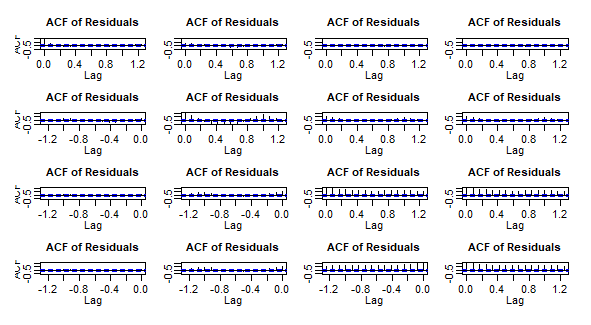
After fitting the model, it's essential to evaluate the residuals to check for any remaining patterns or autocorrelations. Ideally, residuals should behave like white noise, indicating a good model fit.
The Holt-Winters method is a powerful tool for forecasting time series data with trend and seasonality. R's HoltWinters function simplifies its application, allowing for effective forecasting with minimal effort. By understanding the underlying theory and applying it to real-world data, you can create accurate forecasts to inform decision-making in various domains.
Whether you're dealing with sales data, economic indicators, or any other time series, the Holt-Winters method provides a reliable approach to predicting future trends and seasonal patterns.