|
VOOZH | about |
|
VOOZH | about |
Probability is the measure of the likelihood that a specific event will occur. It is expressed as a number between 0 and 1, where 0 means the event cannot happen and 1 means it will definitely happen. Probabilities are used to quantify uncertainty in experiments, real-world events and simulations. In R, we can calculate and visualize probabilities using built-in functions and packages.
R offers various functions and packages for calculating Probability in R and performing statistical analyses. Some commonly used functions include:
Example:
Output:
[1] 0.5
R provides extensive support for probability distributions, which are mathematical functions that describe the likelihood of different outcomes in a random experiment. Common probability distributions include:
Example:
Output:
Simulation is a powerful tool for understanding probabilities through empirical experiments. R facilitates simulation by allowing the generation of random numbers from different probability distributions. Key functions for simulation include:
Output:
[1] 0.494
Visualization is for gaining insights from Probability in R and it offers numerous packages such as ggplot2, lattice and base graphics for creating visualizations. Common plots include histograms, density plots, boxplots and scatter plots, which help in understanding the shape and characteristics of probability distributions.
Output:
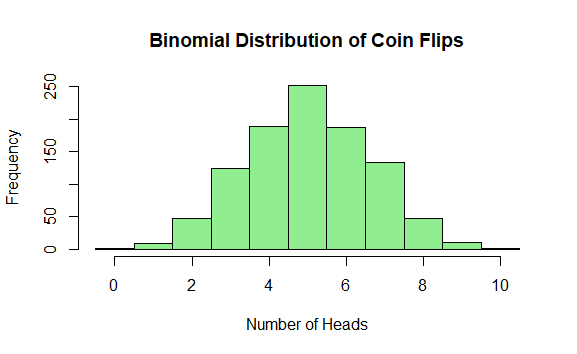
The output shows a histogram of the binomial distribution for 1000 trials of flipping a fair coin 10 times. Most results center around 5 heads, forming a symmetric, bell-shaped curve.