|
VOOZH | about |
|
VOOZH | about |
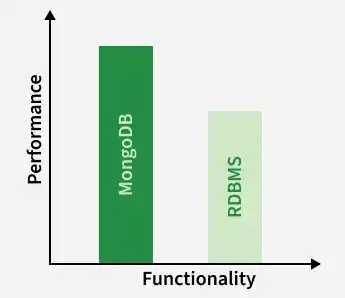
RDBMS and MongoDB are widely used database systems that differ in their data models and scalability approaches.
MongoDB is an open-source, document-oriented NoSQL database designed for scalable and high-volume data storage in modern applications.
Here are some features of MongoDB listed below:
RDBMS (Relational Database Management System) is a traditional database system that stores data in structured tables with fixed schemas, ensuring strong consistency, integrity, and security.
Here is a detailed comparison of RDBMS and MongoDB based on various features:
| RDBMS | MongoDB |
|---|---|
| Relational database | Non-relational, document-oriented database |
| Stores data in tables with rows and columns | Stores data in flexible JSON-like documents (BSON) |
| Fixed, predefined schema | Schema-less, dynamic schema |
| Vertically scalable (increase resources like CPU/RAM) | Horizontally scalable (add more servers to handle increased load) |
| Strong focus on ACID properties | Supports ACID (limited/multi-document in newer versions) |
| Supports complex joins | Supports joins using $lookup (less powerful than SQL joins) |
| Row-based data storage | Document-based data storage |
| Slower for large, distributed datasets | Faster for large-scale, distributed data handling |
| High level of information security | Provides strong security features |
| Uses SQL for querying | Uses JSON-like query language |
| Less flexible for schema changes | Highly flexible for evolving data models |
| Limited indexing options | Extensive indexing on any field in the document |
| Suitable for structured data with well-defined relationships | Best for handling unstructured or semi-structured data |
| Backup and recovery options are manual | Automated backup and recovery options available |
| Can be deployed on-premises or cloud | Cloud-native and supports multi-cloud deployment |
| Ideal for transactional applications | Ideal for high scalability and big data applications |