The MongoDB $cmp operator compares two values and returns their order. It is used in aggregation pipelines for sorting and conditional logic, and follows BSON type ordering for different data types.
Compares two expressions and returns their relative order.
Outputs 0, 1, or -1 based on the comparison result.
Useful for building comparison-based expressions within aggregation pipelines.
Helps implement conditional logic in pipelines.
Works across different data types using BSON ordering.
Syntax
{ $cmp: [ <expression1>, <expression2> ] }
<expression1>: The first value or field to compare.
<expression2>: The second value or field to compare.
Features of the MongoDB $cmp Operator
Here are some features discussed:
Returns -1 if the first value is smaller, 1 if greater, and 0 if equal.
Supports comparisons on nested (embedded) fields.
Considers both value and data type during comparison.
Follows BSON type ordering when comparing different data types.
Used within aggregation pipeline stages like $project, $sort, and conditional expressions.
MongoDB $cmp Operator Examples
Examples of the $cmp operator in MongoDB. In the following examples, we are working with:
Database: GeeksforGeeks
Collection: example
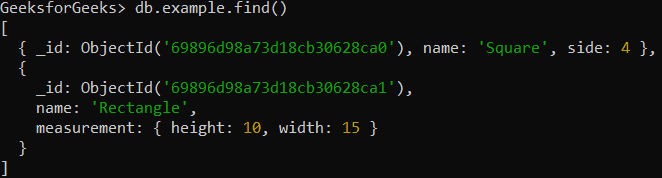
Document: Two documents that contain the details of the shapes in the form of field-value pairs.
Example 2: Using $cmp Operator in the embedded Document
Comparing the value of the measurement.height field with the value of the measurement.width field and $cmp operator return -1 which means both values of measurement.height field is less than the value of the measurement.width field.