|
VOOZH | about |
|
VOOZH | about |
MongoDB logical query operators combine multiple conditions in a single query to enable flexible, precise filtering for advanced searches and data analysis.
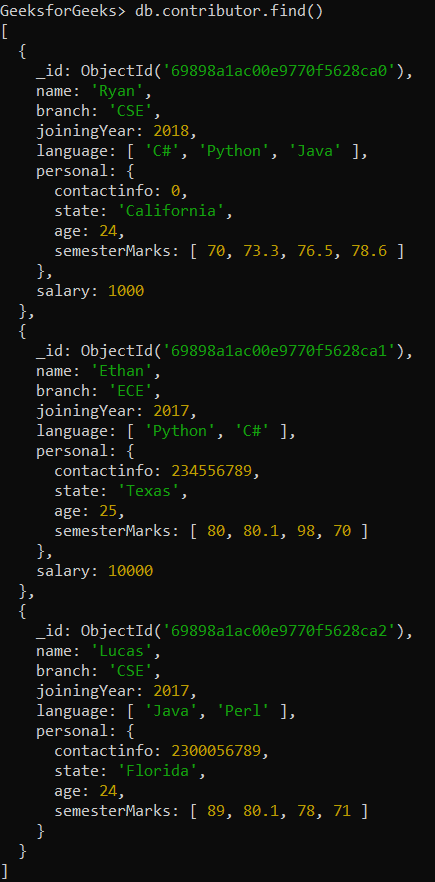
Let’s understand how each operator works with examples from a sample MongoDB collection. In the following examples, we are working with:
It Joins query clauses with a logical AND. Returns documents that match all the conditions.
Syntax
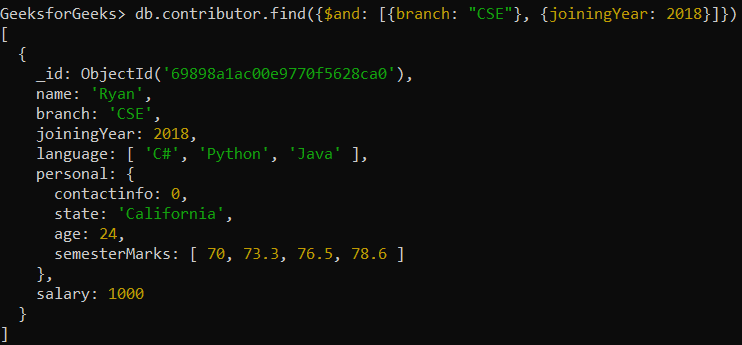
{ $and: [ { <expression1> }, { <expression2> }, ... ] }Example: Retrieving only those employees' documents whose branch is CSE and joiningYear is 2018.
db.contributor.find({$and: [{branch: "CSE"}, {joiningYear: 2018}]})Output:
It Joins query clauses with a logical NOR. Returns documents that fail to match all the specified conditions (i.e., none of the conditions are true).
Syntax
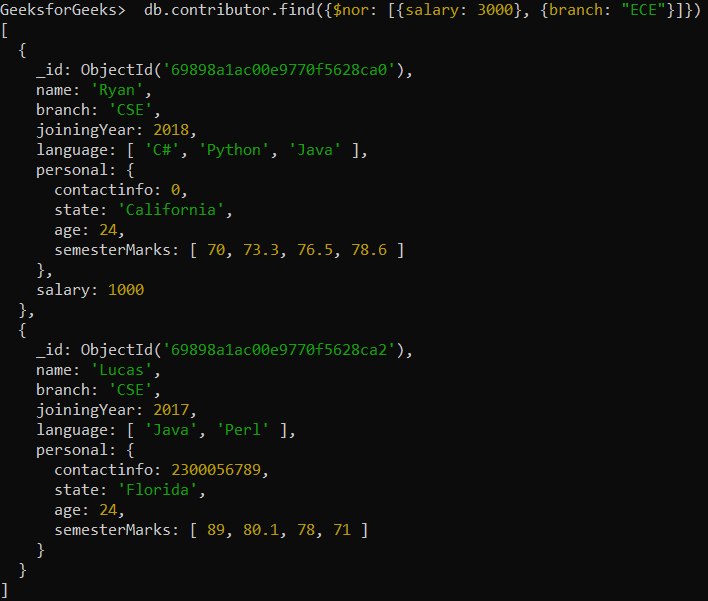
{ $nor: [ { <expression1> }, { <expression2> }, ... ] }Example: Retrieving only those employees' documents whose salary and branch is not 3000 and ECE respectively.
db.contributor.find({$nor: [{salary: 3000}, {branch: "ECE"}]})Output:
The $or operator combines multiple conditions, where at least one of the conditions must be true.
Syntax
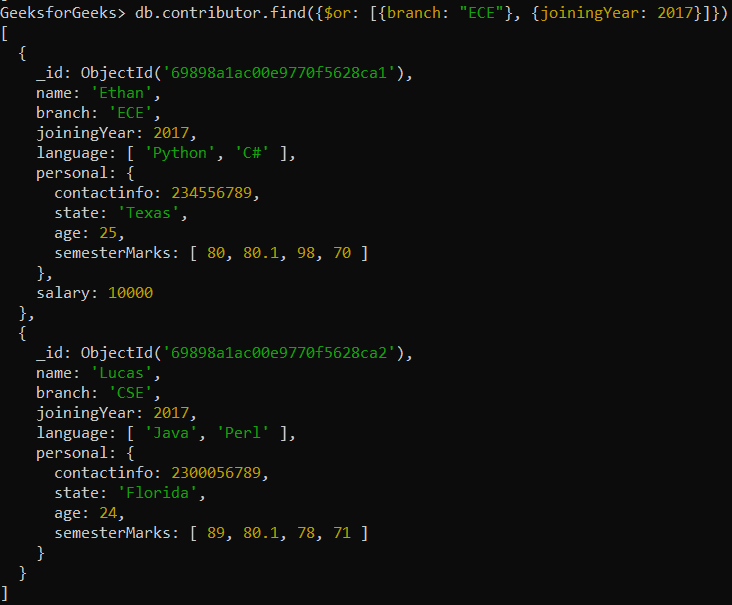
{ $or: [ { <expression1> }, { <expression2> }, ... ] }Example: Retrieving only those employees' documents whose branch is ECE or joiningYear is 2017.
db.contributor.find({$or: [{branch: "ECE"}, {joiningYear: 2017}]})Output:
It negates a condition at the field level and must be used with another operator (e.g., $gt, $eq). Returns documents that do not match the query expression.
Syntax
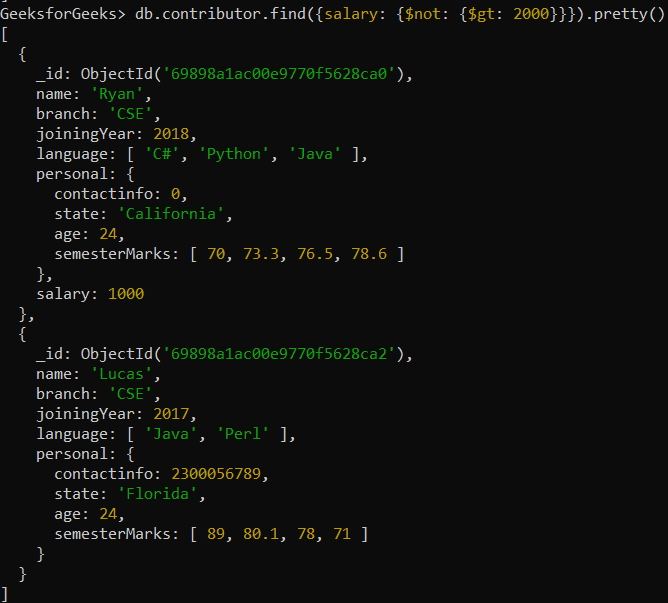
{ <field>: { $not: { <operator-expression> } } }Example: Retrieving only those employee’s documents whose salary is not greater than 2000.
Query:
db.contributor.find({salary: {$not: {$gt: 2000}}}).pretty()Output: