|
VOOZH | about |
|
VOOZH | about |
The MongoDB $log operator is used within the aggregation pipeline to calculate the logarithm of a number with a specified base. This operator helps perform logarithmic calculations on fields whether in simple documents or embedded documents.
The syntax is straightforward by requiring a number and a base to compute the log value. In this article, We will learn about the MongoDB $log Operator by understanding various examples and so on.
$log operator in MongoDB is used in aggregation pipeline stages to compute the logarithm of a number. e) and logarithm to a specified base. Syntax:
{ $log: [ <number>, <base> ] }
Here, the number is a valid expression as long as it resolves to a non-negative number and base is a valid expression until it resolves to a positive number greater than 1.
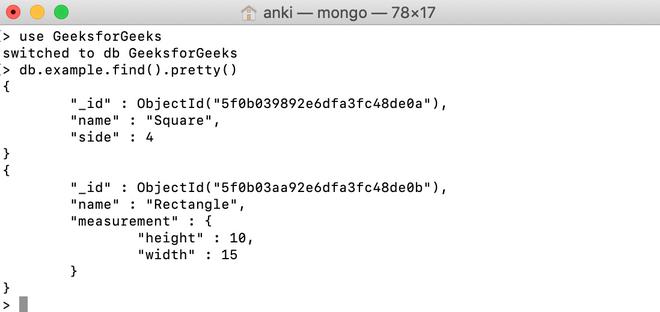
In the following examples, we are working with:
Database: GeeksforGeeks
Collection: example
Document: two documents that contain the details of the shapes in the form of field-value pairs.
Output:
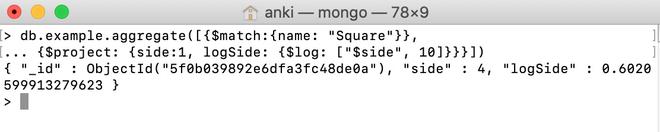
👁 ImageIn this example, we are going to find the log of the value of the side field in the square document. Here, the base value is 10.
db.example.aggregate([{$match:{name: "Square"}},
... {$project: {side:1, logSide: {$log: ["$side", 10]}}}])
Output:
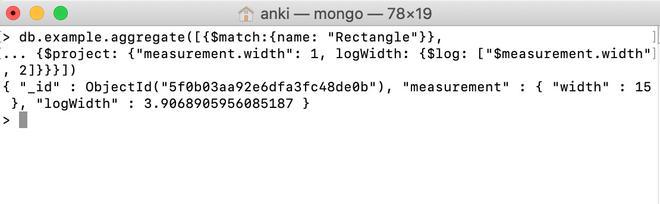
👁 ImageIn this example, we are going to find the log of the value of the measurement.width field in the rectangle document. Here, the base value is 2.
db.example.aggregate([{$match:{name: "Rectangle"}},
... {$project: {"measurement.width": 1,
 logWidth: {$log: ["$measurement.width", 2]}}}])
Output:
Overall, the MongoDB $log operator is a valuable tool for performing logarithmic calculations directly within the database, making it easier to analyze numerical data effectively. By using MongoDB $log operator syntax and various MongoDB $log operator examples, users can apply the operator to both simple and MongoDB log for embedded documents, enhancing their data manipulation capabilities. So, the $log operator is essential for developers and data analysts looking to extract meaningful insights from their datasets in MongoDB.