|
VOOZH | about |
|
VOOZH | about |
MongoDB's aggregationframework provides a powerful set of tools for data manipulation and processing. One such tool is the $exp operator which allows users to perform exponential calculations within aggregation pipelines. In this article, We will learn about the MongoDB $exp Operator in detail.
$exp operator in MongoDB is used to raise the mathematical constant e (approximately equal to 2.718) to the power of a given number. Syntax:
{ $exp: <exponent> }
Here, the exponent is a valid expression until it resolves to a number.
In the following examples, we are working with:
Database: GeeksforGeeks
Collection: example
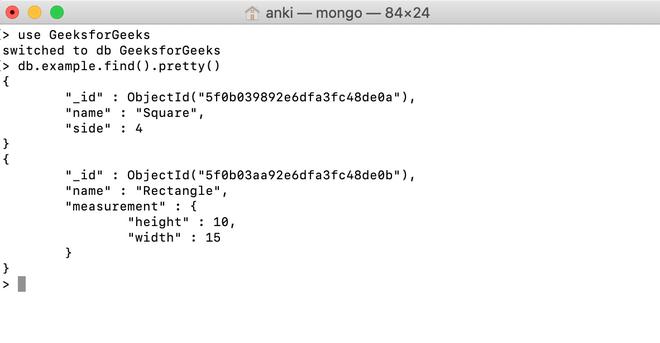
Document: two documents that contain the details of the shapes in the form of field-value pairs.
Output:
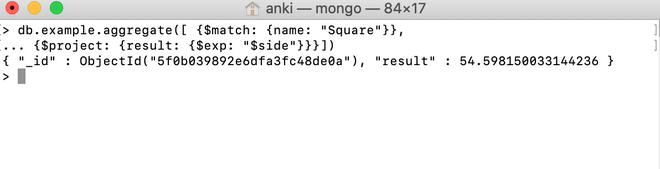
👁 ImageIn this example, we are going to find the exponent of the value of the side field.
db.example.aggregate([ {$match: {name: "Square"}},
... {$project: {result: {$exp: "$side"}}}])
Output:
👁 ImageIn this example, we are going to find the exponent of the difference of the values of measurement.height and measurement.width fields.
db.example.aggregate([ {$match: {name: "Rectangle"}},
... {$project: {result: {$exp:
... {$subtract: ["$measurement.height", "$measurement.width"]}}}}])
Output:
The $exp operator in MongoDB is a useful tool for performing exponential calculations within aggregation pipelines. By raising e to a specified power, it facilitates complex mathematical computations in your MongoDB queries.