|
VOOZH | about |
|
VOOZH | about |
As modern applications generate large amounts of data and experience increasing traffic, database scalability becomes important. MongoDB, a leading NoSQL database, supports both horizontal and vertical scaling, ensuring efficient handling of high-performance workloads, fault tolerance, and availability.
In this article, we will explore Scaling in MongoDB, the differences between Horizontal and Vertical Scaling and their respective advantages. By the end we’ll have a clear understanding of how to scale MongoDB to enhance performance and long-term growth.
Scaling refers to increasing the capacity of a database to handle growing workloads, traffic, and data volume efficiently. MongoDB natively supports horizontal scaling using sharding, making it ideal for big data applications and high-throughput systems.
MongoDB provides two primary types of scaling
Below, we have listed the key differences between horizontal scaling and vertical scaling in MongoDB. This comparison will help us choose the best approach based on our requirements.
| Feature | Horizontal Scaling (Scaling Out) | Vertical Scaling (Scaling Up) |
|---|---|---|
| Description | Adds more machines/nodes to the MongoDB cluster | Increases CPU, RAM, or storage of a single machine |
| Usage Example | Large-scale applications like e-commerce, social media, distributed systems | Small to medium-scale applications with moderate data growth |
| Complexity | Higher, requires configuring sharding | Lower, just upgrade hardware |
| Downtime | Minimal to none | Yes, requires server restarts |
| Cost | Expensive (needs multiple servers) | Less expensive but can become costly for high-end hardware |
| Performance | Higher, as load is balanced across multiple servers | Limited by hardware constraints |
| Implementation Time | Longer, requires careful planning | Quick, just upgrade existing infrastructure |
Horizontal scaling in MongoDB is achieved through sharding, which distributes data across multiple servers (shards). It means scaling out and involves adding more machines or instances to our MongoDB cluster. Each machine in the cluster handles a small amount of the data, distributing the load across multiple servers.
Data is distributed based on a shard key, which determines how documents are split among shards. A well-chosen shard key ensures even data distribution and optimal performance.
Example: Sharding a MongoDB collection based on a numeric field like "userID":
sh.enableSharding("myDatabase");
sh.shardCollection("myDatabase.users", { userID: 1 });
This ensures that data is evenly distributed across multiple servers, improving query performance and availability.
Vertical scaling in MongoDB involves upgrading the hardware of an existing server. It means scaling up, which involves increasing the resources (CPU, RAM, etc.) of a single machine in your MongoDB deployment. This means upgrading the hardware of your existing server to handle more data and traffic. There is a hardware limit to vertical scaling. Once a machine’s maximum capacity is reached, further scaling requires sharding.
If our application is growing fast, use horizontal scaling. If we need immediate improvements with minimal changes, use vertical scaling. The table below compares both approaches to help determine the best fit for our application.
| Factor | Choose Horizontal Scaling | Choose Vertical Scaling |
|---|---|---|
| Data Size | Large-scale applications with massive datasets | Small to medium-sized applications |
| Growth Rate | Rapid and unpredictable growth | Slow and predictable growth |
| Downtime Tolerance | Requires high availability | Some downtime is acceptable |
| Setup Complexity | Ready for a complex setup | Need a quick and simple upgrade |
| Budget | Willing to invest in multiple servers | Limited budget, but willing to upgrade hardware |
There are multiple ways to scale MongoDB based on our application’s needs. We can either scale horizontally using sharding or scale vertically by upgrading hardware resources.
After choosing the shard keys that evenly distributes data and evaluating the data model, shard according to your needs
"sh.addShard("shard_name/shard_hostname:port") "sh.enableSharding()sh.shardCollection()Go to MongoDB Atlas dashboard.
This will upgrade the resources of your existing MongoDB server. Other methods can be
To create an application using MongoDB:
Step 1: Install MongoDB driver for Node.js
Step 2: Set up your MongoDB connection in your Node.js application.
npm init -yStep 3: Install the package using the below command
npm install mongodbThe Updated Dependencies in your package.json file is:
After installing the MongoDB driver, your package.json file should include:
"dependencies": {
 "mongodb": "^46.6.1
}
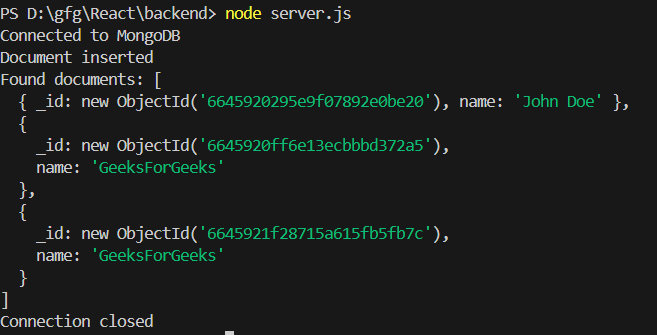
The following Node.js script connects to a MongoDB database, inserts a document, retrieves all documents from a collection, and prints them to the console. This example simulates database interactions in a scaled MongoDB setup.
// server.js
const { MongoClient } = require('mongodb');

// Connection URI
const uri = 'mongodb://localhost:27017';

// Create a new MongoClient
const client = new MongoClient(uri);

async function main() {
 try {
 // Connect to the MongoDB server
 await client.connect();
 console.log('Connected to MongoDB');

 // Use a specific database
 const database = client.db('mydb');

 // Use a specific collection
 const collection = database.collection('mycollection');

 // Insert a document
 await collection.insertOne({
 name: 'GeeksForGeeks'
 });
 console.log('Document inserted');

 // Find documents
 const docs = await collection.find().toArray();
 console.log('Found documents:', docs);
 } catch (error) {
 console.error('Error:', error);
 } finally {
 // Close the connection
 await client.close();
 console.log('Connection closed');
 }
}

main();
Output
Scaling in MongoDB is crucial for managing large datasets, improving performance, and ensuring high availability. Horizontal scaling (sharding) is ideal for applications with rapid data growth and high traffic, while vertical scaling works well for smaller applications with predictable workloads. Choosing the right approach depends on growth rate, budget, downtime tolerance, and complexity. By implementing sharding or upgrading hardware strategically, we can ensure a scalable, efficient, and high-performing MongoDB deployment.