|
VOOZH | about |
|
VOOZH | about |
Hybrid cloud architectures have become the primary model for implementing modern enterprise systems. Today's businesses combine on-premises infrastructure with public cloud platforms to balance regulatory requirements, data sovereignty, cost control, and elastic scalability. Databases are a critical element in this strategy, as they must perform well in diverse environments while maintaining data consistency, performance, and security.
MongoDB is particularly well-suited for hybrid cloud application deployments. Its flexible document model, built-in replication, and support for multi-region and multi-cloud architectures enable teams to design systems that span on-premises data centers and cloud providers without fragmenting their data layer.
This article analyzes how MongoDB enables this type of hybrid cloud architecture, explaining common deployment patterns and highlighting best practices for balancing local control with cloud-native scalability.
The transition to cloud computing has not led to a total abandonment of local infrastructure and on-premises data centers. On the contrary, most companies use a hybrid model, where legacy systems, regulated workloads, and latency-sensitive applications remain on-premises, while new services and elastic workloads move to the cloud.
The hybrid cloud is not just a transitional phase. For many companies, it is a long-term strategy that focuses on compliance, cost optimization, and operational resilience. Databases used in this context must support geographic distribution, partial cloud adoption, and data synchronization between environments.
MongoDB fits this model perfectly. Its architecture is designed to support distributed, replicated, and horizontally scalable systems. Whether deployed on bare metal, virtual machines, Kubernetes clusters, or fully managed cloud services, MongoDB exposes the same data model and APIs. This interface consistency allows organizations to design hybrid architectures without rewriting applications or introducing complex layers of data synchronization.
Hybrid cloud architectures combine private infrastructure and public cloud services, allowing workloads to be placed where they make the most sense. Sensitive or regulated data can remain in local data centers, while customer-facing applications take advantage of the scalability of the cloud.
Why choose this model?
A hybrid cloud architecture brings challenges that go beyond simple infrastructure provisioning. Networking, identity management, data replication, and operational monitoring must work in environments with different security models and performance and operational characteristics.
Databases in hybrid deployments must meet several key requirements. They must reliably replicate data across network boundaries, tolerate intermittent connectivity, and support continuous updates without downtime. They must also maintain predictable latency for local workloads while supporting remote access from applications hosted in the cloud.
MongoDB offers a distributed design that considers replication and failover as fundamental aspects rather than optional extensions.
At the heart of MongoDB's hybrid cloud capabilities is its replica set architecture. A replica set is a group of MongoDB nodes that hold the same data, elect a primary node, and automatically fail over when needed.
Replica sets are independent of the execution environment. A node running on a local server behaves the same as a node running on a cloud virtual machine or container platform. This allows a single logical database to be distributed across multiple physical environments.
MongoDB's replication protocol causes data changes to propagate asynchronously from primary nodes to secondary nodes. In a hybrid scenario, this allows local writes to remain fast while cloud-based replicas receive updates with acceptable latency. This design supports hybrid implementations where local systems remain authoritative, while cloud systems use replicated data for analysis, reporting, or global access.
It is important to note, however, that even though replication is asynchronous, MongoDB provides synchronous write durability from the client's perspective via write concern. In most deployments, the default is w: "majority" (optionally combined with journaling via j: true), meaning the primary confirms success only after a majority of replica set members have durably recorded the write.
The hybrid cloud is not just an architecture, but a set of patterns. MongoDB supports many of these patterns by design, without the need for separate synchronization products or tools.
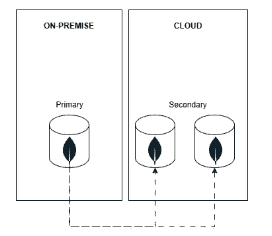
A common use case places the primary MongoDB node on-premises, with secondary nodes hosted in the cloud. This configuration allows companies to maintain direct control over their data while leveraging cloud infrastructure for read scalability, disaster recovery, or sudden workloads.
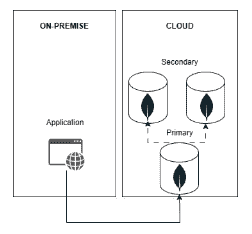
In another approach, MongoDB Atlas is used as the primary database in the cloud, while on-premises systems connect via a secure network. In this case, the cloud becomes the central data hub, while the on-premises infrastructure consumes and updates data as needed.
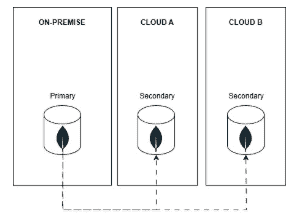
A third architecture involves multi-cloud and hybrid coexistence, where MongoDB clusters span multiple cloud providers alongside on-premises nodes. This approach improves resilience and avoids vendor lock-in, at the cost of increased operational complexity.
In all of these scenarios, MongoDB exposes the same query language and behavior, which significantly reduces the cognitive load for developers and operators.
One of the main reasons for choosing a hybrid cloud is the ability to strike a balance between control and flexibility. On-premises deployments offer predictable costs, direct control over hardware, and compliance with strict data governance rules. Cloud deployments offer elasticity, global reach, and rapid provisioning.
MongoDB allows companies to combine these advantages at the database level. For example, transactional workloads with many writes can be directed to on-premises primaries, ensuring low latency and regulatory compliance. At the same time, analytical or AI workloads with many reads can query cloud-based replicas without impacting local performance.
This separation of responsibilities is achieved through MongoDB's read preference configuration, which allows applications to specify whether queries should be directed to primary or secondary nodes. In a hybrid deployment, cloud applications can read from cloud-based secondaries, while on-premises systems retain full control over writes.
Sharded clusters play a crucial role in hybrid cloud architectures when data volume and throughput exceed the limits of a single replica set. While replica sets provide high availability and redundancy, sharding introduces horizontal partitioning, allowing MongoDB to distribute data across multiple nodes and environments.
In a hybrid cloud deployment, sharded clusters enable organizations to place different shards in different locations, such as on-premises data centers and cloud regions. Each shard is itself a replica set, which means that MongoDB preserves high availability while scaling horizontally. This design allows hybrid systems to handle large datasets and high traffic volumes without central bottlenecks.
A common hybrid pattern involves keeping latency-sensitive shards on-premises while deploying additional shards in the cloud to absorb variable or seasonal workloads. In this configuration, the on-premises infrastructure maintains predictable performance for core operations, while the cloud provides elastic capacity when demand increases. MongoDB’s routing service, the mongos process, abstracts shard placement from applications, ensuring that clients remain unaware of the underlying distribution.
Sharded clusters also support data locality requirements. By carefully choosing shard keys, architects can influence where data is physically stored and how queries are routed. This is particularly important in hybrid environments where regulatory constraints or data sovereignty policies dictate that certain data must remain on-premises while other datasets can reside in the cloud.
However, sharding in a hybrid context requires careful planning. Network latency between shards can affect cross-shard operations, and poorly chosen shard keys may lead to uneven data distribution. For this reason, sharded hybrid deployments benefit from clear workload segmentation and thorough testing before production rollout.
Overall, sharded clusters extend MongoDB’s hybrid cloud capabilities by enabling both scale and flexibility. When combined with replica sets, they allow MongoDB to support large-scale, distributed workloads while maintaining a unified data layer across on-premises and cloud environments.
Networking is often the most complicated part of hybrid cloud architectures. MongoDB deployments must operate over secure and reliable connections between environments. Typical MongoDB hybrid configurations use VPN tunnels or dedicated private links to connect local networks to cloud VPCs (AWS Direct Connect, Azure Express Route).
The MongoDB wire protocol is optimized for efficient communication, but latency and bandwidth limitations must still be considered (latency is significantly higher than on a LAN). Although MongoDB’s wire protocol is efficient, hybrid setups are dominated by WAN latency: Inside the same site/AZ, it’s often sub‑millisecond (~0.1 ms). Across AZs, it’s typically ~1–2 ms. Cross‑region links are usually tens of milliseconds and can be ~70–130 ms for intercontinental paths.
MongoDB also supports replication traffic compression, and in a hybrid environment, this drastically reduces egress costs (traffic leaving the cloud) and improves performance over the VPN or private connection.
Replica set members continuously exchange heartbeat messages and replication traffic. In hybrid implementations, it is necessary to carefully position nodes and optimize timeouts to avoid unnecessary failovers due to transient network issues.
MongoDB's election and replication mechanisms are designed to tolerate network-level partitioning, but it is important to ensure that primary nodes are located in the most stable environment, typically on-premises or in a well-connected cloud region.
Hybrid cloud architectures often originate from security and compliance requirements. In MongoDB, authentication and authorization are enforced at the database level using role-based access control.
Encryption in transit ensures that data remains secure as it passes between on-premises and cloud nodes. Encryption at rest can be managed locally or integrated with cloud key management services.
MongoDB also supports field-level encryption, allowing sensitive data to remain secure even when stored in cloud-hosted nodes. This feature is particularly important in hybrid deployments where regulatory constraints require that certain data elements never be exposed outside of controlled environments.
By applying the same security policies across all nodes, MongoDB reduces the risk of configuration discrepancies between on-premises and cloud deployments.
Managing a database in hybrid environments can be challenging. Monitoring, backups, updates, and incident response must work across different infrastructures.
MongoDB offers consistent operational tools, regardless of where your deployment is located. Metrics, logs, and alerts follow the same structure, whether your nodes are on-premises or in the cloud. This consistency enables centralized monitoring and incident management.
For organizations using MongoDB Atlas, cloud-based nodes can be managed as a service, while on-premises nodes integrate with existing monitoring systems. This hybrid operating model allows teams to gradually move workloads to the cloud without disrupting existing processes.
Continuous updates and configuration changes can be made without downtime, which is critical for hybrid systems supporting mission-critical applications.
Hybrid implementations with MongoDB are very common in industries with strict regulations or latency requirements.
Financial institutions often keep transactional systems on-premises, replicating data to the cloud for analytics, reporting, or AI applications. Manufacturing and IoT platforms use on-premises nodes to collect real-time sensor data, while cloud nodes process aggregated data for optimization and forecasting.
Enterprise SaaS platforms can use MongoDB on-premises for internal systems, using cloud replicas to support global customer access.
Cost optimization is one of the main reasons for choosing a hybrid cloud. MongoDB allows companies to keep costs under control by placing workloads in the most suitable environment.
Workloads that require a lot of computing power but are sensitive to latency can be moved to the cloud, where resources adapt dynamically (and so does spending). Stable, predictable workloads can remain on-premises, where hardware investments are amortized over time, and the elasticity and scalability of the cloud would not be beneficial.
By using a single database platform across all environments, companies avoid the maintenance costs of separate systems and data synchronization pipelines. This consolidation often offsets the additional operating costs caused by hybrid networking.
Although it has its strengths, using a hybrid cloud with MongoDB presents challenges that must be addressed carefully. Network latency between environments can affect replication lag. Application teams must have a solid understanding of distributed-system trade-offs. During a network partition (e.g., the on‑prem and cloud sites cannot communicate), the system must choose between availability and consistency (CAP). When the network is healthy, the main trade-off is often latency versus consistency (PACELC): Stronger coordination across sites improves consistency but increases response time.
Hybrid architectures require careful planning of backup strategies and disaster recovery procedures. Data must be protected from failures in both on-premises and cloud environments.
These challenges are architectural rather than technological in nature. MongoDB provides the building blocks, but successful implementation depends on solid design and rigorous operational discipline.
Successful hybrid cloud implementations with MongoDB start with a clear assignment of architectural responsibilities. Write operations should be directed to a single stable environment, most commonly on-premises or in a primary cloud region with reliable connectivity. This approach minimizes unnecessary elections and ensures predictable latency characteristics.
Replica set members should be placed with network stability in mind. In hybrid environments, voting nodes should avoid locations with variable or intermittent connectivity, as network fluctuations can lead to unwanted failovers. Read preferences should be used judiciously to lighten cloud-based read traffic, while applications should be designed to tolerate eventual consistency when reading from secondary nodes.
Security and operations should remain consistent across all environments. Authentication, encryption, monitoring, and backup strategies must be applied uniformly to avoid configuration variations. Finally, hybrid implementations should be continuously validated through failover testing and operational model reviews, ensuring that the system behaves as expected under real-world conditions.
A common anti-pattern is to let multiple environments compete for write control, increasing the risk of instability and unpredictable failovers. Another very common mistake is to treat cloud and on-premises nodes as separate systems, leading to fragmented monitoring, inconsistent security policies, and operational blind spots.
Hybrid architectures fail when network latency is ignored or when read preferences are enabled without taking replication delay into account. These issues are architectural in nature and can usually be avoided through careful design rather than additional tools.
Hybrid cloud architectures are not a compromise, but a strategy designed to balance control, compliance, and scalability. Databases used in this context must be flexible, resilient, and consistent across all environments.
Distributed design, a unified data model, and environment-independent deployment options make MongoDB a solid foundation for hybrid cloud architectures. By allowing companies to use the same database on both on-premises infrastructure and cloud platforms, MongoDB makes this task easier and enables a gradual transition to the cloud.
For solution designers, MongoDB offers a practical way to approach the hybrid cloud: Maintain control where it's needed, scale where it matters, and have a single, consistent data layer across the entire system.
A hybrid cloud deployment with MongoDB runs database nodes across on-premises and cloud environments within the same logical architecture, allowing data to be accessed and replicated across both.
Yes. MongoDB replica sets can include members running both on-premises and in the cloud, enabling hybrid deployments without changing the data model or APIs.
The primary node is typically placed in the most stable environment, often on-premises or in a primary cloud region, to ensure predictable write latency and stable elections.
MongoDB uses asynchronous replication, allowing write operations to complete locally while data is replicated to remote nodes without blocking.
No. Hybrid deployments can be built using self-managed MongoDB, MongoDB Atlas, or a combination of both.
MongoDB provides a unified data platform that balances on-premises control with cloud scalability using the same database technology across environments.