|
VOOZH | about |
|
VOOZH | about |
Creating a basic button in React Native allows users to perform actions when pressed, such as submitting data or showing alerts. React Native provides a built-in Button component for handling user interactions easily.
Expo is a framework and platform used to build React Native applications easily. It provides tools and services to develop, run, and deploy apps for Android, iOS, and web using the same codebase.
We will create 3 types of buttons here.
<Button title= "setTitle" ></Button>Now, create a project with the following command.
npx create-expo-app app-name --template
Note: Replace the app-name with your app name for example : react-native-demo-app
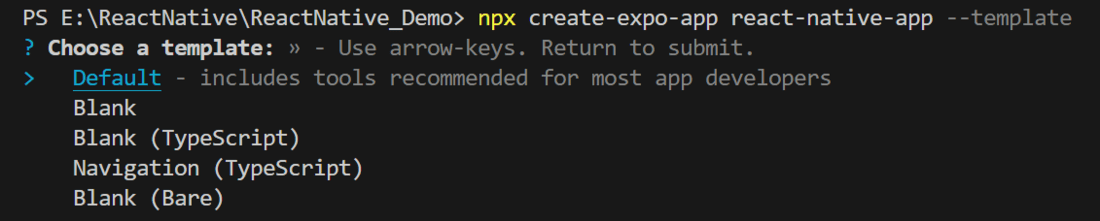
Next, you might be asked to choose a template. Select one based on your preference as shown in the image below. I am selecting the blank template because it will generate a minimal app, as clean as an empty canvas in JavaScript.
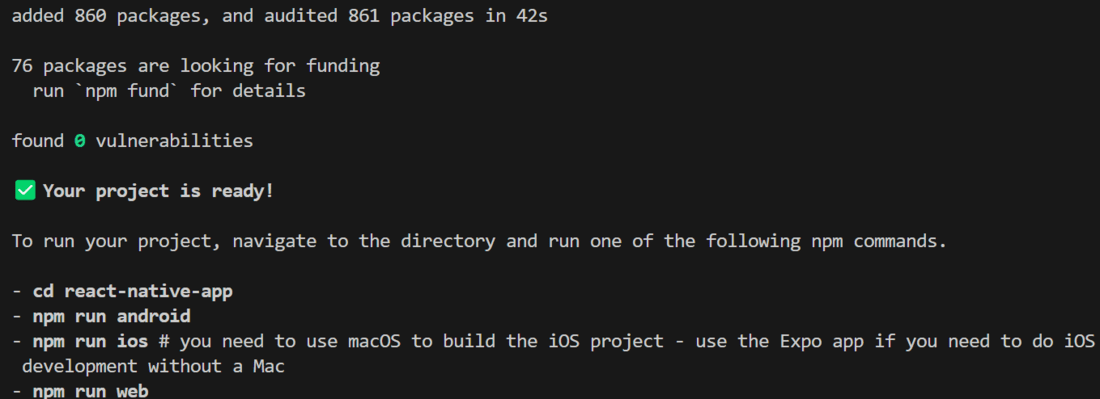
It completes the project creation and displays a message: "Your Project is ready!" as shown in the image below.
Now go into your project folder, i.e., react-native-demo
cd app-nameStart the server by using the following command.
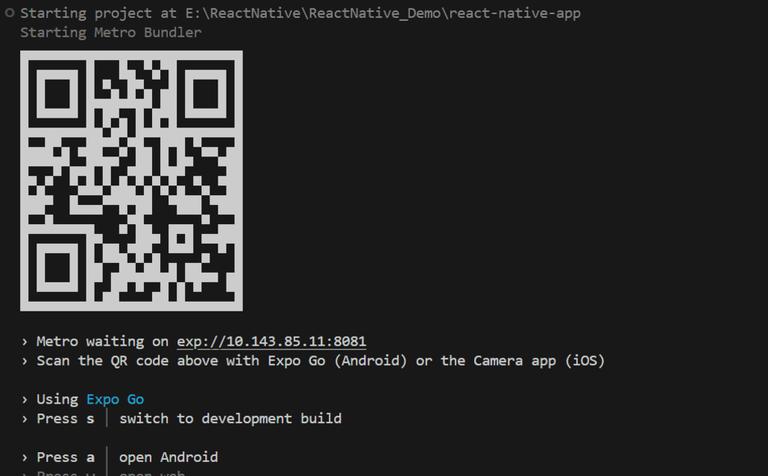
npx expo startThen, the application will display a QR code.
1. For the Android users,
2. For iOS users, simply scan the QR code using the Camera app.
3. If you're using a web browser, it will provide a local host link that you can use as mentioned in the image below.
Below is the implementation of the code. In the App.js file, we simply create a button using the <Button> tag. We will also set its color using a color attribute.
- Import libraries: Import required libraries at the top of the file.
- StyleSheet: Create a StyleSheet to style components like the header and setMargin.
- Buttons: This Button component is used to call an alert function when the user taps on it.
- Text: This is used to display text data in the app.
- alert function: This function is used to display an alert dialog box which contains a Title and message with two buttons.
- App Component: Wrap the Buttons and Texts with a View and return that inside the App function to render, also make sure to export the App.
App.js:
Output: