|
VOOZH | about |
|
VOOZH | about |
The Drawer Navigation component provides a side-menu based navigation system that allows users to access different screens by swiping from the edge or tapping a menu icon. It is commonly used to organize app sections in a clean and space-efficient layout.
Syntax:
const Drawer = createDrawerNavigator();
<Drawer.Navigator>
 <Drawer.Screen />
 <Drawer.Screen />
</Drawer.Navigator>
These props are used to control the appearance, behavior, and navigation flow of the Drawer Navigation component.
These methods are used to programmatically control the opening and closing of the Drawer Navigation.
Drawer navigation is a popular way to organize navigation in apps. It involves sliding in a drawer from the side to display a list of screens or options.
It involves setting up a drawer navigator to enable side-menu based navigation between different screens in a React Native app.
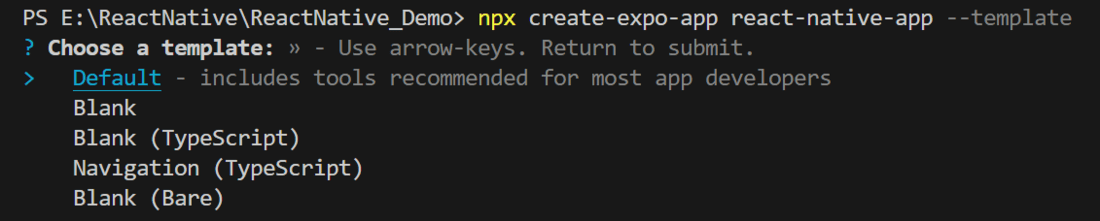
Now, create a project with the following command.
npx create-expo-app app-name --templateNote: Replace the app-name with your app name for example : react-native-demo-app
Next, you might be asked to choose a template. Select one based on your preference as shown in the image below. I am selecting the blank template because it will generate a minimal app, as clean as an empty canvas in JavaScript.
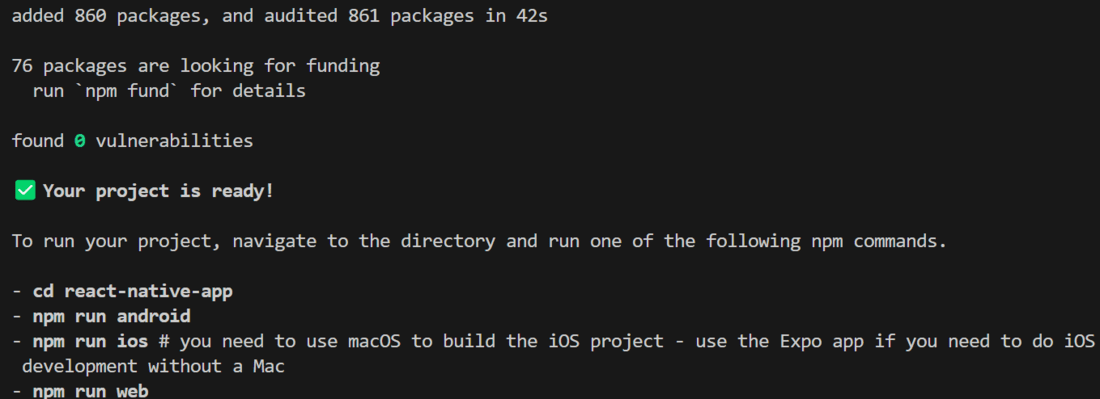
It completes the project creation and displays a message: "Your Project is ready!" as shown in the image below.
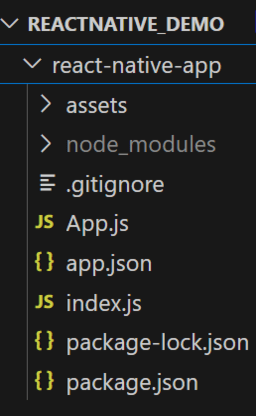
Now go into your project folder, i.e., react-native-demo
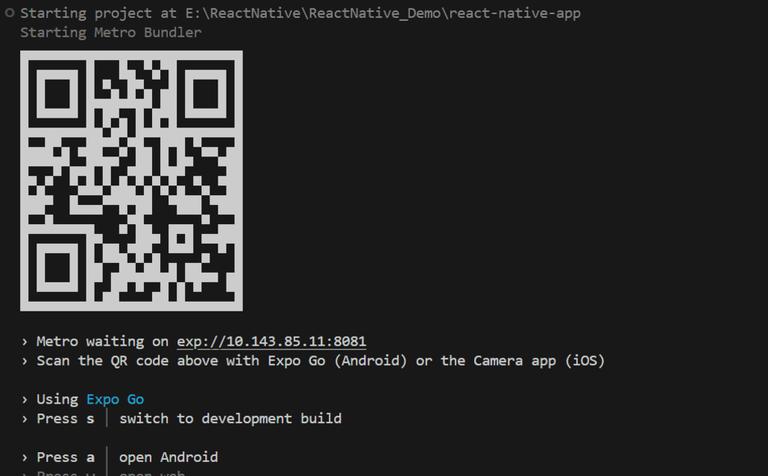
cd app-nameStart the server by using the following command.
npx expo startThis will launch the Expo DevTools and display a QR code in the terminal and browser.
How to run the app:
Now let's implement Drawer Navigation in App.js file.
Output: