 |
VOOZH | about |
|
VOOZH | about |
A biome is a region in a world with distinct geographical features, plants, mobs, temperatures, humidity levels, colors, and more. Biomes separate every generated world into different environments, such as forests, deserts, and oceans.
The biome of a location is determined during world generation rather than by the current environment, even if all blocks in a large area are altered to imitate the terrain of other biomes.
Existing biomes can be located with the /locate biome command. The /fillbiome command in Java Edition, or the "Biome Data Assignment" tool in Bedrock Editor can be used to change the biome in a selected area.
In Java Edition, there are 66 different biome types: 55 for the Overworld, 5 for the Nether, and 5 for the End, plus one used only for a superflat preset. In Bedrock Edition, there are 88 biome types: 55 for the Overworld, 5 for the Nether, 1 for the End, and 27 unused.
On this page, for convenience of description and reading, the biomes in Overworld are divided into 8 categories, which are not official.
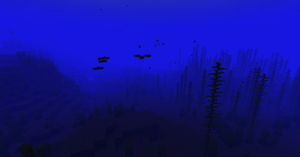
These biomes are used for the generation of oceans and mushroom fields. They are large, open biomes made almost entirely of water going up to Y=63, with underwater relief on the sea floor, such as small mountains and plains, usually including gravel, dirt, and sand. Squid, fish and nautilus spawn frequently in the water, and dolphins spawn in non-frozen oceans. Regular hostile mobs can spawn at rare dry grounds, while drowned and sometimes zombie nautilus jockeys spawn underwater. Shipwrecks and underwater ruined portals are found in all ocean biomes, and ocean ruins may spawn with stone bricks in regular and colder oceans, or sandstone in lukewarm oceans.
| Biome name | Description | Screenshot |
|---|---|---|
| Ocean |
The basic ocean biome, a vast body of water with occasional grassy islands. Like its colder variants, its floor is largely made up of gravel, covered with kelp and seagrass. However, small patches of dirt, sand and clay can also appear. Cod and salmon[BE only] can spawn here alongside dolphins, squid, and nautiluses. |
👁 Image |
| Deep ocean |
In deep ocean biomes, the ocean can exceed 30 blocks in depth, making it twice as deep as the normal ocean. The ground is mainly covered with gravel and kelp can grow much higher. Ocean monuments generate in deep oceans, where guardians, elder guardians, prismarine, and sponges can be found. |
👁 Image |
| Warm ocean |
A variant of the ocean biome with light teal water at the surface. Like the lukewarm ocean, it has a floor made of sand and like all oceans, it is populated with seagrass, but without kelp. Pufferfish and tropical fish spawn here alongside dolphins, squid, and nautiluses, while cod and salmon do not spawn. Unlike other ocean biomes, warm oceans allow for the generation of coral reefs and sea pickles. It is the only ocean biome that does not have a deep equivalent, but the terrain in this biome can reach the same depth as deep oceans. |
👁 Image |
| Lukewarm ocean |
A variant of the ocean biome, with light blue water at the surface. Its floor is made of sand with an occasional patch of dirt or clay. Kelp and seagrass generates here. Unlike the warm ocean biome, cod and salmon[BE only] can spawn here, together with pufferfish[JE only] and tropical fish. Dolphins, squid, and nautiluses may also spawn. |
👁 Image |
| Deep lukewarm ocean |
Similar to the lukewarm ocean biome, but twice as deep. Because they are a deep ocean variant, they can generate ocean monuments. |
👁 Image |
| Cold ocean |
A variant of the ocean biome, with dark blue water at the surface. Like regular oceans and frozen oceans, its floor is made up of gravel, though occasional patches of dirt can be found. Kelp and seagrass generates here. Salmon, cod and nautiluses can spawn in cold ocean biomes alongside squid and dolphins.[BE only] |
👁 Image |
| Deep cold ocean |
Similar to the cold ocean biome, but twice as deep. Like other deep oceans, ocean monuments can generate here. |
👁 Image |
| Frozen ocean |
A variant of the ocean biome with dark indigo water at the surface. Like the cold ocean, it has a gravel seabed and squid swimming about. However, the water's surface is frequently broken up by patches of ice and large icebergs, consisting of packed ice and blue ice, and occasionally topped with snow blocks and snow.[BE only] Strays, polar bears, rabbits,[BE only] and nautiluses can spawn here, but dolphins can't. Salmon and cod[BE only] may also spawn here. |
👁 Image |
| Deep frozen ocean |
Like the frozen ocean biome, but twice as deep. There are no patches of ice on the surface or low enough temperatures for snowfall, instead icebergs are floating standalone in the dark indigo water. Ocean monuments can generate here. |
👁 Image |
| Mushroom fields |
This rare biome consists of a mostly flat island and has mycelium as its surface. Mushroom fields are always adjacent to a deep ocean and isolated from other biomes, ranging in size from only tens of blocks to thousands. It is one of the few biomes where huge mushrooms can generate naturally, and where mushrooms can grow in full sunlight. No mobs other than mooshrooms, bats,[JE only] and glow squid spawn naturally in this biome, including the usual night-time hostile mobs. This also applies to caves, mineshafts and other dark structures, meaning exploring underground is safe. However, mobs can still spawn through other means than the regular spawn cycle, such as monster spawners and wandering traders. Phantoms cannot spawn in Bedrock Edition. |
👁 Image |
Highland biomes are biomes with a higher Y-level. Rugged terrain and snow-covered peaks appear above the snow line.
| Biome name | Description | Screenshot |
|---|---|---|
| Jagged peaks |
One of the three biomes that only generate in the peaks of a mountain. This biome is found in taller and more jagged and pointy peaks that often pass the clouds and can peak at Y=256. It is covered by a single layer of snow blocks with stone underneath often exposing ores such as coal, iron and emerald. Just like the snowy slopes, stone cliffs can generate in some sides of the mountain. Goats spawn in this biome. Polar bears and rabbits may also spawn here and strays appear at night or during thunderstorms.[BE only] Pillager outposts can generate here with tall foundations. |
👁 Image |
| Frozen peaks |
Similar to the jagged peaks, but the snow block cover is varied with packed ice and occasional small blobs of ice. Like jagged peaks, mobs that spawn here include goats, polar bears, rabbits, and strays.[BE only] This biome usually generates in smoother and less jagged mountains compared to the jagged peaks biome. Pillager outposts can generate here. |
👁 Image |
| Stony peaks |
The stony peaks are a warmer variation of peak biomes that generate in warmer regions, without snowfall. It is mainly covered by stone with large strips of calcite and exposed ores. No passive mobs spawn here, and pillager outposts can generate. |
👁 Image |
| Meadow |
The meadow is an elevated grassy biome found in plateaus near mountain ranges. It is filled with patches of almost every type of flower and turquoise-green short grass and tall grass. Rarely, a lone oak or birch tree can generate and always has a bee nest. Sheep, donkeys and rabbits are the only passive mobs that spawn in this biome. Pillager outposts and plains villages commonly generate here. |
👁 Image |
| Cherry grove |
Cherry groves are grassland plateaus with a lot of short grass, tall grass and, instead of the traditional dandelion and poppy flowers, the ground is covered with pink petals. The main environmental feature of the cherry grove are cherry trees identified by their striking pink color and leaf particles filling the atmosphere. The cherry trees may generate densely enough to create a cover of leaves. Sheep, pigs and rabbits are the only passive mobs that spawn in this biome. |
👁 Image |
| Grove |
The grove creates a forest of spruce trees beneath the colder mountain peaks when near a forested biome. It is quite reminiscent of the snowy taiga, but the surface is covered with snow blocks and patches of powder snow instead of grass blocks. Rabbits, wolves and foxes can spawn in this biome. |
👁 Image |
| Snowy slopes |
The snowy slopes generate beneath the colder mountain peaks and are covered with multiple layers of snow blocks and powder snow, with some sides also having stone cliffs. Goats spawn in this biome alongside rabbits and polar bears.[BE only] Strays may also spawn here at night and during thunderstorms.[BE only] This is the only mountain biome where igloos can generate. |
👁 Image |
| Windswept hills |
A highland biome with some steep hilltops and an occasional oak or spruce tree in Java Edition. The terrain is usually flat, but sometimes hilly and shattered. This is one of the few biomes where llamas can spawn naturally. Snowfall also occurs above certain heights, rarely creating snow layers on the top of the hills. Windswept hills are one of six biomes where emerald ore and infested stone can be found naturally. Cold animal variants may also spawn here. |
👁 Image |
| Windswept gravelly hills | A variant of the windswept hills mostly[JE only] or almost entirely[BE only] covered in gravel with occasional patches of grass and stone blocks. In Java Edition, spruce and oak trees can generate here but due to the low amount of grass, the population is sparse. Cold animal variants and llamas may spawn on the rare grass blocks. | 👁 Image |
| Windswept forest |
This variant is found when windswept hills are located next to forested biomes. It does not generate stone patches, so the floor is entirely covered by grass blocks, and there are more spruce and oak trees, forming small forests with a lower tree density than other forest biomes. Cold animal variants and llamas may spawn here. |
👁 Image |
Woodland biomes are rich in plants with a variety of trees, flowers and grasses.
| Biome name | Description | Screenshot |
|---|---|---|
| Forest |
A common biome with many oak and birch trees and a fair amount of short grass, mushrooms and flowers. The ground beneath the trees is covered with leaf litter. Wolves can spawn in this biome. |
👁 Image |
| Flower forest |
This forest variant has fewer trees but contains nearly every type of flower and tall plant in the game. Wolves do not spawn in the flower forest, although rabbits spawn occasionally. Bee nests have a higher chance to generate in this biome. |
👁 Image |
| Taiga |
A biome covered by a forest of spruce trees. Ferns, large ferns and sweet berry bushes grow commonly on the forest floor. One can find packs of wolves here, along with small groups of foxes, rabbits or cold animal variants. Pillager outposts, taiga villages, and trail ruins can generate here. |
👁 Image |
| Old growth pine taiga |
A biome composed of spruce trees, much like the standard taiga biome. However, many trees are 2×2 thick and taller than normal, with few leaves at the top resembling pines. Mossy cobblestone boulders appear frequently, mushrooms are common, and podzol can be found on the forest floor. There are also patches of coarse dirt that do not grow grass, with some dead bushes. Wolves, foxes and cold animal variants can spawn here, as they do in normal taiga biomes. Rabbits may also spawn here.[JE only] |
👁 Image |
| Old growth spruce taiga |
At first glance, this biome may look almost exactly the same as its pine tree counterpart. However, the most striking feature of this biome is its giant spruce trees, which are almost entirely covered with leaves unlike the trees in the old growth pine taiga which only have leaves at the top. Like the old growth pine taiga, wolves, foxes, cold animal variants, and rabbits[JE only] spawn here. Trail ruins can generate here. |
👁 Image |
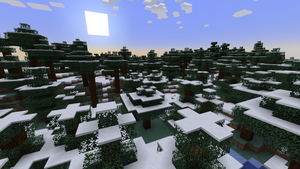
| Snowy taiga |
A hybrid of the normal taiga and the snowy plains. Ferns and large ferns generate commonly, however sweet berry bushes generate more rarely than in the normal taiga. In Bedrock Edition, taiga villages with snowy villagers and pillager outposts can generate here. Wolves, foxes, rabbits and cold animal variants can spawn here. One may also find an igloo nestled between the trees. |
👁 Image |
| Birch forest |
A forest that is solely made of birch trees. The grass has an aqua color, and unlike the regular forest, no wolves spawn in this biome. Wildflowers cover the ground and give the biome a slight yellow tint. |
👁 Image |
| Old growth birch forest |
Birch trees grow much taller than usual in this variant of the birch forest biome. Whereas normal birch trees grow up to 7 blocks tall, these trees can grow up to 13 blocks in height. It is one of the few biomes where trail ruins can generate. |
👁 Image |
| Dark forest |
This biome is mainly composed of dark oak trees, which create a mostly closed roof of leaves. Oak trees, birch trees, and huge mushrooms can also be found occasionally, and the ground is covered with leaf litter. Trees in this forest are so densely packed that areas are dark enough for hostile mobs to spawn, even during the day. Woodland mansions can generate here. |
👁 Image |
| Pale garden |
A rarer variation of the dark forest biome found on higher grounds, where the dark oak trees are replaced with pale oak trees, with lots of pale hanging moss. Patches of pale moss blocks and pale moss carpets cover much of the ground, and eyeblossoms dot the landscape. The sky, foliage, and water in this biome are gray and desaturated, and no music plays inside the biome. Gray fog with Vibrant Visuals is extremely dense and obstructs almost all view. Some of the pale oak trees may have a creaking heart hidden within them, which spawns a creaking at night. Like dark forests, hostile mobs can spawn even at day under the dark trees and woodland mansions generate here. |
👁 Image |
| Jungle |
A dense forested biome that includes many different plants and features. Jungle trees and mega jungle trees are common, with the mega trees having 2×2 thick trunks and possibly growing up to 31 blocks in height. Fancy oak trees are also common, and jungle bushes often cover much of the forest floor. Ferns and large ferns are found commonly, and vines are found growing and hanging on most types of blocks. Additionally, cocoa can also grow on the sides of jungle trees. Melons can generate here in patches, similar to pumpkins, although they are much more common. Single shoots of bamboo can be found scattered throughout the biome. The foliage in the jungle is a bright, lush green color. Ocelots, parrots, pandas, and warm animal variants can spawn in this biome. Jungle pyramids and trail ruins generate here. |
👁 Image |
| Sparse jungle |
In contrast to the wild and overgrown vegetation of the jungle biome, the sparse jungle consists of small jungle and oak trees, and jungle bushes that are spaced out and isolated, creating a much more open environment. Parrots, ocelots, and pandas can still spawn in the sparse jungle.[Bedrock Edition only] Wolves can also spawn in this biome along with warm animal variants. |
👁 Image |
| Bamboo jungle |
In this jungle biome, large areas of the landscape are covered with massive amounts of bamboo. The ground consist of podzol underneath the densely packed bamboo. Additionally, mega jungle trees, fancy oak trees, and jungle bushes can also generate here. Pandas have a much higher chance to spawn here than the other jungle biomes, making this the best place to find them. Ocelots,[BE only] parrots, and warm animal variants are also able to spawn. Jungle pyramids can generate here.[JE only] |
👁 Image |
| Dappled forest[upcoming: Third Drop 2026] |
A forest vegetated by poplar trees on an orange-brown grass tint with red shrubs. The biome also has various mushrooms, fallen trees, and coarse dirt. Foxes and rabbits spawn here alongside cold animals. |
👁 Image |
Wetland biomes are rivers, swamps and beaches. They have a large amount of water resources. Rivers separate other biomes; beaches generate as a transition between the ocean and land.
| Biome name | Description | Screenshot |
|---|---|---|
| River |
A biome that consists of water blocks that form an elongated, curving shape. Rivers cut through terrain or separate the main biomes. They attempt to join up with ocean biomes, but sometimes loop around to the same area of ocean. Rarely, they can have no connection to an ocean, instead forming a loop, or ending in a swamp or far inland. On the landside, or rare occasions where rivers generate entirely dry, the grass has a dull aqua tone, and trace amounts of oak trees and firefly bushes tend to generate there. Rivers are also a reliable source of clay and sand. Drowned, squid, cod, and salmon spawn underwater. In Bedrock Edition, no other mobs can spawn through the spawn cycle, even common hostile mobs. |
👁 Image |
| Frozen river |
A river with a layer of ice covering its surface, generating when a river goes through snowy biomes. Salmon spawn underwater while rabbits[BE only] and polar bears[BE only] spawn on the surface. At night and during thunderstorms, drowned can spawn below the ice with strays[BE only] and skeletons on the surface. In Bedrock Edition, no other hostile mobs can spawn here. |
👁 Image |
| Swamp |
A biome characterized by a mix of flat areas around sea level, and shallow pools of green water with floating lily pads. Clay, sand, and dirt are commonly found at the bottom of these pools. Oak trees are covered with vines and can be found growing out from the water, and in Bedrock Edition, huge mushrooms also generate. Mushrooms, firefly bushes, dead bushes, and sugar canes are abundant, and blue orchids grow exclusively here. Frogs of the temperate variant can spawn here as well. Swamp huts with a black cat and a witch generate exclusively in swamps, and fossils are rarely found underground. Slimes also spawn naturally at night and during thunderstorms, most commonly on full moons, and some skeletons are replaced by bogged. Green volumetric fog and underwater fog is much denser than in other biomes. |
👁 Image |
| Mangrove swamp |
A warmer variant of the swamp, characterized by a dense foliage, featuring plenty of mangrove trees of varying heights. The floor is mainly composed of mud blocks with occasional grass patches. The grass has the same color as in the normal swamp but leaves and vines have a unique light green tint and the water is teal rather than gray. Warm frogs often spawn in this biome. Slimes also spawn naturally at night and during thunderstorms, most commonly on full moons, and some skeletons are replaced by bogged. Fossils generate underground, but swamp huts do not. |
👁 Image |
| Beach |
Generated where oceans meet land biomes, beaches are primarily composed of sand. Buried treasures can be found under few blocks of sand, and an occasional shipwreck can also generate here. Passive mobs other than turtles do not spawn on beaches. |
👁 Image |
| Snowy beach |
Like a regular beach, one can find plenty of sand in this biome and buried treasures can be found underground in this snowy beach. However, sand is covered in a layer of snow. Snowy beaches are found when a snowy biome borders a frozen ocean biome. No passive mobs other than rabbits[BE only] spawn in this biome, and shipwrecks occasionally generate on land. |
👁 Image |
| Stony shore |
This stone-covered biome generates at shores with low erosion values, usually close to mountains. Depending on the height of the nearby land, stony shores may generate as medium slopes or huge cliffs, its tops tall enough to be covered by snow even when near warmer biomes.[1] No passive mobs spawn here. Buried treasures can generate here.[BE only] Strips of gravel can sometimes be found here. |
👁 Image |
These biomes have a wide view because less trees spawn here and the terrain usually does not contain mountains or cliffs, although hills and plateaus are common. They also have a higher number of passive mob spawns.
| Biome name | Description | Screenshot |
|---|---|---|
| Plains |
A grassy biome with rolling hills and few oak trees, as well as many flowers and grasses. Villages and pillager outposts are common. Cave openings, lava lakes and waterfalls are easily identifiable due to the unobstructed terrain. Passive mobs are easily found in plains biomes; this biome is also one of the few biomes where horses and donkeys spawn naturally. Hostile zombie horses spawn rarely at night as zombie horsemen. |
👁 Image |
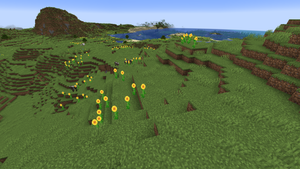
| Sunflower plains |
A fairly uncommon variation of the plains, this biome is the only place where sunflowers naturally generate. In Bedrock Edition, plains villages and pillager outposts can generate here. |
👁 Image |
| Snowy plains |
A variant of plains entirely covered with snow, and freezing water. There are few spruce trees in this biome, and less grass and flowers generate compared to regular plains. No animal mobs other than rabbits and polar bears can spawn; however, it is one of the few biomes where strays and zombie horsemen spawn at night. In Bedrock Edition, this biome does not spawn any other monsters except skeletons, strays, and zombie horsemen. Snowy villages, pillager outposts, and igloos can generate here. |
👁 Image |
| Ice spikes |
A rare variation of the snowy plains biome that features large spikes and glaciers of packed ice. Usually, the spikes are 10 to 20 blocks tall, but some long, thin spikes can reach over 50 blocks in height. The floor in this biome is entirely covered in snow blocks instead of grass, and ice patches made of packed ice can generate on it. Like the regular snowy plains, no animal mobs other than rabbits and polar bears can spawn and strays appear at night or during thunderstorms. |
👁 Image |
In these biomes, it neither rains nor snows. The surface is covered with sparse vegetation.
| Biome name | Description | Screenshot |
|---|---|---|
| Desert |
A barren biome consisting mostly of sand dunes, dead bushes, dry grass, and cacti. Sandstone and sometimes fossils are found underneath the sand. The only passive mobs that spawn naturally in deserts are gold/creamy rabbits and camels. At night and during dry thunderstorms, husks, parched, and camel husk jockeys usually spawn in the place of normal zombies and skeletons. The biome is rich in structures, including desert villages, desert wells, desert pyramids, and pillager outposts. |
👁 Image |
| Savanna |
A relatively flat and dry biome with a dull-brown grass color and acacia trees scattered around the biome, though oak trees may generate occasionally. Tall grass covers the landscape. Savanna villages can generate in this biome, constructed of acacia wood, and pillager outposts also generate. Horses, armadillos and warm animal variants can naturally spawn here, and it is one of the only biomes with rare zombie horsemen. Llamas may also spawn here.[BE only] |
👁 Image |
| Savanna plateau |
This biome generates when a normal savanna biome spawns at high altitudes and near mountains. It is mostly indistinguishable from the standard savanna, with the main differences being the fact that llamas and wolves can spawn. Villages and pillager outpost do not generate. |
👁 Image |
| Windswept Savanna |
In contrast to the mostly flat and calm terrain of the savanna biome, this uncommon variant generates chaotic terrain, with gigantic mountains covered in coarse dirt and some patches of stone. The mountains in the windswept savanna are extremely steep, sometimes jutting out at 90-degree angles and there are floating islands and overhangs. On top of that, they can reach heights comparable to the mountain peak biomes, sometimes rising above the clouds. Massive waterfalls and lavafalls are quite common, and lakes can also generate. Horses, armadillos and warm animal variants can still spawn in the windswept savanna, as well as zombie horsemen and llamas.[BE only] |
👁 Image |
| Badlands |
An uncommon mountainous and desertic biome composed of layers of terracotta and stained terracotta on higher grounds. Red sand covers this in valleys, with occasional cacti, dead bushes, and dry grass. Armadillos are the only mobs that can be found here. Mineshafts generate at a higher altitude than normal, allowing them to be exposed to the surface, and have dark oak planks instead of oak planks. Gold ore also generates more frequently. |
👁 Image |
| Wooded badlands |
On higher altitudes, the wooded badlands have layers of coarse dirt and grass blocks, and forests of small oak trees with leaf litter. The lower parts don't generate the oak forests, exposing terracotta and red sand to the sky. The color of the grass and leaves is a dull green-brown hue, giving it a dried and dead appearance. Armadillos can spawn here during the day, and wolves and warm animal variants can spawn on the wooded plateaus. |
👁 Image |
| Eroded badlands |
This rare variant generates unique terrain features that are similar to the structures in Utah's Bryce Canyon. Tall and narrow spires of colorful terracotta rise out of the floor of the canyon, which like all other badlands variants, is covered in red sand. Armadillos are the only passive mobs that can be found here. |
👁 Image |
These biomes generate inside caves in the Overworld. They are mostly found underground but can sometimes leak out of cave entrances.
| Biome name | Description | Screenshot |
|---|---|---|
| Deep dark |
A dimly lit cave biome that generates deep underground mostly within the deepslate layer under mountains. It is largely sculk blocks 1 block thick upon all surfaces, with frequent sculk sensors and occasional sculk shriekers, the latter of which can directly summon a warden. Large structures known as ancient cities can generate here, containing chests with unique loot. No mobs spawn here from the natural spawn cycle. |
👁 Image |
| Dripstone caves |
These are caves filled with dripstone blocks and pointed dripstone both hanging as stalactites and growing from the ground as stalagmites and small water wells of 1×1 in the ground. Large dripstone clusters structures generate occasionally inside these caves. Copper ore blobs found in this biome are much bigger compared to other biomes. Drowned and rarely zombie nautiluses can spawn in aquifers. |
👁 Image |
| Lush caves |
Lush caves are often found underground below azalea trees. These caves are covered by moss blocks, moss carpets, short grass and azalea bushes on the floors. On the ceiling, vines and cave vines with glow berries grow down and light up the caves, and spore blossoms grow and spore particles. There are also shallow lakes with clay where dripleaf plants grow out of them and axolotls spawn, making this the only biome where they can spawn. Tropical fish can also spawn inside the aquifers in a lush cave. |
👁 Image |
| Sulfur caves |
A biome composed of sulfur and cinnabar blocks, sulfur spikes, as well as potent sulfur in water pools that inflicts the Nausea effect. Sulfur cubes can spawn here. Cave spiders can spawn making it the only biome where they can spawn naturally. Sulfur springs generate at the surface, indicating there are sulfur caves below. |
👁 Image |
| Biome name | Description | Screenshot |
|---|---|---|
| The Void[Java Edition only] |
Can be accessed only through Single Biome world selection or The Void superflat preset. In a single biome world, the landscape consists of stone, as well as water and bedrock depending on the generator type. In the superflat preset, the world is completely empty except for a stone start platform. No mobs from the regular spawn cycle spawn here, and it does not rain. |
👁 Image |
The Nether is considered a different dimension. All biomes in this dimension are hot and dry, and it is not possible to place water; ice can still be placed, though it does not turn into water upon melting. Lava oceans are generated as a feature and are therefore not considered a separate biome.
| Biome name | Description | Screenshot |
|---|---|---|
| Nether wastes |
The Nether wastes is the most common biome in the Nether. The terrain mainly consists of netherrack, with glowstone clusters growing and lava leaking from the ceiling and gravel and soul sand lining its shores. Most of the Nether’s mobs can spawn here, including ghasts, zombified piglins, magma cubes, striders, piglins, and the occasional endermen. |
👁 Image |
| Soul sand valley |
The soul sand valley mainly consists of soul sand, basalt and soul soil. Notable features of the biome are exposed Nether fossils in various shapes and sizes, large amounts of lava, blue fog, large spires made of basalt, soul fire, and the occasional Nether fortress or bastion remnant. Ghasts and skeletons are common in this biome while endermen are rare. Striders can spawn here as well. This is the only place to find dried ghasts naturally. |
👁 Image |
| Crimson forest |
The crimson forest consists of many huge crimson fungi, which act as the "trees" of this biome. The huge fungi often generate with weeping vines hanging from them, and shroomlights which light up the landscape. The floor is mostly covered with crimson nylium, with occasional patches of bare netherrack or Nether wart blocks. Crimson roots, crimson fungus, and occasionally warped fungus grow on the ground. Small patches of Nether wart blocks and weeping vines can also be found growing on the ceiling. Hoglins, piglins, zombified piglins, and striders can spawn in this biome. |
👁 Image |
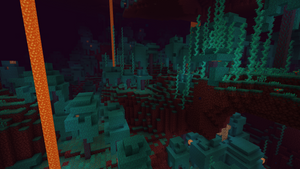
| Warped forest |
The warped forest consists of many huge warped fungi, which act as the "trees" of this biome. The huge fungi often generate with shroomlights, which light up the landscape. Twisting vines grow throughout the biome in patches. The floor is mostly covered with warped nylium, with occasional patches of bare netherrack or warped wart blocks. Warped roots, warped fungus, Nether sprouts, and occasionally crimson fungus grow on the ground. Endermen and striders are the only mobs that spawn in this biome. The biome emits out a magenta-purple fog upon entry. |
👁 Image |
| Basalt deltas |
A gray biome, the basalt deltas are said to be the remnant of ancient volcanic eruptions.[citation needed] The ground consists of basalt and blackstone blocks, with small patches of netherrack and pools of lava. The shape of the terrain is chaotic and uneven, making it somewhat difficult to traverse and build on. Unlike the other biomes in the Nether, bastion remnants do not generate in basalt deltas. When this biome borders a lava ocean, clusters of basalt form near the coast. Fog is colored light-gray and particles of dust can be seen falling from the ceiling upon entry. Magma cubes have a high spawn rate in this biome, making the basalt deltas the best place to farm magma cream. This biome also contains a much higher abundance of blackstone compared to other Nether biomes. Ghasts and striders can spawn in this biome as well. |
👁 Image |
The End is considered a different dimension. The terrain consists of end stone islands of varying sizes, floating in the void. They use five different biomes in Java Edition, or all use the End in Bedrock Edition, with no terrain differences.
| Biome name | Description | Screenshot |
|---|---|---|
| The End |
This biome is used to generate the circle of radius 1000 centered at the 0,0 coordinates in the End. The End central island is generated at the center of this circle, and it's surrounded by a complete vacuum all the way to the edge of the biome. Most of the End features are exclusive to that island, including the ender dragon, the obsidian pillars, the End crystals, the 5×5 spawn platform, the exit portal and the 20 central End gateways. Large amounts of endermen spawn in this biome. It does not rain or snow in this biome unlike the other low-temperature biomes. The outer islands in the End can be accessed using End gateways after the ender dragon has been defeated. In Bedrock Edition, this biome is instead the biggest, as it is used to generate the whole dimension. If the biome is used for a superflat world, the sky appears nearly black and an ender dragon spawns at the 0,0 coordinates in the Overworld. Only endermen spawn at night. |
👁 Image |
| Small End islands[JE only] |
Generates as part of the outer islands of the End. This biome represents the empty expanse between the larger islands, populated by the smaller, circular islands. Large amounts of endermen spawn in this biome. |
👁 Image |
| End midlands[JE only] |
Generates as part of the outer islands of the End. This biome represents the gradual slope from the hilltops of each island down to the cliffs around the edge. End cities generate here, but chorus trees do not. Large amounts of endermen spawn in this biome. |
👁 Image |
| End highlands[JE only] |
Generates as part of the outer islands of the End. This biome represents the hilltops of each island, and is the only biome in the End where both chorus trees and End cities generate. Large amounts of endermen spawn in this biome. |
👁 Image |
| End barrens[JE only] |
Generates as part of the outer islands of the End. This biome represents the outer rims of each island, with steep cliffs below the edge. Neither End cities nor chorus trees generate in this biome. Large amounts of endermen spawn in this biome. |
👁 Image |
Many biomes, made redundant via Caves & Cliffs world generation changes, still exist in Bedrock Edition but have been removed from Java Edition, and are documented on the page linked above.
These biomes can appear only in April Fools snapshots of the game.
| Biome name | Description | Screenshot |
|---|---|---|
_generated:id
|
_generated:id is the resource location of the generated biome. Its namespace is _generated and its name is the biome's numeric ID.
This "biome" includes all the other non-custom dimensions biomes. All mobs, blocks, particles and structures in 20w13b (vanilla) can generate in this biome. A dimension can have multiple of these randomly generated biomes. |
👁 Image |
| Between | Grid of End ships. Generates in the fleet dimension as well as some other random ones. There is no elytra as loot, but dragon heads still generate. Chests generate, but contain only a book titled "orders" written by a mess of changing letters. The contents have at least one word, usually an order (eg: build), a mess of constantly changing letters with varying lengths and another word(s) (eg: Lost Floppy).
|
👁 Image |
| Biome For Player With No Time For Nonsense | Generates as a normal snowy taiga, but all ores are mineral blocks or redstone components. | 👁 Image |
| Shapes | Generates spheres, cubes, octahedra etc. of various colors of terracotta, glazed terracotta, concrete, concrete powder, wool, carpets, stained glass and stained glass panes. | 👁 Image |
| Biome name | Description | Screenshot |
|---|---|---|
| The Moon | Generates flat terrain with craters made of blocks of cheese, which can be "eaten" to change their shape. The only mob that spawns here is the moon cow. There is also the Lunar Base that can be expanded by stepping on the pressure plate, the only feature in the moon. | 👁 Image |
| Biome name | Description | Screenshot |
|---|---|---|
| Arboretum | A forested biome, with every type of tree that exists in 24w12a, along with huge mushrooms and potato trees. Non-uniform foliage color distinguishes this biome from other forest-type biomes. | 👁 Image |
| Corruption | A forested biome, covered in potato trees of various sizes, as well as potato buds, that grow upward like stalagmites. Phantoms here spawn naturally during the day and they don't burn. | 👁 Image |
| Fields | A flat and open biome. Much of the surface is covered with poison farmland, and potatoes grow on top of it. | 👁 Image |
| Hash | A dry biome, with almost no vegetation. Only biome where gravtater and vicious potatoes occur naturally. Hash wells and fossils generate here. | 👁 Image |
| Wasteland | A desolate and dangerous biome. Water and rain applies the Poison effect to players and mobs. Toxifin slabs spawn in large numbers, causing more Poison and Wither. Ancient debris is common in this biome. | 👁 Image |
| Biome name | Description | Screenshot |
|---|---|---|
| Hub | A biome consisting of a "+"-shaped room with a mine crafter in the center, with shimmering doors on opposite sides, which lead to additional rooms once unlocked. On the third side lies the entrance to the memory lane, a long corridor lined with mine revisitors. All the rooms are surrounded in sky blocks. | 👁 Image |
All biomes use a set of colors for various environmental aspects such as the sky, water, fog, and some blocks. In Bedrock Edition, biomes specify their colors in the client_biome JSON files in the vanilla resource packs. Some biomes specify their colors directly, while others use colormaps or separate JSON files which can also control other environmental effects.
In Bedrock Edition, all biome colors for blocks are also visible on maps.[2]
Biome grass and foliage colors are selected from three 256×256 colormap images: grass.png, foliage.png, and dry_foliage.png under assets/minecraft/textures/colormap[JE only] or textures/colormap[BE only] in the vanilla resource pack. The grass.png colormap sets the colors for grass blocks, short grass, tall grass, ferns, large ferns, ferns in flower pots, sugar canes, bushes and stems of pink petals and wildflowers. Meanwhile, the foliage.png colormap sets the colors for vines and tree leaves of oak, jungle, acacia, dark oak and mangrove. The dry_foliage.png colormap sets the colors for leaf litter. Only the colors in the lower-left halfs of the images are used, even though the upper-right side of foliage.png and dry_foliage.png is colored.
The base temperature and downfall values are used when determining the biome color to select from the colormap. Treating the bottom-right corner of the colormap as 0 for both values, the temperature increases to 1.0 along the X-axis, and the downfall increases to 1.0 along the Y-axis. When a biome's temperature or downfall extends past the lower-left half, it will use the color on the closest edge of the image.
In the following cases, the plants are not tinted exactly according to the default colormap.
Swamps
In swamps and mangrove swamps, the grass color is based on a noise on the XZ plane. When the value of this noise is less than -0.1, it uses the color
#4c763c, otherwise using
#6a7039. The foliage color is
#6a7039 in swamps and
#8db127 in mangrove swamps. The dry foliage color in swamps and mangrove swamps is
#7b5334.
In Bedrock Edition, all swamp biomes use colormaps to determine these colors, similar to regular colormaps described above.
Dark forest
In dark forests, the grass color is the result of the bitwise AND between the color in the colormap and
#fefefe, and then averaging with
#28340a. In vanilla, that is
#507a32.
Badlands
In badlands, wooded badlands and eroded badlands, the grass color is
#90814d and the foliage color and dry foliage color is
#9e814d.
Cherry grove
The color for grass and foliage in cherry groves is always
#b6db61.
Pale garden
In the pale garden, the grass color is
#778272, the foliage color is
#878d76, and the dry foliage color is
#a0a69c.
Sulfur caves
In sulfur caves, the grass color is
#aba64f.
Other leaves
The color for spruce leaves is
#619961 and the color for birch leaves is
#80a755. Both are not affected by the biome, but determined by biome colormaps in Bedrock Edition.
The base color of the daytime sky in Overworld changes according to the basic temperature value of the biome. The basic temperature is first modified as T = clamp( Temperature / 3 , -1.0, 1.0 ). Then the triple (0.62222224-0.05T, 0.5+0.1T, 1) is the sky color.
The color of the sky in the pale garden biome is
#b9b9b9, which is unaffected by the above formula. See § List of biome climates below for all sky colors.
The colors and surface opacity of water are defined in the vanilla data pack[JE only] or client biome JSON files in vanilla resource packs.[BE only] Some biomes in Java Edition, or most biomes in Bedrock Edition have unique water colors. Swamps and warm oceans in Bedrock Edition have unique water surface opacities, 65% and 55% respectively.
The color and density of water and sky fog is different for most biomes, defined by separate JSON files for each biome in Bedrock Edition. The underwater fog color is
#050533 with a few exceptions in Java Edition, or the same as the water surface color with some exceptions in Bedrock Edition. The sky fog color is
#c0d8ff[JE only] or
#abd2ff[BE only] in all Overworld biomes, except pale gardens which use
#817770, and sulfur caves use
#8cb831. Nether biomes and the End have unique fog colors.
Vibrant Visuals ignores default colors for the sky, water, and fog, and adds new effects for each biome or a set of biome. Which environmental settings are used is determined by the biome JSON file, and all environmental settings are stored in separate directories in resource packs. In vanilla, the following effects are affected by the biome:
Water colors are not visible with Vibrant Visuals, but all non-air fog colors still apply asides from the volumetric fog. Vibrant Visuals effects are dynamically blended at biome transitions.
When plants or water are at the borders between or among biomes, the color is affected by the biome of the surrounding blocks at the same Y-level. In Java Edition, the range of the block involved in the calculation can be decreased with the biome blend radius in the options. It takes the plant color or water color of the biomes within a square centered on this block and with the side length being the biome blend radius, and calculates their average value to get the final color for this block.
The sky color and the fog color use the color processed by Gaussian blur from colors of the biomes at each block in the range of 5×5×5 centered on the block the camera is in.
Each biome has a base temperature value (see § List of biome climates), but the actual temperature value at each location in the biome is also affected by the height of the location. Locations with Y≤80 use the base temperature as actual temperature. At Y=81, the actual temperature value randomly fluctuates up and down by -0.00875 — +0.01125 from the base temperature based on a noise on the XZ plane, and at Y≥81 the actual temperature decreases by 0.00125 (1⁄800) every block up.
In frozen oceans and deep frozen oceans, it is also affected by a noise value on the XZ plane. In some regions according to the noise, the base temperature value is always regarded as 0.2. The actual temperature values for these regions are also calculated on this basis. This is detectable in frozen oceans, as its base temperature is low enough to freeze or snow, so that only these regions do not freeze or snow at sea level.
The temperature affects at which height snowfall can occur, the sky and block colors, and whether sponges dry in the air.[BE only]
The downfall value is a number between 0.0 and 1.0 (see § List of biome climates) mainly used for block colors. When the downfall value is greater than 0.85, the biome is marked as humid, which is related only to the random extinction of fire.
Additionally, the downfall controls whether a biome is arid in Bedrock Edition; if it is 0.0, no rain or snow occurs. Otherwise, a location is rainable when its temperature value is equal or greater than 0.15, and snowable otherwise.
In Java Edition, precipitation is separate from downfall, which can be "true" or "false".
If the base temperature is less than 0.15, it's snowable at any Y level. If equal or greater than 0.15, it will still snow above a certain Y level, caused by temperature decrease above Y=81.
| Biomes | Minimum height for snowfall |
|---|---|
| 👁 Image Frozen River 👁 Image |
Any |
| 👁 Image Windswept Hills 👁 Image Windswept Gravelly Hills 👁 Image Windswept Forest 👁 Image Stony Shore[1] 👁 Image Dripstone Caves[BE only][3][note 1] Some regions of 👁 Image Frozen Ocean and 👁 Image Deep Frozen Ocean |
120±8 |
| 👁 Image Old Growth Spruce Taiga 👁 Image Taiga |
160±8 |
| 👁 Image Old Growth Pine Taiga 👁 Image Meadow[BE only] 👁 Image Cherry Grove[BE only] |
200±8 |
| Others | 356±8 (out of world) |
The exact minimum height for snowfall is randomized per block because the temperature slightly shifts, with a margin of up to 8 blocks. In Bedrock Edition, this is a transition layer where both snow and rain particles are visible at the same time. This transition also appears when moving horizontally between snowy and rainy biomes, and the particle density decreases when moving to a dry biome.
The amount of snow layers generated on the surface is based on the snow accumulation value of the biome. The first value calculates how snow is randomly stacked – a value of 0 results in all blocks covered by 1 snow layer; a value of 0.125 results in some areas not being covered by snow, and snow gets stacked when next to a full block; a higher value adds random patches of higher piles which increase in size and height with the value.
During snowfall, snow can stack infinitely on top of generated snow, unlike in Java Edition where this is controlled by a snow accumulation game rule. The second value calculates how quickly snow accumulates during snowfall.
| Biomes | Base temperature | Downfall | Precipitation[JE only] | Snow accumulation[BE only] | Grass color | Foliage color | Dry foliage color | Sky color |
|---|---|---|---|---|---|---|---|---|
| 👁 Image Badlands |
2.0 | 0.0 | FALSE | 0.0-0.125 | #90814d |
#9e814d |
#9e814d |
#6eb1ff |
| 👁 Image Wooded Badlands | ||||||||
| 👁 Image Eroded Badlands | ||||||||
| 👁 Image Desert |
#bfb755 |
#aea42a |
#a38046 | |||||
| 👁 Image Windswept Savanna | ||||||||
| 👁 Image Savanna |
2.0[JE only] 1.2[BE only] |
#6eb1ff[JE only] #75aaff[BE only] | ||||||
| 👁 Image Savanna Plateau |
2.0[JE only] 1.0[BE only] |
#6eb1ff[JE only] #76a8ff[BE only] | ||||||
| 👁 Image Stony Peaks |
1.0 | 0.3 | TRUE | #9abe4b |
#82ac1e |
#927957 |
#76a8ff | |
| 👁 Image Jungle |
0.95 | 0.9 | #59c93c |
#30bb0b |
#a36346 |
#77a8ff | ||
| 👁 Image Bamboo Jungle | ||||||||
| 👁 Image Sparse Jungle |
0.8 | #64c73f |
#3eb80f | |||||
| 👁 Image Mushroom Fields |
0.9 | 1.0 | #55c93f |
#2bbb0f |
#a36246 | |||
| 👁 Image Mangrove Swamp |
0.8 | 0.9 | #6a7039 #4c763c |
#6a7039 |
#7b5334 |
#78a7ff | ||
| 👁 Image Swamp |
0.9[JE only] 0.5[BE only] |
#8db127 | ||||||
| 👁 Image Plains |
0.8 | 0.4 | #91bd59 |
#77ab2f |
#a37546 |
#78a7ff | ||
| 👁 Image Beach | ||||||||
| 👁 Image Sunflower Plains | ||||||||
| 👁 Image Deep Dark | ||||||||
| 👁 Image Sulfur Caves |
#aba64f | |||||||
| 👁 Image Dripstone Caves |
0.8[JE only] 0.2[BE only] |
0.4[JE only] 0.0[BE only] |
#91bd59[JE only] #8db58a[BE only] |
#77ab2f[JE only] #70a26c[BE only] |
#a37546[JE only] #957754[BE only] |
#78a7ff[JE only] #7da2ff[BE only] | ||
| 👁 Image Forest |
0.7 | 0.8 | #79c05a |
#59ae30 |
#a36d46 |
#79a6ff | ||
| 👁 Image Flower Forest | ||||||||
| 👁 Image Dark Forest |
#507a32 |
#7b5334 | ||||||
| 👁 Image Pale Garden |
#778272 |
#878d76 |
#a0a69c |
#b9b9b9 | ||||
| 👁 Image Birch Forest |
0.6 | 0.6 | #88bb67 |
#6ba941 |
#a37246 |
#7aa5ff | ||
| 👁 Image Old Growth Birch Forest | ||||||||
| 👁 Image Dappled Forest[upcoming: Third Drop 2026] |
#df6827 |
#e68e30 |
#8c3a04 |
#7ca3ff | ||||
| 👁 Image Lush Caves |
0.5[JE only] 0.9[BE only] |
0.5[JE only] 0.0[BE only] |
#8eb971[JE only] #b9b75b[BE only] |
#71a74d[JE only] #a6a432[BE only] |
#a17448[JE only] #A37E46[BE only] |
#7ba4ff[JE only] #77a8ff[BE only] | ||
| 👁 Image The Void[JE only] |
0.5 | 0.5 | FALSE | N/A | #8eb971 |
#71a74d |
#a17448 |
#7ba4ff |
| 👁 Image River |
TRUE | 0.0-0.125 | ||||||
| 👁 Image Warm Ocean | ||||||||
| 👁 Image Lukewarm Ocean | ||||||||
| 👁 Image Deep Lukewarm Ocean | ||||||||
| 👁 Image Ocean | ||||||||
| 👁 Image Deep Ocean | ||||||||
| 👁 Image Cold Ocean | ||||||||
| 👁 Image Deep Cold Ocean | ||||||||
| 👁 Image Deep Frozen Ocean | ||||||||
| 👁 Image Cherry Grove |
0.5[JE only] 0.3[BE only] |
0.8 | #b6db61 |
#b6db61 |
#a17148[JE only]
|
#7ba4ff[JE only] #7ca3ff[BE only] | ||
| 👁 Image Meadow |
#83bb6d[JE only] #86b87f[BE only] |
#63a948[JE only] #68a55f[BE only] | ||||||
| 👁 Image Old Growth Pine Taiga |
0.3 | #86b87f |
#68a55f |
#9c754d |
#7ca3ff | |||
| 👁 Image Old Growth Spruce Taiga |
0.25 | #86b783 |
#68a464 |
#9a764f |
#7da3ff | |||
| 👁 Image Taiga | ||||||||
| 👁 Image Windswept Gravelly Hills |
0.2 | 0.3 | #8ab689 |
#6da36b |
#977752 |
#7da2ff | ||
| 👁 Image Windswept Forest | ||||||||
| 👁 Image Windswept Hills |
0.0-0.25 | |||||||
| 👁 Image Stony Shore | ||||||||
| 👁 Image Snowy Beach |
0.05 | 0.125-0.25 | #83b593 |
#64a278 |
#917958 |
#7fa1ff | ||
| 👁 Image Frozen River |
0.0 | 0.5 | #80b497 |
#60a17b |
#8f7a5a |
#7fa1ff | ||
| 👁 Image Frozen Ocean | ||||||||
| 👁 Image Snowy Plains |
0.25-1.0 | |||||||
| 👁 Image Ice Spikes |
0.5[JE only] 1.0[BE only] |
0.5-1.5 | ||||||
| 👁 Image Grove |
-0.2 | 0.8 | 0.125-0.25 | #81a0ff | ||||
| 👁 Image Snowy Slopes |
-0.3 | 0.9 | 0.125-0.5 | #829fff | ||||
| 👁 Image Snowy Taiga |
-0.5 | 0.4 | #839eff | |||||
| 👁 Image Frozen Peaks |
-0.7 | 0.9 | 0.125-0.25 | #859dff | ||||
| 👁 Image Jagged Peaks |
| Biome | Base temperature | Downfall | Precipitation | Grass color | Foliage color | Dry foliage color | Sky color | Water color | Water fog color | Fog color |
|---|---|---|---|---|---|---|---|---|---|---|
| 👁 Image Nether Wastes |
2.0 | 0.0 | FALSE | #bfb755 |
#aea42a |
#a38046 |
#6eb1ff |
#3f76e4[JE only] #905957[BE only] |
#050533[JE only] #905957 15 blocks distance[BE only] |
#330808 |
| 👁 Image Warped Forest |
#1a051a | |||||||||
| 👁 Image Crimson Forest |
#330303 | |||||||||
| 👁 Image Soul Sand Valley |
#1b4745 | |||||||||
| 👁 Image Basalt Deltas |
#3f76e4 |
#050533[JE only] #423e42 15 blocks distance[BE only] |
#685f70 |
| Biome | Base temperature | Downfall | Precipitation | Grass color | Foliage color | Dry foliage color | Sky color | Water color | Water fog color | Fog color |
|---|---|---|---|---|---|---|---|---|---|---|
| 👁 Image The End 👁 Image End Highlands[JE only] 👁 Image End Midlands[JE only] 👁 Image Small End Islands[JE only] 👁 Image End Barrens[JE only] |
0.5 | 0.5 | FALSE | #8eb971 |
#71a74d |
#a17448 |
#000000 |
#3f76e4[JE only] #62529e[BE only] |
#050533[JE only] #62529e 15 blocks distance[BE only] |
#a080a0[JE only] #0b080c[BE only] |
| Biome | Area cover by altitude | Volume cover | |||||
|---|---|---|---|---|---|---|---|
| Y = -55 | Y = -32 | Y = 0 | Y = 32 | Y = 64 | Y < 64 | Y < 320 | |
| Surface biomes | 88.16% | 86.42% | 76.38% | 87.95% | 96.29% | 85.74% | 95.00% |
| 👁 Image Dripstone Caves |
0.914% | 4.41% | 12.66% | 8.75% | 3.03% | 6.78% | 2.48% |
| 👁 Image Lush Caves |
0.886% | 5.23% | 10.18% | 3.20% | 0.668% | 4.74% | 1.62% |
| 👁 Image Deep Dark |
10.04% | 3.94% | 0.776% | 0.108% | 0.013% | 2.74% | 0.915% |
| Biome | Volume cover |
|---|---|
| 👁 Image Nether Wastes |
36.30% |
| 👁 Image Crimson Forest |
22.22% |
| 👁 Image Soul Sand Valley |
17.08% |
| 👁 Image Basalt Deltas |
15.86% |
| 👁 Image Warped Forest |
8.54% |
This only applies to Java Edition, in Bedrock Edition the entire dimension is set to the End biome.
| Biome | Area cover |
|---|---|
| 👁 Image Small End Islands |
45.81% |
| 👁 Image End Midlands |
25.70% |
| 👁 Image End Highlands |
17.66% |
| 👁 Image End Barrens |
10.82%[note 2] |
| 👁 Image The End |
9.14 × 10⁻¹⁰ |
Each type of biome has its own Resource Location, shown in the following tables.
Before 1.13 biomes used to have a numerical ID. These can be seen in this page: Biome/IDs before 1.13
In versions after 1.13 biomes use a numerical ID which is determined by the alphabetical ordering of their resource locations.[verify] This information is however only used by the game internals and is not included below.
Each type of biome has its own Resource Location / IDs, shown in the following tables.
| Icon | Achievement | In-game description | Actual requirements (if different) | Gamerscore earned | Trophy type (PS) | ||
|---|---|---|---|---|---|---|---|
| PS4 | Other | ||||||
| 👁 Image | 👁 Image | Adventuring Time | Discover 17 biomes. | Visit any 17 biomes. Does not have to be in a single world. | 40 | Silver | |
| 👁 Image | 👁 Image | Sound of Music | Make the Meadows come alive with the sound of music from a jukebox. | Use a music disc on a jukebox in the Meadow biome. | 10 | Bronze | |
| 👁 Image | 👁 Image | Sail the 7 Seas | Visit all ocean biomes | Visit all ocean biomes except the deep warm ocean/legacy frozen ocean (as they are unused). | 40 | Gold | |
| 👁 Image | 👁 Image | Hot tourist destination | Visit all Nether biomes | Note: Can be completed if the player visits the biomes in different worlds. | 30 | Silver | |
| Java Edition Alpha | |||||||
|---|---|---|---|---|---|---|---|
| v1.0.4 | Added Winter Mode. Maps now have a snowy or grassy theme randomly determined when creating the world. | ||||||
| v1.2.0 | preview | Added true biomes; they were rainforest, seasonal forest, forest, shrubland, taiga, tundra, savanna, plains, swampland, desert, frozen desert and the Nether. | |||||
| World saves remained unchanged, other than a change in the hue of the grass. If the player moves into ungenerated chunks, the new biomes would generate. | |||||||
| Java Edition Beta | |||||||
| 1.6 | Added the Sky Dimension with its own biome. It could be viewed only through the use of modifications. | ||||||
| 1.8 | August 18, 2011 | Notch tweeted a screenshot of a revamped river biome. | |||||
| September 2, 2011 | Notch teases a screenshot of the new desert biome. | ||||||
| September 3, 2011 | Notch teases a screenshot of the new swamp biome. | ||||||
| Pre-release | Added extreme hills, river and ocean. | ||||||
| Biomes got an overhaul, removing some biomes, such as the tundra, and others replaced with nine fractal-based biomes that were a mix of the previous biomes and new biomes. See here for more details. | |||||||
| Java Edition | |||||||
| 1.0.0 | September 14, 2011 | Notch mentions "snow biomes". | |||||
| September 15, 2011 | Notch teases a screenshot of the ice plains, which was then referred to as a "snow biome". | ||||||
| Beta 1.9 Prerelease | Re-added tundra as ice plains. | ||||||
| Added ice mountains, frozen river, frozen ocean, mushroom island and mushroom island shore. | |||||||
| Beta 1.9 Prerelease 4 | Added the End. | ||||||
| 1.1 | 12w01a | Added the desert hills, wooded hills, taiga hills, mountain edge, and beach biomes. | |||||
| Smoothed color transitions between biomes – swampland grass, foliage and water smoothly transition into other biomes. | |||||||
| 1.2.1 | January 18, 2012 | Jens Bergensten tweeted a teaser screenshot of a new jungle biome. | |||||
| January 19, 2012 | He tweeted another jungle screenshot, showcasing the bright green foliage. | ||||||
| 12w03a | Added the jungle biome. | ||||||
| 12w07a | The Anvil file format was introduced and it allows for biomes to be stored in the world data. In contrast, the Region file format relies on the world seed to dynamically calculate biome placement. This would cause biome placement in older worlds to change when the biome generation code was changed. With the current Anvil format, the biome data is stored along with the rest of the world data, meaning it does not change after the world is generated and can be edited by third-party map-editing tools. Furthermore, "edge" biomes allow for biomes to continue to extend beyond the edge chunks of an old world. This allows for smooth transitions in world generation after the generation code changes in an update. | ||||||
| 1.3.1 | 12w19a | Increased the scale and depth of desert hills, forest hills, extreme hills, ice mountains, jungle hills and taiga hills biomes. | |||||
| 12w27a | Some sections of ice plains biomes were replaced with taiga biomes. | ||||||
| 1.7.2 | August 2, 2013 | Jens Bergensten tweeted the first image of the mesa biome. He jokingly referred to them as "disco mountains." | |||||
| August 7, 2013 | Jens Bergensten tweeted the first image of a mega taiga, unofficially dubbed the redwood forest. The name was changed following 1.7's release. | ||||||
| August 9, 2013 | Jens Bergensten tweeted the first image of a stone beach, which was then referred to as a "cliff" biome. | ||||||
| 13w36a | Mesa, mega taiga, roofed forest, birch forest, savanna, extreme hills+, deep ocean and snowless taiga biomes were added as well as variations for many of the biomes. Biomes were also separated by temperature, and snowing was added to extreme hills. | ||||||
| Biomes avoid getting placed next to a biome that is too different from itself, temperature-wise. | |||||||
| The frozen ocean and extreme hills edge biomes no longer generate naturally. | |||||||
| "Adventuring Time" achievement added, but it was broken until 1.8, making the goal of getting all achievements impossible in 1.7. | |||||||
| 1.8 | 14w17a | The End's biome name is now "The End" instead of "Sky". | |||||
| "Adventuring Time" is now available without commands. Before, the 38 biomes had to be visited without visiting any other biomes, which made the achievement unavailable because The End has to be visited for its prerequisite, "The End?". The "no other biomes" restriction is now lifted. | |||||||
| Visiting the frozen ocean and extreme hills edge biomes, which no longer generate since 13w36a, is no longer required for "Adventuring Time". | |||||||
| 1.9 | 15w37a | Added new biome "The Void", which is used in superflat preset "The Void". | |||||
| 16w02a | A lot of M type biomes no longer generate due to MC-95612. | ||||||
| 16w03a | M biomes generate again, with the exception of birch forest M (which messes with a lot of other things), see MC-98995. | ||||||
| 1.11 | 16w43a | Birch forest M biomes generate once again. | |||||
| 1.13 | 18w06a | The outer islands of The End biome are now divided up into four separate biomes: The End - floating islands, The End - medium island, The End - high island and The End - barren island. | |||||
| Slightly tweaked the placements of all modified biomes. | |||||||
| 18w08a | Added ocean variants, including warm ocean, lukewarm ocean, cold ocean, warm deep ocean, deep lukewarm ocean, deep cold ocean and deep frozen ocean. | ||||||
| Frozen ocean now generates naturally again, for the first time since 13w36a. | |||||||
| 18w08b | Deep warm ocean biome no longer generates. | ||||||
| 18w16a | Biome names are now translateable. | ||||||
| Cleaned up several biome names, mainly by adding missing spaces and changing "Biome M" for "Mutated Biome". | |||||||
| 18w19a | Names of several biomes are changed. The exact name changes are listed here. | ||||||
| pre5 | Changed several biome IDs, mostly to comply with their names, listed here. | ||||||
| 1.14 | 18w43a | Added bamboo jungles. | |||||
| 1.15 | 19w36a | Biome information now stores Y-coordinates, allowing biomes to be changed based on height. However, this is not yet implemented. | |||||
| September 28, 2019 | Nether biomes were shown at Minecon Live 2019. | ||||||
| 1.16 | 20w06a | Implemented vertical biomes in the Nether. | |||||
| Added soul sand valleys, crimson forests and warped forests. | |||||||
| "Nether" biome has been renamed to "Nether Wastes". | |||||||
Added the /locatebiome command that shows the coordinates of the nearest biomes. | |||||||
| 20w15a | Added the basalt deltas. | ||||||
| 20w19a | Tweaked biome distribution in the Nether. | ||||||
| 1.16.2 | 20w28a | Experimental Support for Custom Biomes was added. | |||||
| October 3, 2020 | Cave biomes and new mountains were shown at Minecraft Live 2020. | ||||||
| 1.17 | 20w46a | Biome-specific sky colors now blend more smoothly. | |||||
| 20w49a | Added the dripstone caves biome. Currently accessible only using the buffet world options. | ||||||
| 21w10a | Added the lush caves biome. Currently accessible only using the buffet world options. | ||||||
| October 16, 2021 | New swamps were shown and overhauls for other biomes were hinted at Minecraft Live 2021. | ||||||
| 1.18 | Experimental Snapshot 1 | Implemented multi-noise biome generation in the Overworld. | |||||
| Biomes no longer control the terrain height. | |||||||
| Added the meadow, grove, snowy slopes, lofty peaks and snowcapped peaks biomes. | |||||||
| Dripstone caves, lush caves and deep warm ocean biomes can now generate naturally. | |||||||
| Several variant biomes no longer generate naturally. Affected biomes are listed here. | |||||||
| Swamp does not generate properly. | |||||||
| experimental snapshot 2 | Savanna plateau, eroded badlands and ice spikes can now generate naturally once again. | ||||||
| Swamp now generates properly. | |||||||
| experimental snapshot 3 | Added the stony peaks biome. | ||||||
| experimental snapshot 5 | Jungle edge now generates naturally once again. | ||||||
| 21w40a | Names of several biomes changed. The exact name changes are listed here. | ||||||
| Unused height variation sub-biomes have been removed and merged with their base counterparts. See here for more details. | |||||||
| Non-cave biomes no longer change with height. | |||||||
| Increased biome sizes to better match pre-1.18 sizes. | |||||||
| 21w42a | Beaches are no longer created when a desert borders an ocean.[4] | ||||||
| 21w43a | Removed the deep warm ocean biome. | ||||||
| 1.18.2 | 22w03a | Eroded badlands now require positive weirdness instead of negative weirdness. | |||||
| 22w05a | Temporarily reverted changes to badlands in the previous snapshot. | ||||||
| 1.19 | Deep Dark Experimental Snapshot 1 | Added the deep dark biome. | |||||
| 22w13a | Eroded badlands once again require positive weirdness instead of negative weirdness. | ||||||
| 22w14a | Added the mangrove swamp biome. | ||||||
| 1.19.4 | 23w03a | The precipitation value of a biome can now only be "true" or "false", meaning whether it rains or snows in a biome is determined only by its temperature.[5] | |||||
| 1.19.4 Experiment | 23w07a | Added the cherry grove biome. | |||||
| 1.20 | 23w12a | Cherry groves are now available without using the "Update 1.20" experimental data pack. | |||||
| 1.21.2 Experiment | 24w40a | Added the pale garden biome. | |||||
| 1.21.4 | 24w44a | Pale gardens are now available without using the "Winter Drop" experimental data pack. | |||||
| 1.21.11 | 25w42a | Added environment attributes for biomes. | |||||
| 26.2 | snap1 | Added the sulfur caves biome. | |||||
| Upcoming Java Edition | |||||||
| 26.3 | snap1 | Added the dappled forest biome. | |||||
| New Nintendo 3DS Edition | |||||||
|---|---|---|---|---|---|---|---|
| 0.1.0 | Added biomes including, but not limited to: jungles, savannas, rivers and the Nether.[more information needed] | ||||||
| 1.7.10 | Added the End biome. | ||||||
| Java Edition | |||||||
|---|---|---|---|---|---|---|---|
| 20w14∞ | Added _generated:id, between, biome for player with no time for nonsense and shapes biomes. | ||||||
| 23w13a or b | Added the Moon biome. | ||||||
| 24w14potato | Added the arboretum, corruption, fields, hash, and wasteland biomes. | ||||||
Issues relating to "Biome" are maintained on the bug tracker. Issues should be reported and viewed there.
| |||||||||||||||||||||||||||||||||
| Environment | |||||||
|---|---|---|---|---|---|---|---|
| Geography | |||||||
| Weather | |||||||
| Dimensions | |||||||
| World types |
| ||||||
| Player constructions |
| ||||||
| Matter | |||||||
| Sound | |||||||
| Joke |
| ||||||
| Bugs |
| ||||||
| Removed |
| ||||||










.png)


.png)


